Search
 Michigan Criminal Defense Lawyer Blog
OWI With a Minor Passenger: The Misdemeanor DUI That Can End a Healthcare Career in Michigan


If you are a physician, nurse, advanced practice provider, dentist, or other licensed healthcare professional in Michigan, an OWI charge may threaten your license, your job, and your reputation. But Operating While Intoxicated with a minor passenger, often called OWI child endangerment, is uniquely dangerous for many licensed health care professionals is because it can be treated as “endangering others,” in this case children, and that framing can trigger Medicare and Medicaid consequences that do not typically attach to other misdemeanor OWI offenses.
The consequence framework that governs licensed healthcare professionals across all categories of criminal charge, and why the decisions made at the charging and plea stages often determine whether federal program exclusion is triggered, is addressed in the firm’s analysis of criminal charges and licensed healthcare professionals in Michigan.
The criminal case is only the beginning. A single misdemeanor conviction under Michigan’s OWI with a minor passenger enhancement can create a domino effect involving Medicaid termination for a minimum period of five (5) years, Medicare enrollment revocation, licensure emergency action, controlled substance and DEA consequences, national reporting, and exclusion from federally funded healthcare work.
This article explains why this charge is different, what the most dangerous collateral consequences are for healthcare professionals, and why time is the enemy if you hope to protect your ability to practice and bill.
What Is OWI Child Endangerment in Michigan
 Michigan law criminalizes operating while intoxicated with a person under 16 years of age in the vehicle. Mich. Comp. Laws § 257.625(7). This is a standard misdemeanor OWI but with the “child endangerment enhancement. Therefore, it is not dependent on a given bodily alcohol content or drug level. Even a low BAC can trigger the enhancement.
While the case is usually charged as a misdemeanor, the “minor passenger” element changes how agencies may categorize the conduct. In professional licensing and federal program participation contexts, that element can cause the offense to be evaluated as conduct involving the neglect of a child, which is the key factor that elevates risk for healthcare professionals.
Michigan OWI With a Minor Passenger: Why This Misdemeanor DUI Can End a Healthcare Career
For Michigan physicians and other licensed healthcare professionals, an Operating While Intoxicated charge is never routine. But an OWI involving a minor passenger, sometimes called OWI child endangerment or OWI under 16 occupant, presents a uniquely dangerous risk profile that does not apply to other misdemeanor DUI offenses.
The reason is simple and devastating: this charge can be interpreted by state and federal regulators as conduct involving the endangerment or neglect of others, and, as explained more thoroughly below, that interpretation can trigger Medicare and Medicaid sanctions that effectively end a medical career.
For healthcare professionals, the criminal penalty is often not the real threat. The true danger lies in how licensing authorities and federal healthcare programs classify the conduct after a conviction.
What Michigan Healthcare Professionals Should Do After an OWI With a Minor Passenger Arrest
This type of case must be treated as a dual emergency, criminal defense and professional survival.
For Michigan healthcare professionals, the goal is not simply to avoid jail or minimize fines. The critical objective is to prevent a conviction or plea outcome that allows regulators to characterize the conduct as child endangerment for licensing and federal program purposes. Once that characterization is attached to a conviction, many of the most severe consequences become automatic or extraordinarily difficult to reverse.
Early involvement of counsel experienced in representing healthcare professionals is essential. Decisions made at the charging, plea negotiation, and factual stipulation stages often determine whether Medicare and Medicaid consequences are triggered.
Why the Child Endangerment Enhancement Is the Central Issue
Most commentary on this charge for healthcare professionals focuses on the misdemeanor versus felony distinction. That analysis, while important, misses the central issue.
It is not the severity classification of the conviction that exclusively drives the federal program consequences, but how the conduct is characterized. Where the conduct alleged involves the endangerment or neglect of others, then federal consequences may follow.
A first-offense OWI with a minor passenger is generally charged as a misdemeanor, but jail time is possible and the financial penalties may be significant. If the defendant has a prior OWI conviction within the preceding seven years, the charge is elevated to a felony, and a felony conviction drives mandatory federal program exclusions more directly than a misdemeanor. Both the severity of the conviction and how the conduct is characterized matter — they just matter for different reasons and through different mechanisms.
An OWI can be enhanced in several ways. High BAC, a minor in the vehicle, and injury to another person are among the most common enhancements, and each carries its own consequence profile for licensed professionals. The child endangerment enhancement and the injury enhancement are the ones most likely to end a healthcare career.
The criminal court imposes a sentence. The federal programs and licensing boards decide whether the conduct disqualifies the professional from continued participation. Those are different proceedings applying different standards, and none of them waits for the others to conclude.
Why Michigan Doctors Cannot Treat OWI With a Minor as “Just a Misdemeanor”
A Michigan OWI with a minor passenger is not merely an aggravated DUI. It is a charge that can be interpreted as endangering a child, and that interpretation is what places physicians at risk of losing the ability to bill Medicare and Medicaid.
For many doctors, loss of federal healthcare program participation is a professional death sentence, regardless of whether a medical license technically remains intact. That is why healthcare professionals facing this charge need immediate guidance from counsel who understands not only Michigan criminal law, but also LARA discipline, Medicaid termination authority, Medicare revocation regulations, and federal exclusion mechanics.
If your livelihood depends on practicing medicine in Michigan, this is not a situation to navigate alone or with generic DUI counsel. The consequences extend far beyond the courtroom, and the window to protect your career is often far shorter than the timeline of the criminal case itself.
What Michigan Healthcare Professional OWI Defense With a Minor Passenger Actually Requires
The window between the arrest and the first court appearance is where the most important decisions in these cases are made, and most healthcare professionals do not know that.
The immediate priority is retaining both a criminal defense attorney and a healthcare licensing attorney and getting them working together before any court date is set. The coordination between those two attorneys determines the strategic objective, which in virtually every OWI with a minor passenger case involving a licensed healthcare professional is the same: reduce the charge to something that removes the child endangerment enhancement entirely, because that enhancement is what triggers the potentially catastrophic federal program and licensing consequences.
A substance use evaluation is likely to be recommended early in that same window, not because a conviction is assumed, but because it establishes a clinical baseline and informs whether treatment engagement is appropriate for the specific client. That baseline, combined with any treatment record that develops from it, is the foundation of the compelling narrative we bring to the prosecuting authority when seeking a reduction.
A prosecutor evaluating a reduction request responds differently to a defendant who has already taken meaningful steps than to one who has not. Building that record early, before the first pretrial conference, creates the conditions for the best possible outcome.
One dynamic that experienced healthcare defense counsel anticipates but general DUI attorneys often miss is that some prosecutors hold physicians and other licensed healthcare professionals to a higher standard precisely because of their education and professional standing. The reasoning is that a person with a medical degree and years of clinical training should have known better.
That framing can make a reduction harder to achieve than it would be for a defendant without those credentials, and the defense strategy has to account for it. The narrative we build is not simply a recitation of professional accomplishments. It is a human story that explains the conduct in a way that addresses the prosecutor’s skepticism directly rather than inadvertently reinforcing it.
Frequently Asked Questions for Michigan Healthcare Professionals Facing OWI Child Endangerment
Is OWI With a Minor Passenger a Misdemeanor or a Felony in Michigan
In Michigan, Operating While Intoxicated with a minor passenger is not automatically a felony, but it can become a felony depending on prior convictions.
Under MCL 257.625(7), a first-time OWI involving a passenger under the age of sixteen is generally charged as a misdemeanor. However, the statute expressly provides for felony enhancement based on prior OWI convictions.
If a person commits an OWI with a minor passenger after having one prior OWI conviction within the preceding seven years, or after having two or more prior OWI convictions at any time, the offense is elevated to a felony, punishable by up to five years’ imprisonment and substantial fines. See MCL 257.625(7)(d).
This is consistent with Michigan’s broader OWI framework, under which a third OWI in a lifetime is a felony, regardless of whether a child is present. The presence of a minor does not replace that framework, it layers additional exposure on top of it.
For healthcare professionals, this distinction is critical. Even when OWI with a minor passenger remains a misdemeanor, it may still be treated by licensing boards and federal healthcare regulators as conduct involving the neglect of others. When the offense is elevated to a felony, the risk of Medicaid termination, Medicare revocation, licensure suspension, and federal exclusion increases dramatically.
In short, one prior OWI plus a current OWI with a minor passenger can result in a felony charge in Michigan, and even a misdemeanor version of this offense carries professional consequences that far exceed those of a standard OWI.
Can a Michigan OWI with a Minor Passenger Lead to Medicaid Termination
Yes, it can.
Under Michigan law, the Medicaid Director has authority to terminate a provider’s enrollment when necessary to protect the integrity of the program. That authority is derived from MCL 400.111e and is implemented through the Michigan Medicaid Provider Manual, which authorizes termination when a provider has a federal or state misdemeanor conviction related to “rape, abuse or neglect, assault, or other similar crimes against persons.” Although OWI with a minor passenger is not enumerated by name, the Michigan Department of Health and Human Services has historically construed the “abuse or neglect” language expansively. Based on prior administrative interpretations by the Medicaid Director, a conviction involving intoxicated driving with a child passenger carries a substantial risk of being classified as conduct falling within that category, thereby triggering mandatory termination and disqualification from Medicaid participation for a minimum period of five years pursuant to MCL 400.111e and the Provider Manual.
While OWI child endangerment is not listed by name, the risk arises from how the conduct is characterized. Michigan Medicaid authorities have historically interpreted the “abuse or neglect” language broadly. When a conviction involves intoxicated driving with a child passenger, there is a substantial risk that it will be treated as conduct inconsistent with participation in Medicaid.
A Medicaid termination carries a minimum exclusion period of five years. For most Michigan physicians, that alone is enough to make hospital employment or group practice participation impossible.
Does Medicaid Termination in Michigan Affect Medicare Enrollment
In most cases, yes.
Federal regulations allow the Centers for Medicare and Medicaid Services to revoke Medicare enrollment when a provider has been terminated from a state Medicaid program. 42 C.F.R. § 424.535(a)(12). This revocation authority flows from Section 1128(b)(4) of the Social Security Act.
Once Medicare billing privileges are revoked, a healthcare professional may retain a license on paper but be unemployable in any setting that depends on Medicare reimbursement. For many Michigan doctors, that outcome is career-ending regardless of the underlying criminal sentence.
Can LARA Suspend a Medical License After a Michigan OWI Child Endangerment Conviction
It can.
Michigan’s Public Health Code authorizes the Department of Licensing and Regulatory Affairs to impose a summary suspension when it determines that emergency action is required to protect the public health, safety, or welfare. MCL 333.16233(5). Summary suspension is discretionary for certain misdemeanor convictions, including those not punishable by more than two years of imprisonment.
In practice, a summary suspension can remove a physician from practice immediately, before any full hearing on the merits. The process to challenge a suspension is slow. Initial hearings may take weeks, and final resolution can take months. During that time, the physician is prohibited from practicing medicine.
Why a Michigan License Suspension Can Trigger Controlled Substance and DEA Consequences
When a medical license is suspended, the accompanying state-controlled substance license is typically marked as lapsed because active licensure is a prerequisite. Even after a suspension is lifted, reinstating controlled substance authority can be delayed.
A lapsed or inactive state-controlled substance license creates a separate problem at the federal level. The DEA may require relinquishment of federal registration because an active state authorization is a condition of maintaining DEA privileges. Loss of DEA registration often leads to additional Medicare consequences and makes re-entry into practice significantly more difficult.
Can a Michigan OWI Child Endangerment Case Lead to Federal OIG Exclusion
Yes.
Federal law permits the Office of Inspector General to exclude healthcare providers from participation in Medicare and Medicaid when a license has been suspended or revoked for reasons bearing on professional competence or performance. 42 U.S.C. § 1320a-7(b)(4).
An exclusion not only prevents billing. It can also prohibit employment by hospitals, clinics, or practices that receive federal healthcare funds. In Michigan’s healthcare market, that restriction is often functionally disqualifying.
Will This Be Reported to the National Practitioner Data Bank
Adverse licensure actions can be reportable to the National Practitioner Data Bank, and the NPDB framework emphasizes that reportability turns on whether the action meets reporting requirements, not the label placed on it by the reporting authority.
NPDB reporting can materially impair hospital privileges, credentialing, payer contracting, and mobility across states and health systems.
What About Private Insurance Plans and Malpractice Coverage
Private payers often have contractual provisions that permit de-participation based on licensure status, loss of Medicare or Medicaid eligibility, or exclusion-related events. Malpractice underwriting can also change dramatically after a conviction or disciplinary action, including increased premiums or denial of coverage. These consequences are often professionally crippling even when the criminal penalty itself is modest.
Protect Your License, Your Career, and Your Ability to Practice
If you are a Michigan physician or licensed healthcare professional facing an OWI charge involving a minor passenger, time is not on your side. Decisions made early in the criminal case can determine whether regulators later classify the conduct as child endangerment in a way that triggers Medicaid termination, Medicare revocation, licensing suspension, or federal exclusion.
This is not a situation for general DUI representation. You need counsel experienced in defending healthcare professionals where criminal charges intersect with professional licensure, Medicare and Medicaid participation, and federal regulatory oversight.
Before you make any statements, enter any pleas, or assume that a misdemeanor outcome is manageable, speak with an attorney who understands how these cases are evaluated beyond the courtroom. An early, informed strategy may be the difference between preserving your ability to practice and losing it entirely.
Call 1-877-ALL-MICH (877-255-6424) today for a confidential consultation and begin protecting what you have spent your career building.
About the Author
This post was written by Patrick Barone, founding attorney of Barone Defense Firm in Birmingham, Michigan. Patrick has represented licensed healthcare professionals at the intersection of criminal defense and professional licensing consequences for more than three decades.
His published analyses include Representing Licensed Health Care Professionals Accused of Alcohol- or Drug-Related Crimes, published in the Michigan Bar Journal in October 2013, and Criminal Accusations Cause Health Care Professionals to Face Potentially Debilitating Collateral Consequences, published through the State Appellate Defender Office and Defending Drinking Drivers (James Publishing).
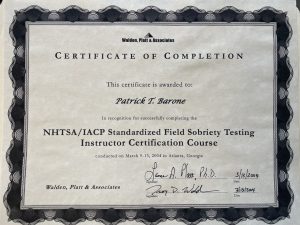 Patrick is an IACP/NHTSA certified SFST instructor and practitioner and is believed to be the only Michigan attorney judicially qualified as an SFST court expert. He holds manufacturer-level certification on the DataMaster DMT breath testing instrument.
He is a graduate of the Gerry Spence Trial Lawyers College, a Board Certified TEP (the highest level of certification) in psychodrama, sociometry, and group psychotherapy through the American Board of Examiners, and the only such credential holder in Michigan.
He has been recognized as a Michigan Super Lawyer continuously since 2007 and is listed in The Best Lawyers in America.