 Barone Defense Firm Home
Protect Your Future Don't Let One Moment
Define You. With the right defense, you can win back your life
and confidently move forward.



DUI Testing in Michigan: Chemical Tests, the Intoxilyzer 9000, and How Results Are Challenged
When Michigan police arrest a driver for operating while intoxicated, they are authorized under MCL 257.625c to request a chemical test to determine blood alcohol concentration. The most common test is a breath test administered on the Intoxilyzer 9000, the evidentiary instrument now deployed at police stations throughout the state. Whether a driver submits to the test or refuses, the physical driver’s license is confiscated at the scene and replaced with one of two paper forms whose legal consequences diverge sharply depending on the driver’s choice.
What Chemical Tests Can Police Request After a Michigan OWI Arrest?
Michigan law authorizes police to request a breath, blood, or urine test from a driver lawfully arrested on suspicion of operating while intoxicated, under the implied consent provisions of MCL 257.625c; . Breath testing is by far the most common method. Blood tests are most often ordered when a driver has been in an accident, is unconscious, or has refused the evidentiary breath test and police have obtained a search warrant. Urine testing is rare and presents scientific problems addressed in a later section.
Two distinct breath testing devices are used in Michigan OWI investigations, and the difference controls what follows from a refusal. The first is the preliminary breath test, or PBT, a handheld device administered roadside before arrest. Because of the fuel-cell technology that makes PBT results inadmissible at trial, refusing a roadside PBT carries only a civil fine with no license consequence and no implied consent violation.
The second is the post-arrest evidentiary breath test, administered on the Intoxilyzer 9000 at the police station after a lawful arrest. It is this test that is governed by Michigan’s implied consent law, and its result is the chemical evidence the prosecution will present at trial. Conflating these two devices and their respective refusal consequences is one of the most common errors made by drivers and by attorneys who do not regularly practice OWI defense.
What Is the Intoxilyzer 9000 and How Does It Produce a Result?
Michigan law enforcement agencies completed a statewide equipment transition in mid-2023, replacing the DataMaster DMT with the Intoxilyzer 9000, ending deployment of an instrument that had been Michigan’s evidentiary breath testing standard for decades. The Intoxilyzer 9000, manufactured by CMI, Inc., uses infrared spectroscopy to estimate blood alcohol concentration from a sample of deep-lung breath. A result at or above 0.08 grams percent forms the core of the prosecution’s chemical evidence in most Michigan OWI cases.
The result of no breath test is a direct measurement of blood alcohol concentration. The instrument measures ethanol in the driver’s breath and applies a fixed population-average partition ratio to convert that breath measurement into an estimated blood alcohol value. This ratio, which describes the relationship between breath alcohol and blood alcohol, varies substantially among individuals depending on body temperature, lung physiology, and absorption phase, and can differ within the same individual depending on those same variables at the time of the test. A result derived from a fixed average ratio applied to a physiologically variable population carries inherent individual error that the reported number does not reflect.
The assumption underlying all evidentiary breath testing is that end-exhaled breath reflects alcohol concentration in alveolar air, which is in turn in equilibrium with blood. This model is no longer scientifically acceptable. Studies demonstrate that alcohol exchanges with airway tissue throughout the breath cycle, during both inspiration and expiration, not only in the alveoli. This means the measured sample is shaped by conditions throughout the conducting airways, and that breathing pattern, lung size, and body temperature all influence the reported result independently of a driver’s actual blood alcohol concentration.
Can Breath Test Results Be Challenged in Michigan?
OWI cases are not self-proving, and chemical test results must be formally admitted into evidence under the applicable Michigan Court Rules. Michigan courts have suppressed Intoxilyzer 9000 results when the appropriate scientific and procedural challenges are raised. The grounds for those challenges fall into two categories that are analytically distinct and require separate investigation.
The Intoxilyzer 9000’s internal COBRA diagnostic records provide a primary challenge basis. These records, maintained by the Michigan State Police, who are statutorily responsible for the calibration and upkeep of evidentiary breath testing instruments statewide, document the instrument’s calibration history and the diagnostic outputs generated for every subject tested on that machine. The firm typically requests two years of COBRA records and examines them for patterns of exception codes that are irregular and recurring, which indicate instrument instability rather than isolated anomalies. This data frequently reveals calibration failures and performance drift that do not appear on the standard police report and that support suppression motions before trial.
The instrument’s slope detector is designed to identify mouth alcohol contamination by flagging a rapid decline in the breath sample’s alcohol concentration curve during sampling. GERD, or gastroesophageal reflux disease, is the primary physiological condition that can defeat this safeguard, because reflux drives stomach contents, which carry alcohol absorbed from the gastrointestinal tract, back into the oral cavity in a way that the slope detector cannot reliably distinguish from deep-lung breath. Dental procedures that trap residual mouth alcohol present a similar slope detection problem.
Infrared interferents are a distinct challenge category. Certain compounds unrelated to beverage alcohol absorption absorb infrared light at wavelengths similar to ethanol, causing the instrument to register a falsely elevated result that is not detected by the optical filters. Ketones produced during low-carbohydrate diets or diabetic ketosis are the most clinically significant example.
Because the instrument reads ketone absorption as ethanol absorption, a driver following a ketogenic diet may produce an Intoxilyzer result that overstates actual blood alcohol concentration without any mouth alcohol present and without triggering the slope detector. Partition ratio variance, operator certification failures, and other instrument-specific defects provide additional and independent grounds for challenging any Intoxilyzer result that do not depend on the interferent issues addressed here.
Operator certification failures provide a further independent challenge. If the officer who administered the test was not currently certified on the Intoxilyzer 9000, the result is foundationally defective regardless of the reading. Certification records are obtainable through a records request and should be verified in every case.
Gastric bypass and other bariatric surgical procedures present a further and underappreciated challenge basis. Because alcohol is absorbed dramatically faster after gastric bypass surgery, peak blood alcohol levels are both higher and reached more rapidly than in a driver of comparable weight without surgical alteration. A driver who has undergone such surgery may produce an Intoxilyzer result that substantially overstates intoxication at the time of driving.
Can Blood Test Results Be Challenged in Michigan?
Due to the nature of blood testing in Michigan DUI cases, the results are often more subject to challenge than a breath test case. Yes, headspace gas chromatography blood testing is the “gold standard” of chemical tests, but there are many more avenues to attack a blood test that make it more susceptible to challenge.
But, blood test challenges also involve a distinct and more substantial layer of complexity than breath testing. Introducing a blood test result at trial requires establishing, among other things, the lawful basis for the draw, the qualifications of the person who performed it, sterile collection equipment, proper preservation and accurate labeling of the vials, an unbroken chain of custody from the draw site to the laboratory, and the laboratory’s compliance with applicable testing protocols. A deficiency in any one of these foundational requirements provides an independent basis for a suppression motion separate from any challenge to the chemistry of the result itself.
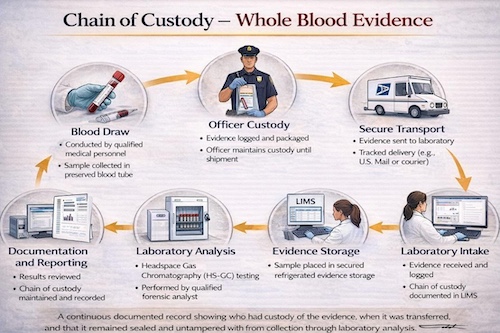
If a blood sample is not properly preserved after collection, naturally occurring microbes can convert sugars in the blood into ethanol, generating a result that is falsely elevated through no fault of the driver. The state police kit vials contain sodium fluoride as a preservative, but if the vials are not properly handled, or if an expired kit is used, fermentation can occur before the sample reaches the laboratory.
The timing of the breath test relative to the driver's drinking pattern introduces a distinct source of error that the instrument cannot detect or correct for. During the absorptive phase, while alcohol is still moving from the gut into the bloodstream, arterial blood alcohol concentration is higher than venous blood alcohol concentration. Because breath testing measures alcohol carried in arterial blood, a driver tested during the absorptive phase may produce a breath test result that overestimates venous blood alcohol concentration by more than 100 percent, with documented individual deviations reaching 230 percent above the corresponding venous result. The instrument reports a single number with no indication of whether absorption was complete at the time of the test.
When hospital blood is drawn rather than a police-collected kit sample, serum testing is performed rather than whole-blood testing. In the serum method, the cellular solids are removed, and the remaining liquid is treated with an enzymatic reagent whose color change in the presence of ethanol is measured and reported as a BAC.
Because the ratio of plasma to cellular material, measured as hematocrit, varies among individuals, serum testing consistently produces a result that overstates whole-blood BAC by 16 to 20 percent, and some published studies place the potential overstatement as high as 40 percent. This overstatement is inherent in the method and independent of any laboratory error.
What About Urine Testing in Michigan OWI Cases?
Urine testing in Michigan OWI cases is used almost exclusively to detect the presence of controlled substances, not alcohol. When drugs are at issue, urine is particularly unreliable as forensic evidence of impairment because urine reflects the historical accumulation of drug metabolites rather than the active concentration of an impairing substance present at the time of driving.
Because urine metabolite levels cannot establish what a driver's impairment was at the time of driving, a positive urine result for a controlled substance proves only that the substance was metabolized at some point in the hours or days before the test, which may be entirely consistent with the driver having been unimpaired at the wheel.
Urine alcohol testing presents separate scientific limitations and is rarely used in Michigan OWI practice. The more scientifically significant problem in Michigan OUID prosecutions is the drug metabolite issue: there is no validated method for working backward from a urine metabolite concentration to a conclusion about impairment at a specific earlier time. A positive urine test for THC, opiates, benzodiazepines, or other substances cannot reliably answer the question the jury must decide.
Does Measurement Uncertainty Apply to Breath and Blood Tests in Michigan OWI Cases?
Measurement uncertainty is a foundational concept in metrology, the science of measurement, and it applies equally to breath tests and blood tests in Michigan OWI prosecutions. No chemical measurement produces a single exact true value. Every result is the center of a range of values that could reasonably be attributed to the substance being measured, and without a reported uncertainty range, a concentration result cannot answer the question at the core of every per se prosecution: did the driver’s BAC actually exceed the statutory threshold, or does the uncertainty in the measurement span the limit?
ISO 17025, the internationally recognized standard for forensic laboratory competence, requires that measurement uncertainty be determined and reported alongside all measured results. The National Academy of Sciences has stated that all forensic science methods should report measurement uncertainty, and specifically that methods for measuring blood alcohol can do so only within a confidence interval of possible values. These requirements apply to both the Intoxilyzer 9000 breath test and to blood tests analyzed by gas chromatography at the Michigan State Police forensic laboratory.
Michigan courts have begun requiring uncertainty budgets before admitting chemical test results. The first Michigan court to address this issue held, in the context of a blood test, that results are not reliable until the state crime lab calculates an uncertainty budget and reports it alongside the result, and that this calculation is an essential element of the scientific methodology required under Daubert and MRE 702.
Subsequent courts extended the requirement to breath tests and added that the prosecution must establish not merely that an uncertainty budget exists but that it was determined in a scientifically acceptable manner. The Michigan State Toxicology Lab and the Police Breath Test Unit have developed uncertainty budgets for both test types, but defense counsel can challenge whether those budgets correctly identify and quantify all relevant sources of uncertainty, and whether the reported uncertainty is actually sound enough to support a beyond-reasonable-doubt verdict on a per se threshold.
In a Washington state court hearing, two drivers with identical breath test results above the per se limit were shown to have different underlying uncertainty ranges, one carrying a ten percent probability that the driver’s actual concentration was below the legal limit and the other carrying a twenty percent probability. Without a reported uncertainty range, those results are indistinguishable and the difference in what they actually prove is invisible.
What Do the DI-177 and DI-93 Forms Mean for My Driving Privileges?
If a driver submits to the post-arrest evidentiary test and the result is 0.08 grams percent or higher, the arresting officer confiscates the physical driver’s license and issues a form called the DI-177, the Breath, Blood, Urine Test Report, which serves as a temporary driving permit for the duration of the criminal case. A driver who refuses the test receives a DI-93 instead and has exactly fourteen days to contest the automatic one-year suspension that otherwise takes effect under Michigan's implied consent statute. The full refusal framework, including the four elements the arresting officer must prove at the administrative hearing and the hardship appeal available even if the suspension is upheld, is governed by that same statute.
How Does the Barone Defense Firm Approach Chemical Testing Evidence?
The firm’s approach begins with a single principle: no number on a police report is accepted as valid until the firm has independently confirmed it. Chemical test results are the product of instruments, maintenance programs, trained operators, and laboratory protocols, and each of those components must be examined before the result can be evaluated as evidence. The instrument must have been properly calibrated and maintained.
The operator must have been certified and must have administered the test in compliance with the applicable administrative rules. The COBRA records must show a stable instrument without recurring exception codes. The blood draw, if applicable, must have been performed by a qualified individual using sterile equipment, with a complete and unbroken chain of custody. The lab analyst must have followed their training, prepared the sample properly and run the test adequately. The blood testing equipment must have been properly set up, calibrated and kept in proper working order. The firm’s job is to confirm that every one of these requirements was actually met, and to hold the prosecution to task when they were not.
Even instruments that are functioning within their operational specifications require humans to set them up, to maintain them on schedule, and to operate them properly on each individual test. A lazy administration, an uncertified operator, or a missed calibration check is as legally significant as a malfunctioning instrument. The firm examines recurring procedural errors across all three chemical test methodswith the same rigor it applies to the instrument science, because the prosecution must establish a proper foundation for the result regardless of the method used.
Why Is the Barone Defense Firm Uniquely Qualified to Challenge Chemical Test Results?
Patrick Barone holds manufacturer certification on the DataMaster DMT, earned through a four-day curriculum covering alcohol and human physiology, infrared spectroscopy theory and operation, and field and laboratory calibration applications, qualifying the holder to perform diagnostic verifications and calibration checks. He is the only attorney in active Michigan OWI practice with this training.
Because the Intoxilyzer 9000 operates on the same underlying infrared spectroscopy science, this certification transfers directly to the analytical work on the instrument now deployed throughout Michigan. A BS in Biology on a pre-medical track provides the scientific foundation to evaluate breath and blood testing evidence at a depth most defense attorneys cannot approach, and Patrick Barone teaches the firm’s COBRA analytical method to other Michigan OWI defense attorneys through continuing legal education.
Lead litigating attorney Ryan Ramsayer has done groundbreaking work identifying patterns in COBRA exception code data that have produced case dismissals and no-alcohol plea reductions for clients. He presented this methodology at a 2025 MIAOWI seminar, sharing the approach with OWI defense attorneys across Michigan. Ryan Ramsayer also authored Chapter 13 of the LexisNexis treatise Michigan Criminal Law and Procedure with Forms, the standard reference work on OWI law for Michigan practitioners.
Partner Michael Boyle is the firm’s lead attorney in driving under the influence of drugs cases, where his expertise in gas chromatography mass spectrometry governs blood and urine drug testing analysis. His understanding of the GC-MS methodology used by the Michigan State Police forensic laboratory makes him the firm’s primary resource when the question is whether a controlled substance in a blood or urine sample was present in a concentration sufficient to cause impairment at the time of driving. Michael Boyle is also a graduate of the Gerry Spence Trial Lawyers College and authored Chapter 8 of the same LexisNexis treatise.
Patrick T. Barone is the founding attorney of the Barone Defense Firm and the author of five books on OWI defense, including Defending Drinking Drivers. He holds manufacturer certification on the DataMaster DMT, is an IACP/NHTSA-certified field sobriety testing instructor and practitioner, and is believed to be the only Michigan attorney to have been judicially qualified as an expert in field sobriety test administration. He has been recognized as a Michigan Super Lawyer continuously since 2007, is listed in Best Lawyers in America, and was named to the Leading Lawyers Advisory Board as a peer-selected member in 2026.
Frequently Asked Questions About DUI Chemical Testing in Michigan
Does a low breath test result guarantee I will not be charged with OWI?
No. A result below 0.08 grams percent does not prevent a charge of operating while visibly impaired (OWVI) under MCL 257.625(3), which requires no minimum BAC threshold and is based on observable evidence that alcohol materially affected the driver’s ability to operate a vehicle. Michigan also permits the prosecution to pursue OWI can be proved through the OUIL theory preserved in Michigan's standard jury instructions, which similarly focuses on observable impairment without a numerical threshold. A prosecutor may pursue either or both theories based on officer observation and field sobriety test performance even without a per se BAC finding.
What is the difference between the PBT and the Intoxilyzer 9000?
The PBT is a handheld roadside device used before arrest to help establish probable cause. Its results are inadmissible at trial, and refusing it is a civil infraction only, carrying no license consequence and no implied consent violation. The Intoxilyzer 9000 is the approved post-arrest evidentiary instrument administered at the police station after a lawful arrest. Its result is admissible as evidence, and refusing it triggers Michigan’s implied consent law and its administrative license consequences.
Can I request an independent blood test after submitting to the breath test?
Michigan law gives an arrested driver the right to request an independent chemical test at their own expense after submitting to the required evidentiary test, and the arresting officer is required to advise the driver of this right. However, this option is strategically useful only if the independent test returns a result meaningfully lower than the police result. If the independent test confirms or exceeds the police result, it becomes additional evidence for the prosecution and is counterproductive. The decision should be made with guidance from a defense attorney before the test is requested.
How does the prosecution use retrograde extrapolation in a Michigan OWI case?
Retrograde extrapolation is a forensic method the prosecution uses to project a driver’s estimated BAC backward from the time of the station test to the time of driving. Michigan courts are generally inclined to admit this testimony when the prosecution presents sufficient foundational evidence, but the analysis depends on assumptions about absorption rate, elimination rate, and drinking pattern that are frequently impossible to establish with scientific certainty.
There are at least five independent scientific grounds on which defense counsel can contest this testimony, including the near-impossibility of confirming that the driver was in the pure elimination phase of ethanol kinetics at the time of testing.
What are the consequences of a first implied consent violation in Michigan?
A first implied consent violation results in a 12-month license suspension and six points added to your driving record. There are no criminal charges and no criminal record associated with the refusal itself. You have the right to contest the suspension at an administrative hearing before the Secretary of State, provided the written request is submitted within fourteen days of the arrest date.
If you were recently arrested for OWI and submitted to or refused a chemical test, how that evidence is challenged may be the most consequential decision in your case. The Barone Defense Firm reviews the instrument records, the officer’s certification, the testing procedure, and the scientific basis of the reported result, and identifies every available basis for suppression or reduction. Call 1-877-ALL-MICH (877-255-6424) for a free, confidential consultation, available 24 hours a day.



 Your Privacy Choices