 Barone Defense Firm Home
Protect Your Future Don't Let One Moment
Define You. With the right defense, you can win back your life
and confidently move forward.



Michigan's Legal BAC Limit: OWI Charges, Penalty Tiers, and Your Defense
In Michigan, the legal blood alcohol concentration (BAC) limit for drivers over the age of 21 is 0.08 grams percent. A driver at or above this level can be charged with Operating While Intoxicated (OWI) under MCL 257.625. However, Michigan law also permits an OWI charge below 0.08 grams percent when other evidence of impairment exists, and imposes substantially elevated penalties when a driver's BAC reaches 0.17 grams percent or higher under the state's High BAC law.
If you have been arrested for drunk driving in Michigan, contact the Barone Defense Firm for a free consultation at 1-877-ALL-MICH (877-255-6424).
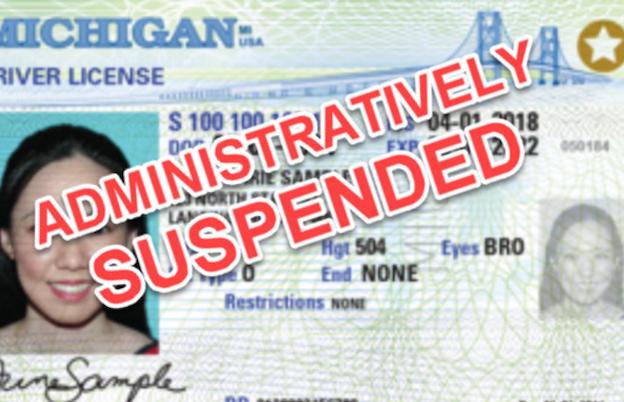
The Legal BAC to Drive in MI. Drivers who reveal numbers close to the Michigan breathalyzer test limit of 0.08 gr. percent for an OWI can expect to face a potential drunk driving charge, if other indications of impairment are noticed by police.
Our law firm handles a handful of these DUI-DWI cases annually, which usually arise after a traffic accident. The good news is that over 90% of these cases are for first offenders, and a favorable outcome is usually possible.
Michigan's BAC Penalty Tiers: What the Numbers Mean
Michigan law creates three distinct penalty tiers based on a driver's BAC level at the time of the offense. Understanding these tiers is critical because the difference between them can mean the difference between a standard misdemeanor and a charge carrying mandatory jail time and a year-long license suspension.
For drivers over 21, a BAC of 0.08 grams percent or higher supports an OWI charge under MCL 257.625(1). A first offense carries up to 93 days in jail, fines between $100 and $500, up to 360 hours of community service, and a possible 30-day license suspension. Drivers whose BAC falls between 0.08 and the legal limit may still be charged with Operating While Visibly Impaired (OWVI) if the officer observes signs of impairment.
For a detailed explanation of how BAC is calculated and why the number varies from person to person, see our in-depth guide to how Michigan's 0.08% BAC limit works in practice.
Michigan's High BAC law, sometimes called the "super drunk" law under MCL 257.625(1)(c), applies when a driver's BAC is 0.17 grams percent or higher. A first offense at this level carries up to 180 days in jail, fines up to $700, mandatory participation in an alcohol treatment program, and a license suspension of 45 days followed by 320 days of restricted driving only in a vehicle equipped with an ignition interlock device.
For commercial drivers, the legal limit is 0.04 grams percent. For drivers under the age of 21, Michigan's Zero Tolerance law permits a charge when any BAC between 0.02 and 0.07 grams percent is detected.
How the Legal Limit of Alcohol to Drive has Changed. Sixty years ago, most states used 0.15 grams percent, which is roughly twice as much alcohol in the Great Lakes State as would be a legal blood alcohol concentration level in 2023.
With the exception of Utah, all states now have the adult level for the legal limit for alcohol at 0.08 grams percent for their DUI BAC level. Utah lowered its legal alcohol driving limit to 0.05 gr. % in 2021, making it the only state to depart from the 0.08 gram % level "ordered" by NHSTA during the least year of the Bill Clinton Administration.
Learning How Long You Must Wait Before Driving, after Alcohol Consumption

Widmark's formula takes quite a bit of math calculation. But, in 2023, online computer programs can give you a ballpark number for your BAC level after a certain number of standard drinks.
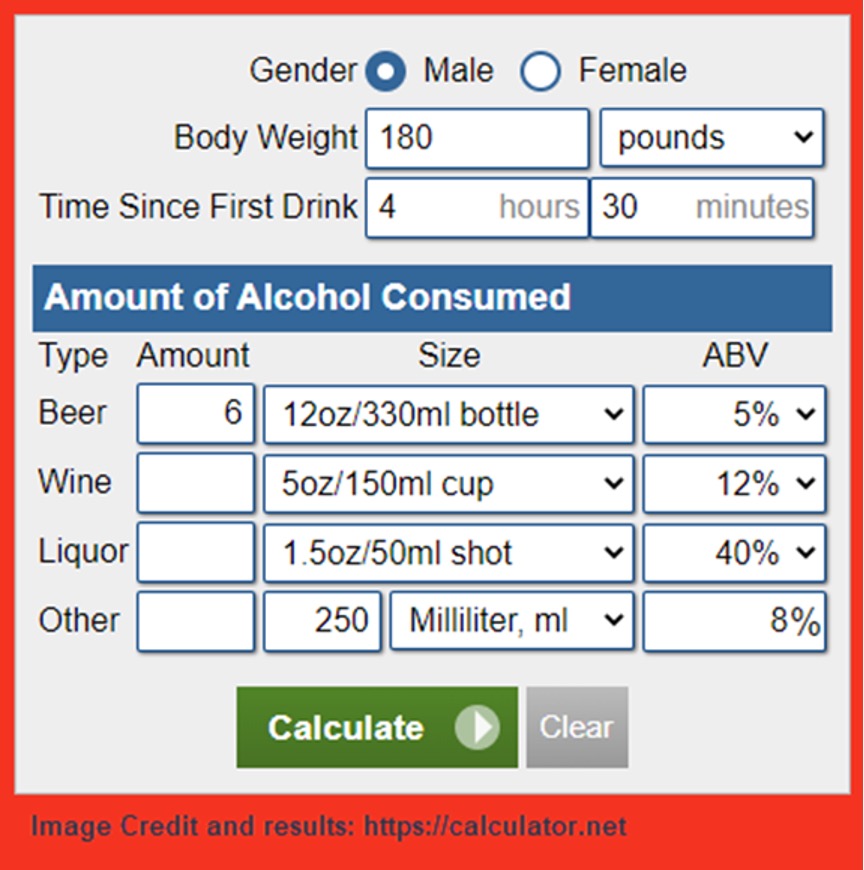
In researching several free, online BAC calculators, one with Calculator.net seemed to be easy to use and pretty close to BAC charts generated from prior research. The example checked was for a 180-pound male, whose drinking started 4.5 hours earlier. Our test subject drank six (6) standard 12-ounce beers, like a Budweiser in a can or bottle.
Only after 4.5 hours did this male drinker's BAC level drop below the adult 0.08 grams percent level. This lengthy "waiting period" shocks many yet matches Dr. Widmark's research. Some prefer to see an alcohol elimination chart, for various body weights.
Some of Widmark's findings included that since women (pound for pound, as compared to a male of the same weight) have more adipose tissue (fat content), on average. Because they have less muscle tissue within which alcohol gets metabolized, they will get drunk quicker.
Thus, after so many standard drinks (e.g., a 4.5-to-5-ounce glass of wine, a 12-ounce standard beer containing a 5% alcohol content) are consumed, a 125-pound woman will have a higher BAC level than a male at that same weight. This was proven by testing thousands of subjects and documenting the results.
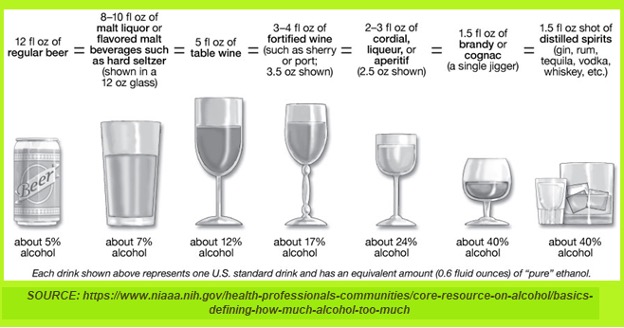
Knowing the legal drinking limit to drive. These findings provide guidance for estimating your blood alcohol level driving rules. Most readers are astonished at how slowly alcohol leaves the body.
The answer depends on your particular body composition, as well as a number of other variables. The metabolism of alcohol is an essentially important component to understand how to defend DUI cases in Michigan properly.
Gender, Body Composition, and the Bearing on Alcohol Absorption
There are many physiological factors that play a role in determining how your body will be affected by alcohol. For example, men and women process alcohol differently, mainly due to differences in liver size and the presence of alcohol-eliminating enzymes as well as the percentage of body water that helps dilute alcohol.
Women also naturally have more body fat, which helps alcohol stay in the blood stream longer than in men. Because of these differences in body composition, a man and woman of the same weight will feel different effects from the same amount of alcohol.
The average rate of elimination or a male driver is .015 per hour, for a female driver it's .018 per hour, which is contrary to common sense. Most people think that women would eliminate slower and that's why they get more drunk, more quickly. The reason that that happens is because women tend to have more fat in their bodies. So, what ends up happening is that there are less places for the alcohol to go because the alcohol goes where the water is.
Thus, the water in the blood tends to hold more of the alcohol, which increases the amount of alcohol that's in the blood. On the other hand, women's livers are larger as a percentage of body mass than men's livers are, which is why they eliminate more quickly.
But remember, men are larger, and they have more water in their muscle tissue, which provides more places for the alcohol to migrate into, other than in the bloodstream. As a result of this gender difference, a male is probably going to have less alcohol in their blood per unit time than women would.
A variation will exist between the two different factors, and it becomes very complicated as far as the math is concerned. A general rule of thumb is that (on average), that drinker should expect to eliminate between 0.015 grams % to 0.020 grams percent, per hour.
Frequently Asked Questions: Michigan's Legal BAC Limit
What is the legal BAC limit in Michigan?
For drivers over the age of 21, Michigan's legal BAC limit is 0.08 grams percent under MCL 257.625. A driver at or above this level can be charged with OWI regardless of whether they show visible signs of impairment. Drivers between 0.02 and 0.07 grams percent can be charged under the Zero Tolerance law if they are under 21, and commercial drivers face a lower threshold of 0.04 grams percent.
Can you be charged with OWI in Michigan if your BAC is below 0.08%?
Yes. Michigan law permits an OWI charge below the 0.08 grams percent threshold when a prosecutor can demonstrate that alcohol materially and substantially lessened the driver's ability to operate a vehicle. This theory of prosecution, known as OUIL, does not require a chemical test result at or above the legal limit. A driver can also be charged with Operating While Visibly Impaired (OWVI), a lesser offense, when impairment is observable even at lower BAC levels.
What happens if your BAC is 0.17% or higher in Michigan?
A BAC of 0.17 grams percent or higher triggers Michigan's High BAC law under MCL 257.625(1)(c), commonly called the super drunk law. Penalties for a first offense include up to 180 days in jail, fines up to $700, mandatory alcohol treatment, and a license suspension with ignition interlock requirements. Because a High BAC OWI is based entirely on the breath or blood test result, challenging the reliability of that test is often the centerpiece of the defense.
How long does alcohol stay in your system in Michigan?
The average elimination rate for alcohol is approximately 0.015 grams percent per hour for men and 0.018 grams percent per hour for women, based on research by Dr. Erik Widmark. However, elimination rates vary significantly based on body composition, food consumption, and individual metabolism. Online BAC calculators can provide a rough estimate but are not reliable enough to use as a basis for deciding whether to drive.
What should you do if you are charged with OWI in Michigan?
Contact an experienced Michigan OWI defense attorney as soon as possible. The steps taken in the first 24 to 72 hours after an arrest — including whether to challenge the traffic stop, the field sobriety testing, or the chemical test result — can significantly affect the outcome of your case. There are also strict deadlines related to your driver's license that must be addressed promptly. The Barone Defense Firm offers free consultations at 1-877-ALL-MICH (877-255-6424).



 Your Privacy Choices