Search
 Michigan Criminal Defense Lawyer Blog
How NCMEC and Tech Platforms Report CSAM to Law Enforcement


NCMEC reports CSAM to Michigan law enforcement after technology platforms detect it and generate an automated tip. Federal law requires platforms to submit those reports to the NCMEC CyberTipline, which reviews and forwards them to the appropriate investigative agency. Detection can happen without any human review of your files.
What most people do not understand about a case where NCMEC reports CSAM to Michigan law enforcement is that by the time an agent makes contact, the investigation has typically been underway for weeks or months. The platform detected the material, generated an automated report, NCMEC reviewed and forwarded it, and federal or state investigators identified the account holder, confirmed the address, and built a probable cause foundation for a warrant, all before any contact with the suspect. The person receiving that knock believes they are at the beginning of a process. In reality they are near its end.
That asymmetry produces four predictable and serious mistakes. The first is believing that cooperating with investigators will result in more lenient treatment. It rarely does, and statements made during voluntary cooperation frequently become the most damaging evidence in the case. The second is believing that deleting files or destroying the device eliminates the evidence. It does not. Hash values and metadata can persist in ways that are not visible to the user, and destruction of a device after a person knows or reasonably suspects an investigation is underway carries its own serious legal consequences. The third is believing that because no contact has occurred for weeks or months, law enforcement lost interest or moved on. Investigations of this kind do not expire. The fourth is believing that a prior conversation with investigators went well and the matter is resolved. It almost certainly is not.
The state and federal distinction in Michigan CSAM cases is real but not always predictable. A case that originates as a state investigation under MCL 750.145c can become a federal prosecution under 18 U.S.C. § 2252 based on decisions made by investigators and prosecutors that have nothing to do with the underlying evidence. Conversely, the same conduct can result in charges in both courts simultaneously. The charging forum is not fixed at the moment of detection, and decisions a client makes early in the process, including decisions about whether to cooperate, proclaim innocence, or delay retaining counsel, can directly influence which direction a case travels.
The state-to-federal escalation is not a theoretical risk. In one case handled by the Barone Defense Firm, the client was offered a negotiated resolution at the state level that represented a genuinely favorable outcome given the circumstances. The client delayed, continued to assert his innocence to investigators, and the case stalled. Investigators eventually lost patience, dismissed the state charges, and referred the matter federally. The client then faced mandatory minimum sentencing exposure and a federal conviction record that the original state resolution would have avoided entirely. The window that existed at the beginning of that case never reopened.
 For this reason, the Barone Defense Firm’s approach to NCMEC-referred cases begins with a frank assessment of both state and federal exposure before any other strategic decision is made. The firm’s of counsel attorney Keith Corbett served as a federal prosecutor for more than thirty years, including as head of the organized crime unit in the United States Attorney’s Office for the Eastern District of Michigan, and brings that institutional knowledge directly to bear in evaluating how federal investigators and prosecutors are likely to approach a given matter.
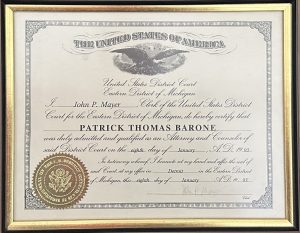
Patrick Barone and the firm’s litigating attorneys are admitted to practice in both the Eastern and Western Districts of Michigan. When a CSAM case has federal dimensions, or when the risk of federal escalation is present, that combination of perspective is available from the first consultation.
How Do Technology Companies Detect CSAM Before NCMEC Reports It to Michigan Law Enforcement?
Under 18 U.S.C. § 2258A, electronic service providers are required by federal law to report apparent CSAM to the NCMEC CyberTipline when they become aware of it. The most widely used detection technology is PhotoDNA, originally developed by Microsoft and now used under license by major platforms including Google, Meta, and others. PhotoDNA converts known CSAM images into unique hash values, essentially digital fingerprints, and compares those fingerprints against files uploaded or transmitted through a platform. A match triggers an automated report to NCMEC without any human review of the specific content.
This reporting obligation is broad. It applies to social media platforms, messaging applications, email providers, and cloud storage services. A person does not need to send or share CSAM for a detection event to occur. Uploading or backing up a file to a cloud service is sufficient.
What Happens After an NCMEC CyberTipline Report?
Once NCMEC reports CSAM to Michigan law enforcement or federal investigators, agents move quickly to identify the account holder and prepare warrant applications. Law enforcement uses the tip to establish probable cause for a search warrant targeting the account holder’s devices. The process from platform detection to a knock on your door can move quickly, sometimes within days.
This detection and referral process is distinct from the question of what police may search once they contact you. For a detailed explanation of police search authority and your Fourth Amendment rights, see our article on whether police can search your phone or computer for child pornography.
Penalties for Child Porn Often Include Long Prison Sentences
If someone is caught with sexually explicit child pornography on their Apple device, they could face both state and federal criminal charges. Under Michigan Compiled Laws, Sec. 750.145c, possession of Child Sexually Abusive Material is a felony punishable by up to four years in state prison.
There are aggravating factors which can increase the potential sentence. These include if the child is prepubescent, if the images were re-shared (distributed), and if the defendant produced the images.
Federal Child Porn Sentences are Harsh!
Under federal law, possession of child pornography is prohibited under 18 USC Section 2252. If convicted of federal child pornography possession, a defendant faces zero to 10 years in prison. Like state law, federal penalties increase depending on age of the victim and whether the defendant produced or distributed the child pornography.
Federal penalties are also enhanced if the defendant has prior convictions for sex crimes. As a result, persons with child pornography convictions can end up being sent to prison for 15 years or even 20 years.
If you are facing federal child pornography charges, be sure and hire an federal crimes expert. Federal courts have their own rules and procedures and require someone with much experience in these courts. To help you understand some of these federal rules and procedures, we have posted a series of articles that appear elsewhere on this website.
Privacy Concerns and the Limits of Corporate Scanning

The reporting obligations imposed on technology platforms raise genuine privacy concerns. Because hash matching is automated, there is a risk of false positives — cases in which legal content is incorrectly flagged due to a hash collision or database error. There are also concerns that expanded scanning infrastructure could eventually be used for purposes beyond CSAM detection, including government surveillance.
For individuals under investigation, the more immediate concern is what happens after a report is made. Once NCMEC refers a tip to law enforcement, agents move quickly to identify the account holder, obtain warrants, and execute searches. If you have been contacted by law enforcement or believe you may be the subject of an investigation, do not wait.
Dos and Don’ts When Facing a Child Pornography Case
If you have been charged with child pornography, the first thing to do is not agree to any searches. This includes a search of your phone or computer. The second thing is, don’t agree to give an interview or answer any questions.
The third thing to do is to contact the child pornography defense attorneys at the Barone Defense Law Firm. We can handle your case in any court in the State of Michigan. We can also represent you in federal court if you’re charged with a federal crime of any kind.
For a more detailed examination of police search authority, including warrant requirements, consent, and the plain view doctrine, see our article on whether police can search your phone or computer for child pornography.
Frequently Asked Questions: CSAM Detection and Reporting
Is it legal for Apple, Google, or Facebook to scan my files for child pornography?
Yes. Under federal law, electronic service providers are required to report apparent CSAM to NCMEC when they become aware of it. Many platforms conduct hash-based scanning as part of compliance with this obligation. When you agree to a platform’s terms of service, you generally consent to this type of scanning. The constitutional protections of the Fourth Amendment apply to government action, not private company conduct.
Can I be investigated for child pornography based on a cloud backup?
Yes. Files backed up to cloud services such as iCloud, Google Photos, or Dropbox are scanned by those services using hash-matching technology. If a file matches a known CSAM hash value, the platform is required to report it to NCMEC regardless of whether you actively shared or distributed the material. You do not need to send or view the file for a report to be generated.
How Does NCMEC Report CSAM to Michigan Law Enforcement Through the CyberTipline?
The CyberTipline is a national reporting system operated by the National Center for Missing and Exploited Children. Electronic service providers are required by 18 U.S.C. § 2258A to submit reports of apparent CSAM to the CyberTipline. NCMEC reviews reports and forwards them to the appropriate federal or state law enforcement agency. The tipline serves as the central intake point for most technology-initiated CSAM investigations in the United States.
How quickly can law enforcement act after an NCMEC report?
Very quickly. Once NCMEC forwards a report to law enforcement, agents can move to identify the account holder, prepare warrant applications, and execute searches within days. The urgency is heightened in cases involving production or distribution allegations. If you believe you may be the subject of an NCMEC referral or law enforcement contact, retaining an attorney immediately, even before charges are filed, is essential.
Contact a Michigan CSAM Defense Attorney
If you are under investigation for or have been charged with a CSAM offense in Michigan, the time to act is now. Investigations of this kind move faster than most people realize, and the decisions made in the earliest days of a case have consequences that cannot always be undone later. The Barone Defense Firm offers free consultations and our phones are answered 24 hours a day, seven days a week. Call 1-877-ALL-MICH (877-255-6424) today. For a full overview of Michigan child pornography charges, penalties, and defense strategies, see our Michigan child pornography laws and penalties page.
About the Author: Patrick Barone
Patrick Barone is the founding attorney of the Barone Defense Firm in Birmingham, Michigan. A graduate of the Gerry Spence Trial Lawyers College, Mr. Barone holds board certification as a Trainer, Educator, and Practitioner (TEP) in psychodrama, sociometry, and group psychotherapy through the American Board of Examiners, the highest certification level available and the only such credential held by an attorney in Michigan. He has represented clients in CSAM matters at both the state and federal level across Michigan, including cases originating from NCMEC CyberTipline referrals.
The firm’s of counsel attorney Keith Corbett served as a federal prosecutor for more than thirty years, including as head of the organized crime unit in the United States Attorney’s Office for the Eastern District of Michigan. Mr. Corbett’s background in federal prosecution informs the firm’s assessment of federal exposure and charging decisions in CSAM and related matters. All litigating attorneys at the Barone Defense Firm are admitted to practice in both the Eastern and Western Districts of Michigan.
Mr. Barone has been recognized as a Michigan Super Lawyer continuously since 2007 and is listed in Best Lawyers in America.