Search
 Michigan Criminal Defense Lawyer Blog
Michigan’s 0.08% BAC Limit: What It Really Means for OWI Defense



By Patrick Barone, Michigan DUI Lawyer Near Me
Michigan’s DUI legal limit is 0.08 grams percent for drivers over 21, but that number does not define the full boundaries of OWI liability in Michigan. A driver can also be charged with operating while visibly impaired at any BAC level if alcohol has materially affected their ability to drive. Michigan does not require a BAC reading at or above 0.08 to support a conviction.
But the Michigan DUI legal limit of 0.08 is widely understood as the dividing line between lawful and unlawful driving. That understanding is incomplete in two important ways. First, most people significantly overestimate how much alcohol is required to reach 0.08. For many adults, as few as two to three standard drinks consumed within an hour are sufficient. Individual variables, body weight, food intake, metabolism, and the ABV of what is being consumed, mean there is no reliable way to count your way to safety.
The practical implication is that staying near but below Michigan’s DUI legal limit does not guarantee protection from an OWI charge. Michigan law also permits a charge of operating while visibly impaired (OWVI) at any BAC level if an officer determines that alcohol has materially affected the driver’s ability to operate a vehicle. That standard contains no numerical floor. A driver with a BAC of 0.05 can be charged and convicted if the prosecution can establish impairment through field sobriety test observations, officer testimony, or video evidence.
The practical implication is that two units of alcohol, the commonly cited threshold for entering what researchers describe as measurable impairment for many individuals, places a driver in a legally vulnerable position regardless of the breath test result. The breath test number is one piece of evidence in an OWI prosecution. It is not the only piece, and it is not always the most important one.
The breath test result itself is also scientifically contestable. Michigan recently transitioned from the DataMaster DMT to the Intoxilyzer 9000 as the state’s evidentiary breath testing instrument, the first time in nearly half a century that Michigan has adopted a device from a different manufacturer. The transition introduced new calibration protocols, histogram-based breath sample analysis, and a data management system called COBRA that stores detailed electronic records of each test sequence. How those records are obtained, analyzed, and challenged is now one of the most consequential areas of OWI defense practice in Michigan.
In every OWI case where the client’s BAC was near Michigan’s DUI legal limit, the Barone Defense Firm obtains the COBRA data for the specific Intoxilyzer 9000 instrument used in the client’s test as a standard first step. That data includes calibration checks embedded in the test sequence, exception messages generated during the testing process, and historical test records from the instrument before and after the client’s test.
Discrepancies between what the breath test ticket shows and what the underlying instrument data reveals have been consequential in OWI cases across Michigan. The details matter in ways that are not visible from the printed result alone. For a detailed overview of the specific defenses available to challenge a breath test result in Michigan, see our breath test defenses page.
Patrick Barone holds manufacturer-level certification on the Intoxilyzer 9000, the instrument currently in use across Michigan, and is believed to be the only Michigan attorney judicially qualified as a Standard Field Sobriety Test expert. He is also an IACP/NHTSA certified SFST instructor and practitioner. In February 2026, Mr. Barone co-authored “Intoxilyzer 9000 Replaces DataMaster DMT for Breath Tests,” published in the Michigan Bar Journal, examining the legal and scientific implications of Michigan’s instrument transition for OWI defense practitioners.
That combination of manufacturer-level instrument certification, judicial qualification as an SFST expert, and published scientific analysis of the instrument currently generating breath test results in Michigan courts is genuinely rare. It means that when the Barone Defense Firm evaluates a breath test result, the analysis begins from a foundation that most defense attorneys cannot replicate.
How Many Drinks Does It Take to Reach Michigan’s DUI Legal Limit?
Let’s consider what 0.08 really means. First, a 0.08 gr. % legal limit ostensibly relates to the amount of alcohol in a person’s breath or blood. Alcohol tests of a person’s breath or blood are expressed as the percentage of beverage alcohol as a function of mass. Thus, a BAC of 0.08 (0.08%) means that there are 0.08 grams of alcohol for every deciliter (100 ml) of blood or every 210 liters of breath.
Assuming the breath or blood tests used by the police actually measure bodily alcohol levels properly, in considering how many drinks must be consumed to reach a BAC of 0.08%, it is important to agree on the meaning of the word “drink.”
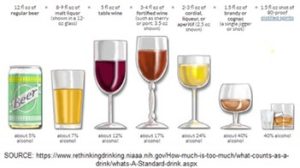
In the United States, the term “standard drink” refers to a drink containing 14 grams (0.6 ounces) of pure ethanol. The following quantities typically have 14 grams of pure ethanol: 12 ounces of 5 percent alcohol-by-volume (ABV) beer, 5 ounces of 12 percent ABV wine, or 1.5 ounces of 40 percent (80 proof) ABV distilled spirits.
When counting drinks, therefore, it is important to know the ABV and the size of the pour. Most craft beers have ABVs higher than 5 percent and are often served in quantities larger than 12 oz. Also, popular craft drinks, such as an Old Fashioned, are often made with “over-proof” bourbon with an ABV of 50 percent or more.
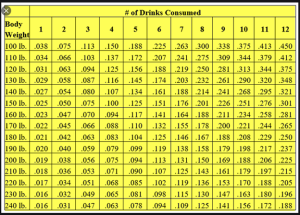
Now that we know the definition of a standard drink, we can turn to the scientific research which has shown that each standard drink has enough alcohol to raise a person’s BAC by approximately 0.017% . The numbers given will vary slightly, depending on the scientific study referenced.
When we consider the complexity of the human body, however, it’s clear that such simple math breaks down. This is a question from Professor Barone’s 2018 law school exam:
- Three men meet for dinner, Mr. Jones, Mr. Smith, and Mr. Howe. Each weigh 160 lbs. Mr. Jones has not eaten all day and is obese. Mr. Smith had a light lunch and works out regularly. This is Mr. Howe’s 2nd dinner, and he works out with Mr. Smith. Each has the same amount of alcohol with dinner at 8:30 p.m. Two hours later who will have the highest BAC?
Few of the law students answered this question correctly, even after sitting through Professor Barone’s lecture and review on the metabolism of alcohol. The question addresses two important variables relative to alcohol metabolism and bodily alcohol content: the type and amount of food in a person’s stomach while drinking and body mass index. Thin people (those with very little fat tissue) metabolize alcohol differently from heavy people with lots of adipose tissue. Plus, those drinking on an empty stomach will cause a higher BAC level, if all other things are being equal.
Taken together these factors help explain why it is perilous to simply count drinks when trying to avoid a drunk driving arrest and conviction. Thus, the only safe way to avoid a drunk driving conviction is to not drink and drive at all! This is ironic when juries sitting on drunk driving cases will be told by the judge:
Just because a person has consumed alcohol or smells of alcohol does not prove, by itself, that the person is under the influence of alcohol. The test is whether, because of drinking alcohol the defendant’s mental or physical condition was significantly affected and the defendant was no longer able to operate a vehicle in a normal manner.
In other words, it’s not unlawful to drink and drive in Michigan, and a jury can’t convict on this basis alone. Unfortunately, this means you are being set up to fail because you can lawfully drink and drive, but if you do, there’s no way to know you won’t be convicted of drunk driving until you take the police test.
Michigan’s so-called “super drunk” law, codified at MCL 257.625(1)(c), imposes substantially elevated penalties when a driver’s BAC is 0.17 grams percent or higher. A conviction at this level carries up to 180 days in jail, fines up to $700, mandatory license suspension of 45 days followed by 320 days of restricted driving, and mandatory participation in an alcohol treatment program. These enhanced penalties make the accuracy and admissibility of the BAC result even more consequential, and make experienced legal representation even more critical.

Making matters worse, you are not “safe” simply because you have a BAC less than .05 or even 0.08. The reason this is true because in Michigan drunk driving can be proved when a prosecutor can show, beyond a reasonable doubt, that a person’s ability to operate a motor vehicle is materially and substantially lessened due to the consumption of alcohol. This definition of drunk driving in Michigan does not even contain a legal limit.
From this explanation, two things are evident; first, there is no need to reduce the legal limit in Michigan because 0.05 grams % BAC level is already an illegal “number” provided the prosecutor can show that the alcohol significantly impacted the person’s ability to drive their car. Second, lowering the legal limit will cause more people who can still drive perfectly to be convicted of a serious and potentially life-changing crime.
Frequently Asked Questions: Michigan DUI BAC Limit and OWI Law
Can You Be Charged With DUI in Michigan Below the Legal Limit?
Yes. Michigan law permits a charge of operating while visibly impaired (OWVI) at any BAC level if an officer determines that alcohol has materially affected the driver’s ability to operate a vehicle. That standard contains no numerical floor and does not require a breath or blood test result. Commercial drivers face a lower per se limit of 0.04 percent, and drivers under the age of 21 can face legal consequences for any detectable amount of alcohol under Michigan’s zero tolerance law.
What Are Common Defenses to a Michigan OWI Charge?
An experienced Michigan OWI defense attorney will examine whether the traffic stop was constitutionally valid, whether the standardized field sobriety tests were properly administered and scored, and whether the breath testing equipment was functioning correctly and operated in compliance with applicable regulations. BAC results are not self-proving. The science behind how the test was conducted, whether the Intoxilyzer 9000 was properly calibrated and certified, and what the underlying COBRA data shows are all subject to challenge in the right circumstances.
How Does the Intoxilyzer 9000 Measure BAC Against Michigan’s DUI Legal Limit?
The Intoxilyzer 9000 is the evidentiary breath testing instrument currently used across Michigan, replacing the DataMaster DMT. It uses infrared spectroscopy to measure breath alcohol concentration and generates a histogram of each breath sample along with a detailed electronic record accessible through COBRA data management software. Defense attorneys routinely obtain that data through FOIA requests to evaluate calibration history, exception messages, and instrument performance before and after a client’s test. How that data is analyzed and challenged is now one of the most consequential areas of OWI defense in Michigan.
What Are the Penalties for a First OWI Conviction in Michigan?
A first-offense OWI conviction in Michigan carries fines between $100 and $500, up to 93 days in jail, up to 360 hours of community service, and a possible 30-day license suspension with restricted driving for an additional 150 days. If the BAC was 0.17 percent or higher, Michigan’s high BAC or super drunk law applies and the penalties increase significantly, including a mandatory minimum of 45 days of restricted driving and possible ignition interlock requirements. A first offense can also affect professional licenses, employment, and insurance rates in ways that outlast the criminal penalties.
For a comprehensive overview of Michigan’s drunk driving laws, charge thresholds, and license consequences, see our guide to Michigan’s legal BAC limit and OWI charges.
Contact a Michigan OWI Defense Attorney
If you have been charged with OWI in Michigan or are under investigation, the details of your breath test result are not the end of the analysis — they are the beginning. The calibration history of the Intoxilyzer 9000 used in your case, the COBRA data behind the printed result, the officer’s certification status, and the circumstances of the stop and field sobriety testing are all subject to scrutiny by an attorney who understands the science. The Barone Defense Firm offers free consultations and our phones are answered 24 hours a day, seven days a week. Call 1-877-ALL-MICH (877-255-6424) today.
About the Author: Patrick Barone
Patrick Barone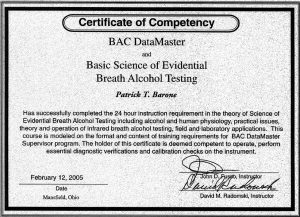 is the founding attorney of the Barone Defense Firm in Birmingham, Michigan and one of Michigan’s most credentialed OWI defense attorneys. He holds manufacturer-level certification on the DataMaster DMT, Michigan’s former evidentiary breath testing instrument, and brings that foundation of instrument-level knowledge to his analysis of the Intoxilyzer 9000, which replaced the DataMaster as Michigan’s evidentiary breath testing instrument.
He is also an IACP/NHTSA certified Standard Field Sobriety Test instructor and practitioner. He is believed to be the only Michigan attorney judicially qualified as an SFST court expert. Mr. Barone holds a Bachelor of Science in Biology, which informs his approach to the forensic and scientific evidence central to OWI litigation.
Mr. Barone co-authored “Intoxilyzer 9000 Replaces DataMaster DMT for Breath Tests,” published in the Michigan Bar Journal in February 2026, examining the legal and scientific implications of Michigan’s breath testing instrument transition. He is the also author of Do Field Sobriety Tests Reliably Predict Intoxication?, published in the Michigan Bar Journal. He is also the author of five books including the two-volume treatise Defending Drinking Drivers, and has published extensively on DUI science and litigation.
Mr. Barone has been recognized as a Michigan Super Lawyer continuously since 2007 and is listed in Best Lawyers in America.