Search
 Michigan Criminal Defense Lawyer Blog
Michigan OWI for Doctors: Consequences and Strategies


A Michigan OWI for doctors triggers two separate proceedings that move on different timelines and are evaluated by different decision-makers: the criminal case in court, and a licensing inquiry before LARA and the Board of Medicine that applies its own fitness and public safety standard regardless of how the criminal case resolves.
A conviction that appears manageable in criminal court can produce a licensing consequence that threatens the medical career, because the Board does not evaluate OWI conduct as an isolated lapse in judgment. It evaluates what the charge reflects about the physician’s fitness to practice and risk to patients.
What Legal Consequences Do Michigan Doctors Face for an OWI?
Doctors face the same statutory criminal penalties as any driver in Michigan, including possible jail time, fines, points on a driving record, and license suspension. For a Michigan OWI for doctors charged as a first offense, jail is possible but not inevitable and depends heavily on the court, the judge, and the facts of the case.
For a second offense, jail is not mandatory but the likelihood increases significantly and in some courts and with some judges it becomes a near-certainty. Mitigation matters enormously at this stage, which is one reason early and thorough preparation of the personal narrative is a central part of every physician OWI representation at this firm.
Will a Michigan OWI Affect My Medical License?

An OWI conviction can trigger disciplinary proceedings before LARA and the Board of Medicine under MCL § 333.16221(1)(b), which authorizes discipline for unprofessional conduct. Possible outcomes include reprimand, probation with monitoring conditions, limitation, suspension, or revocation.
No single outcome is predetermined for a Michigan physician facing an OWI charge. Each case depends on the prior disciplinary history, the nature of the charge, and how the matter is handled from the moment of arrest. The Board applies a fitness and public safety standard that is entirely separate from the criminal court’s judgment.
When a Minor Is in the Car: A Different Level of Risk
An OWI with a minor passenger under MCL § 257.625(7) is charged as a standard misdemeanor OWI but with an enhancement that changes everything for a physician. That enhancement can be interpreted by state and federal regulators as conduct involving the endangerment or neglect of a child, which is the framing that can trigger Medicaid termination, Medicare revocation, and LARA emergency action simultaneously.
Separately, where a minor is present and there are aggravating circumstances, a charge of child abuse in the fourth degree under MCL § 750.136b(7) can be added or substituted. That charge carries its own consequence profile that can be more severe than the OWI itself from a licensing and federal program perspective.
For a physician, a conviction involving child endangerment, whether from an OWI with a minor passenger that was not reduced, or from a child abuse fourth degree charge, can trigger mandatory exclusion from Medicare and Medicaid and LARA emergency action. The minor passenger article linked below develops these consequences in detail.
Do I Have to Report a Michigan OWI to LARA?
Yes. Michigan law requires self-reporting any criminal conviction to LARA within thirty days under MCL § 333.16222(3). The court is also independently required to report qualifying convictions within twenty-one days, though courts frequently miss this requirement. A physician should never assume that silence from LARA means no report was received.
The self-report letter is the opening document of the licensing proceeding. It should be drafted with the guidance of a healthcare licensing attorney, not submitted as a routine administrative form.
An Arrest Is Not a Conviction: Why Physician OWI Cases Can Be Successfully Contested
Physicians use test results every day in clinical practice to assess and diagnose patients. When those tests are performed correctly, the results are reliable. The same is not necessarily true for breath and blood testing in OWI cases.
Breath and blood testing involves instruments, protocols, and officers who can and do make errors. There are a multitude of possible error sources in the collection, handling, and analysis of this evidence, and at Barone Defense Firm we challenge it in court regularly and successfully. A physician who reflexively trusts a breath test number the way they trust a laboratory result has accepted a premise about evidentiary reliability that the science and the case law do not always support.
Michigan recently transitioned to the Intoxilyzer 9000 for evidentiary breath testing, introducing new calibration protocols and a data management system called COBRA that stores detailed electronic records of every test sequence. Obtaining and analyzing that data is now a standard first step in every OWI case we handle. Discrepancies between what the printed result shows and what the underlying instrument data reveals have been consequential in OWI cases across Michigan. Whether the Intoxilyzer 9000 result in a specific case can be challenged depends on the COBRA data and the specific circumstances of the test.
What Most Discussions of Physician OWI Miss
Most discussions of physician OWI consequences address the Board of Medicine and LARA and stop there. What they do not address is that an OWI can also affect a physician’s DEA registration and federal program participation independently of the licensing outcome.
Under federal law, the DEA may suspend or revoke a registration upon finding that continued registration is inconsistent with the public interest. That analysis explicitly considers prior criminal convictions. A controlled substance-related OWI carries meaningfully higher DEA registration risk than an alcohol-only charge, and the strategic implications of that distinction must be understood before any plea decision is made.
The three-category consequence framework, developed in Patrick Barone’s analysis published through the State Appellate Defender Office, describes how mandatory exclusion, discretionary regulatory action, and informal professional disqualification can all flow from a single conviction and why the criminal defense strategy must account for all three from the first day of representation.
What Michigan Physician OWI Defense Actually Requires
The first mistake I see consistently in physician OWI cases is self-disclosure to the hospital or practice group before counsel is retained. Physicians are accustomed to transparency and often disclose immediately, before understanding what their employment agreement actually requires. Employment agreements vary considerably, some require disclosure upon arrest, some upon conviction, some upon any criminal charge, and some are silent entirely. We review the employment agreement with every physician client before any disclosure is made.
The plea negotiation is where the licensing outcome is determined, and most physicians represented by general criminal defense counsel do not know there is a hierarchy of outcomes that matters enormously to the Board of Medicine. At the top is a civil infraction, which carries no LARA reporting obligation because it is not a criminal conviction. Achieving that outcome requires a genuine defect in the case, a compelling personal narrative developed through thorough client preparation, or ideally both.
We invest the time to understand every client’s personal story from the beginning, because a well-developed narrative and a technical defect together give us the strongest possible platform. In other cases we’re doctor’s were involved we’ve been able to accomplish a dismissal of the OWI in return for a plea of responsible to a civil infraction such as careless driving, in others, we’ve accomplished reductions of the OWI to a lesser misdemeanor with no alcohol or drug nexus, such as drag racing, or reckless driving. Such misdemeanors are still reportable to LARA but they remove the substance-related element the Board weighs most heavily, which can still be highly beneficial relative to the professional licensing aspect of the case.
In a different context, client’s may not understand that a reduction from OWI with a minor passenger to a lower charge, one that removes the child-related element entirely, is among the most consequential outcomes available in those cases, because it is the minor passenger enhancement that triggers the most severe federal program and licensing consequences for licensed health care providers. That reduction must be a primary objective in any child endangerment case, and it requires exactly the kind of contested defense that most physicians assume is not worth pursuing.
The other mistake I see consistently is physicians who hire a DUI attorney and assume that covers the representation. It does not. A physician facing an OWI needs two attorneys working in coordination from the first day. At Barone Defense Firm we maintain a referral cadre of healthcare licensing specialists who are among the best in Michigan at what they do, and we make that introduction at the outset of every healthcare professional OWI representation.
The full consequence framework governing criminal charges and licensed healthcare professionals in Michigan, including how the criminal defense strategy must account for the licensing, DEA registration, and federal program participation consequences simultaneously, is addressed in the firm’s analysis of criminal charges and licensed healthcare professionals in Michigan.
Frequently Asked Questions: Michigan OWI for Doctors
Will a Michigan OWI affect my medical license?
An OWI conviction can trigger disciplinary proceedings before LARA and the Board of Medicine under MCL § 333.16221(1)(b). Possible outcomes range from reprimand to revocation. The Board applies a fitness and public safety standard entirely separate from the criminal court’s judgment.
Do I have to report an OWI to LARA?
Yes. Michigan law requires self-reporting any criminal conviction within thirty days. The court is also required to report qualifying convictions independently, though courts frequently miss this requirement. Never assume the court’s report substitutes for the physician’s own timely submission.
Can a Michigan OWI result in a civil infraction rather than a conviction?
In some cases, yes. A civil infraction carries no LARA reporting obligation because it is not a criminal conviction. Achieving that outcome requires a genuine defect in the case, a compelling personal narrative, or ideally both. It is not the most common outcome but it is what we pursue in every healthcare professional OWI case where the evidence supports it.
Can OWI breath and blood test results be challenged?
Yes. Breath and blood testing involves instruments, protocols, and officers who can and do make errors. A physician who trusts clinical laboratory results because they are performed under controlled conditions should understand that roadside and evidentiary breath testing operates under entirely different reliability conditions. These cases can be successfully contested.
Should I hire both a DUI attorney and a healthcare licensing attorney?
Yes. A physician facing an OWI needs both attorneys working in coordination from the first day. Barone Defense Firm maintains a referral cadre of top Michigan healthcare licensing specialists and introduces that resource at the outset of every healthcare professional OWI representation.
Next Steps for Michigan Physicians Facing an OWI Charge
If you are a licensed physician in Michigan facing an OWI charge, the decisions made in the first days after the arrest — including what your employment agreement requires before any disclosure is made — can significantly affect the outcomes available to you. At Barone Defense Firm, we defend physicians in court and coordinate with healthcare licensing specialists from the first day of representation.
To schedule a confidential consultation, call 1-877-ALL-MICH (877-255-6424), or contact us online.
This post was written by Patrick Barone, founding attorney of Barone Defense Firm in Birmingham, Michigan. Patrick has represented licensed physicians at the intersection of criminal defense and professional licensing consequences for more than three decades.
His published analyses include Representing Licensed Health Care Professionals Accused of Alcohol- or Drug-Related Crimes, published in the Michigan Bar Journal in October 2013, and Criminal Accusations Cause Health Care Professionals to Face Potentially Debilitating Collateral Consequences, published through the State Appellate Defender Office.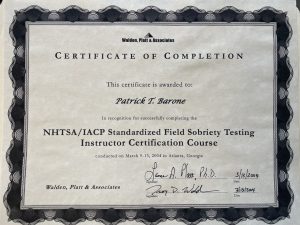
About the Author
This post was written by Patrick Barone, founding attorney of Barone Defense Firm in Birmingham, Michigan. Patrick has represented licensed physicians at the intersection of criminal defense and professional licensing consequences for more than three decades.
His published analyses include Representing Licensed Health Care Professionals Accused of Alcohol- or Drug-Related Crimes, published in the Michigan Bar Journal in October 2013, and Criminal Accusations Cause Health Care Professionals to Face Potentially Debilitating Collateral Consequences, published through the State Appellate Defender Office.
 In February 2026, Patrick co-authored Intoxilyzer 9000 Replaces DataMaster DMT for Breath Tests, published in the Michigan Bar Journal, documenting the instrument transition and its implications for OWI defense practice in Michigan. Patrick is an IACP/NHTSA certified SFST instructor and practitioner and is believed to be the only Michigan attorney judicially qualified as an SFST court expert. He holds manufacturer-level certification on the DataMaster DMT breath testing instrument.
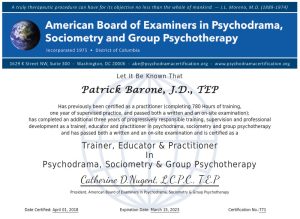
He is a graduate of the Gerry Spence Trial Lawyers College, a Board Certified TEP (the highest level of certification) in psychodrama, sociometry, and group psychotherapy through the American Board of Examiners, and the only such credential holder in Michigan. He has been recognized as a Michigan Super Lawyer continuously since 2007 and is listed in The Best Lawyers in America.