 Barone Defense Firm Home
Protect Your Future Don't Let One Moment
Define You. With the right defense, you can win back your life
and confidently move forward.



What Is a Preliminary Breath Test in a Michigan DUI Stop?
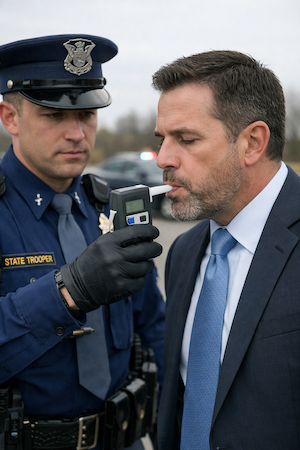 The preliminary breath test, or PBT, is a handheld roadside screening device used by Michigan police officers during the pre-arrest phase of a DUI investigation to obtain an indication of a driver's blood alcohol concentration. It is the final tool administered in the roadside investigation before the officer makes an arrest decision. Unlike the Intoxilyzer 9000 used at the police station after arrest, the PBT is a screening device only. Its results are generally inadmissible as evidence in court, and refusing to submit to it carries only a civil infraction fine with no points and no license consequences.
Where Does the Preliminary Breath Test Fit in a Michigan DUI Stop?
The National Highway Traffic Safety Administration trains officers to conduct a DUI investigation in three phases. Phase One is vehicle in motion. Phase Two is personal contact. Phase Three is pre-arrest screening, during which the officer administers the standardized field sobriety tests and, where authorized by state law, arranges for a preliminary breath test. The PBT is the final step in that sequence.
Officers are specifically trained not to rely on the PBT alone as the basis for arrest. NHTSA instructs that the PBT should corroborate what the officer has already observed during the field sobriety tests and personal contact, not substitute for that observation. An arrest decision that rests primarily on a PBT result, without documented field sobriety observations, is a more vulnerable arrest than one built on the full Phase Three record.
Michigan law treats the PBT as a screening tool, not as evidence of intoxication. The result is generally inadmissible in the criminal case to prove the driver's blood alcohol concentration. It can, however, contribute to the probable cause determination that supports the arrest and to the basis for a blood test warrant.
Why Is the Roadside PBT Less Accurate Than the Intoxilyzer 9000?
The PBT and the Intoxilyzer 9000 work on fundamentally different scientific principles. The Intoxilyzer 9000 uses infrared spectroscopy, which measures the absorption of infrared light by alcohol molecules at specific wavelengths. The PBT uses an electrochemical fuel cell, which generates an electrical current when alcohol is oxidized at a platinum electrode. Fuel cell technology is portable but introduces sources of error that infrared testing does not.
Fuel cells are subject to cell fatigue. A fuel cell that has processed multiple samples in succession loses sensitivity and accuracy until it recovers. They are also subject to refractory periods, during which the cell cannot produce reliable readings regardless of the concentration of alcohol in the sample. These characteristics make sequential PBT testing in a busy roadside investigation inherently less reliable than a single properly administered evidentiary test.
The most significant limitation is the absence of slope detection. Infrared evidentiary instruments use slope detection to identify mouth alcohol contaminating the breath sample. When a subject has residual alcohol in the mouth from a recent drink, burp, or reflux event, the slope of the breath alcohol curve rises sharply at the beginning of the sample and then drops, revealing the contamination. PBTs cannot perform this analysis. A driver who experiences a reflux event in the minutes before the test, has ketosis from a low-carbohydrate diet, or has had dental work involving alcohol-based compounds can produce a falsely elevated PBT result that the device has no mechanism to detect or flag.
The fuel cell technology, infrared spectroscopy, slope detection, and the full range of physiological factors that affect breath testing results are addressed in comprehensive scientific detail in Defending Drinking Drivers, a practitioner's treatise on DUI defense authored by Patrick Barone and published by James Publishing. Chapter 2, devoted to chemical evidence in DUI cases, covers these topics at a depth of analysis not available in any other Michigan OWI defense resource.
What Are Michigan's Administrative Rules for Preliminary Breath Test Administration?
Michigan's administrative rules establish specific requirements governing how a PBT must be administered and how the instrument must be maintained. These rules are the foundation of any legal challenge to a PBT result and must be reviewed in full in every case.
Under Mich Admin Code R 325.2657a, a PBT may be administered only after the operator determines that the individual has not smoked, regurgitated, or placed anything in his or her mouth for at least fifteen minutes. The rule requires a determination, not merely elapsed time. The officer must be able to demonstrate something beyond the passage of fifteen minutes that constitutes an affirmative determination that the condition was met.
What constitutes an adequate determination is a fact-specific question and is subject to the substantial compliance analysis applicable to roadside breath test administration. The requirement carries particular significance for PBTs because, unlike the Intoxilyzer 9000, a PBT has no slope detection capability and cannot independently identify whether an interfering substance was present in the driver's mouth at the time of the test. The determination requirement exists precisely to compensate for that technological limitation.
Under Mich Admin Code R 325.2656a, a PBT instrument must be verified for accuracy at least once each calendar month using a controlled alcohol standard device. The instrument must produce a result within plus or minus five percent of the standard. Police agencies are required to maintain calibration and maintenance logs for PBT instruments, and those logs must be obtained through a FOIA request as part of the complete investigation of any PBT-based evidence. Unlike evidentiary instruments, PBTs do not generate breath flow graph histogram data, but the calibration logs are a required and reviewable record.
PBT instruments must be operated only by a certified Class I operator. The officer's certification status is part of the foundational compliance record for any PBT result.
Should You Refuse the Roadside PBT in Michigan?
Refusing the roadside PBT in Michigan is legal and carries only a civil infraction fine. There are no points, no license consequences, and no implied consent violation for refusing the PBT. This is a fundamentally different consequence structure than refusing the evidentiary breath test at the police station after arrest.
In many cases, refusing the PBT is the better strategic decision. Without a PBT result, the officer must build the probable cause for arrest entirely on field sobriety observations and personal contact evidence. That is a thinner foundation and a more challengeable one. In a marginal case where the driver performed reasonably on the standardized tests, the absence of a PBT result may provide grounds to challenge the validity of the arrest.
It is important to understand that PBT results are generally inadmissible in the criminal case to prove blood alcohol concentration. The evidentiary breath test administered on the Intoxilyzer 9000 after arrest is the instrument whose result the prosecution will rely on. The decision about whether to refuse that post-arrest evidentiary test involves a completely different legal framework and a different set of consequences.
What About the Handheld Breath Test Given Before You Are Released From Custody?
After a Michigan DUI arrest, a driver may be asked to submit to a second handheld breath test before being released from custody. This is not the evidentiary breath test administered on the Intoxilyzer 9000. It is a preliminary breath test administered to confirm that the driver's blood alcohol concentration has fallen to a level where release is appropriate.
This post-arrest PBT has no evidentiary purpose. It is a safety check, not a forensic measurement. The result is not introduced at trial and does not become part of the evidentiary record of the chemical test administered at arrest. A driver who submitted to the evidentiary Intoxilyzer 9000 test at the station has already fulfilled the implied consent obligation. The pre-release PBT is separate from that process entirely.
The same technological limitations that apply to the roadside PBT apply here. Fuel cell devices cannot perform slope detection and are subject to cell fatigue and refractory periods. The result should be understood for what it is: a rough screening indicator for release purposes, not a scientific measurement of blood alcohol concentration.
How Does the Barone Defense Firm Approach PBT Evidence in a Michigan DUI Case?
The Barone Defense Firm examines PBT evidence through two distinct lenses: the legal framework governing the officer's administration of the test, and the scientific limitations of the device itself. Both provide grounds for challenge that most attorneys do not pursue.
On the legal side, the substantial compliance standard requires the officer to make a documented determination that nothing entered the driver's mouth for fifteen minutes before the test. Patrick Barone is an IACP/NHTSA certified SFST instructor and is believed to be the only Michigan attorney judicially qualified as a court expert in field sobriety testing protocols, including the Phase Three pre-arrest screening sequence. That training gives him a precise understanding of what a proper Phase Three investigation looks like and what deviations from required procedure mean for the evidentiary weight of the result.
On the scientific side, the firm examines whether the PBT device was properly maintained under the monthly calibration requirements of R 325.2656a and whether the calibration logs obtained through FOIA show any accuracy failures. Because PBTs do not generate breath flow graph data, the calibration log is the primary documentary record available for evaluating instrument reliability. The firm also examines whether any physiological condition introducing mouth alcohol, including a reflux event, may have affected the result in ways the device could not detect.
The relationship between the PBT result and the subsequent Intoxilyzer 9000 result is also relevant. Significant divergence between the two raises questions about the reliability of the roadside reading and, in some cases, about what occurred in the interval between the two tests.
Frequently Asked Questions: Preliminary Breath Testing in Michigan DUI Cases
Is refusing the roadside PBT the same as refusing the breath test under implied consent?
No. Refusing the roadside PBT is a civil infraction carrying a fine only. It does not trigger implied consent consequences, does not result in an automatic license suspension, and does not count as a chemical test refusal under Michigan law. The implied consent framework applies to the evidentiary breath test administered at the police station after arrest, not to the roadside screening device.
Can a PBT result be used against me in court?
PBT results are generally inadmissible as evidence of guilt in a Michigan DUI case. They can be considered in the probable cause determination supporting the arrest and in the basis for a blood test warrant, but cannot be used by the prosecution to prove your blood alcohol concentration at trial.
What does the fifteen-minute determination requirement actually mean?
Michigan Administrative Code R 325.2657a requires the officer to determine that the driver has not smoked, regurgitated, or placed anything in his or her mouth for at least fifteen minutes before administering the PBT. The rule requires an affirmative determination, not merely the passage of time. Because PBTs lack slope detection and cannot independently identify interfering substances, the adequacy of the officer's determination is a subject of substantial compliance analysis in every case.
What is the difference between the PBT and the Intoxilyzer 9000?
The PBT uses an electrochemical fuel cell and is a screening device only. The Intoxilyzer 9000 uses infrared spectroscopy and is the evidentiary breath testing instrument approved for use in Michigan criminal prosecutions. The PBT cannot perform slope detection to identify mouth alcohol and is subject to fuel cell fatigue and refractory periods. The Intoxilyzer 9000 generates detailed COBRA diagnostic data that the defense can review, while the PBT generates only the calibration and maintenance logs maintained by the police agency.
If I blow below the legal limit on the PBT can I still be arrested?
Yes. A PBT result below 0.08 does not prevent an arrest. The officer can arrest based on the totality of the roadside investigation, including field sobriety observations and personal contact evidence, even when the PBT result does not reflect a per se violation. NHTSA trains officers to treat the PBT as corroboration, not as the primary basis for the arrest decision.
If you were arrested for OWI in Michigan following a roadside investigation that included a preliminary breath test, the circumstances of that investigation, including how the PBT was administered, whether the fifteen-minute determination was properly made, and what the calibration records show, are part of the record your attorney must examine. At the Barone Defense Firm, we evaluate every phase of the roadside investigation as part of building the most complete picture of what the evidence actually supports. To schedule a confidential consultation, call 1-877-ALL-MICH (877-255-6424) or contact us online. Consultations are available around the clock.
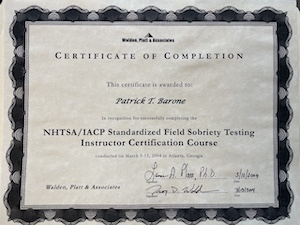 This page was written by Patrick Barone, founding attorney of the Barone Defense Firm in Birmingham, Michigan. Patrick is an IACP/NHTSA certified SFST instructor and practitioner, and is believed to be the only Michigan attorney judicially qualified as a court expert in field sobriety testing protocols, including the Phase Three pre-arrest screening sequence in which the preliminary breath test is administered. His undergraduate training in biology on a pre-medical track gives him the scientific foundation to evaluate fuel cell technology, infrared spectroscopy, and the physiological factors that affect breath test results at the roadside and at the station.
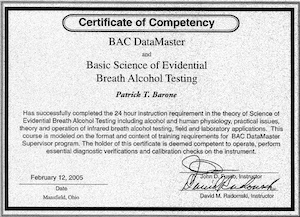 He holds manufacturer certification on the DataMaster DMT, earned through a four-day curriculum covering alcohol and human physiology, infrared spectroscopy theory and operation, and field and laboratory applications, making him the only attorney in active Michigan OWI practice with this training. He is the author of Defending Drinking Drivers, published by James Publishing, including Chapter 2 on Chemical Evidence which addresses the science of fuel cell and infrared breath testing in depth. He co-authored a 2005 Michigan Bar Journal analysis of whether the standardized field sobriety tests reliably predict intoxication, and a February 2026 Michigan Bar Journal article examining Michigan's transition to the Intoxilyzer 9000.
He has been named a Michigan Super Lawyer continuously since 2007, is recognized by Best Lawyers in America, and has been selected as a Leading Lawyer and serves on the Leading Lawyers Advisory Board.



 Your Privacy Choices