Search
 Michigan Criminal Defense Lawyer Blog
When Can a Michigan DUI Causing Death Become Second-Degree Murder?


A fatal intoxicated-driving crash can expose a driver to one of Michigan’s most serious felony prosecutions. But the fact that alcohol or drugs were involved, even when combined with a death, does not automatically transform an OWI causing death case into second-degree murder.
When murder is alleged, the central question becomes not simply whether the driver was intoxicated or caused the crash, but whether the prosecution can prove the additional mental state Michigan law calls malice. That distinction can affect charging, the preliminary examination, plea negotiations, trial strategy, and ultimately the potential sentence.
What Is the Difference Between OWI Causing Death and Second-Degree Murder?
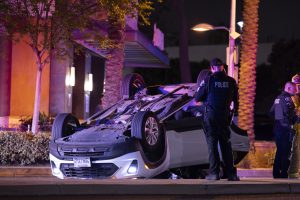 Under MCL 257.625(4), a person commits OWI causing death when the person operates a motor vehicle in violation of Michigan’s intoxicated-driving law and, by that operation, causes another person’s death. The ordinary statutory maximum is 15 years in prison, although Michigan law provides higher maximums in specified circumstances.1
A broader discussion of that offense, its elements, and its consequences is available on our Michigan DUI causing injury or death practice page.
Second-degree murder is different. Michigan’s courts require proof of four elements: a death, caused by an act of the defendant, malice, and the absence of justification or excuse.2 Under MCL 750.317, second-degree murder is punishable by life imprisonment or any term of years.
| Issue | OWI Causing Death | Second-Degree Murder |
|---|---|---|
| Intoxicated driving | Must prove the applicable violation of Michigan’s OWI statute | May be part of the evidence, but intoxication alone does not establish murder |
| Causation | Operation must cause the death | The defendant’s act must cause the death |
| Malice | Not an element | Required |
| Ordinary statutory maximum | 15 years, subject to specified statutory enhancements | Life or any term of years |
A DUI murder charge therefore requires evidence from which the prosecution can prove the additional element of malice, rather than merely the elements of OWI causing death. A prosecutor cannot obtain a murder conviction simply by proving the elements that would establish OWI causing death. It’s important to know Michigan calls drunk driving OWI, or Operating While Intoxicated, and uses this as its statutory terminology, even though most people searching for information use the term DUI. A separate explanation of the terminology is available in our discussion of the difference between DUI and OWI in Michigan.
What Must Prosecutors Prove for a DUI Murder Charge?
The Michigan Supreme Court’s leading decision is People v. Goecke, 457 Mich. 442, 579 N.W.2d 868 (1998). The Court held that malice may consist of an intent to kill, an intent to cause great bodily harm, or an intent to act in wanton and willful disregard of the likelihood that the natural tendency of the conduct is to cause death or great bodily harm.2
In a fatal DUI prosecution, it is normally the third form of malice that matters. The prosecutor does not have to prove that the driver wanted anyone to die. Instead, the question becomes whether the driver’s intentional conduct reflected an obvious disregard for consequences that endangered human life. What distinguishes a potential DUI murder charge is not any single traffic violation, but whether the driving pattern and surrounding circumstances permit a reasonable inference of malice.
This is sometimes described as “depraved-heart” murder. Importantly, the Michigan Supreme Court has characterized second-degree murder as a general-intent crime. Voluntary intoxication therefore does not itself provide a defense to the malice element of second-degree murder.2
Does Intoxication Plus a Death Automatically Establish Murder?
No, and in fact the opposite is true, and this is one of the most important limitations in Michigan law.
Goecke rejected the proposition that every fatal drunk-driving case is second-degree murder. The Michigan Legislature’s creation of the separate OWI-causing-death offense did not prevent prosecutors from bringing a murder charge when the evidence supports it. But neither did it eliminate the prosecution’s obligation to prove malice.
For that reason, none of the following facts automatically establishes second-degree murder by itself: a positive blood or breath result, a BAC above the legal limit, a fatal collision, speeding, running a red light, or another traffic violation.
Those facts can be important. Several can become powerful when considered together. But the inquiry is always whether the complete circumstances support the much more demanding inference of malice.
What Facts Can Support a DUI Murder Charge?
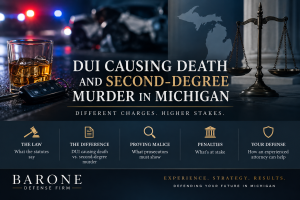 Michigan law does not provide a checklist that automatically converts OWI causing death into murder. The cases instead show recurring types of evidence that prosecutors use to argue that the driver’s conduct crossed the line. To prove second degree murder, the prosecutor must prove that the defendant had one of these three states of mind: (1) intended to kill, or (2) intended to do great bodily harm, or (3( knowingly created a very high risk of death or great bodily harm knowing that death or such harm would be the likely result of his / her actions. Second degree murder is not a specific intent crime. See CJI 16.5.
In a DUI causing death charged as second degree murder, it is the third state of mind that is at issue, and the prosecutor must establish this state of mind by producing evidence of it beyond a reasonable doubt. The following constitutes what this evidence might consist of:
Exceptionally dangerous driving before the crash
A sustained pattern of extraordinarily dangerous driving can be important. Prosecutors may rely on evidence of extreme speed, repeated weaving through traffic, driving the wrong way, running traffic controls, narrowly avoiding other collisions, or continuing to drive after repeatedly losing control.
In Goecke, for example, evidence in one of the consolidated cases included substantial drinking, speeds estimated at 70 to 80 miles per hour on a city roadway, a near collision, and then continued travel through a red light before the fatal impact. In the other consolidated cases, the Court considered similarly dangerous patterns rather than isolating a single traffic mistake.2
Evidence that the driver had been warned about the danger
Evidence showing that a driver had reason to recognize the particular danger can strengthen a malice theory. A passenger warning the driver to slow down, an earlier near collision, a previous loss of control, or a recent alcohol-related driving incident may become significant because it can bear on what the driver understood before continuing.
In People v. Werner, 254 Mich. App. 528, 659 N.W.2d 688 (2002), the defendant drove the wrong way on a freeway while seriously intoxicated and caused a head-on collision. The Court of Appeals considered evidence of a recent alcohol-induced blackout during which he had driven into boulders. The earlier incident supported the prosecution’s argument that he knew alcohol could affect him far more severely than simply slowing his reflexes or judgment.3
People v. Mayhew, 236 Mich. App. 112, 600 N.W.2d 370 (1999), illustrates the same principle in a different way. There, evidence indicated that the driver had previously been warned that a mechanical problem with his vehicle could cause it to fishtail if he drove too fast or turned sharply. Evidence that he nevertheless sped, weaved through traffic, and cut off other vehicles supported allowing the jury to decide malice.4
Continuing to drive after an obvious danger becomes apparent
The chronology can matter as much as the final seconds before impact. A prosecutor may argue that a near crash, passenger warning, earlier collision, police pursuit, or loss of control gave the driver an unmistakable opportunity to recognize the danger and stop.
For the defense, this means that the event should rarely be analyzed only from the point of impact backward a few seconds. The complete driving sequence may reveal either the escalating conduct on which the prosecution relies or facts showing that the alleged pattern is being overstated.
Can Prior DUI Convictions Support a DUI Murder Charge?
A prior DUI conviction does not automatically convert a later fatal crash into second-degree murder. There is no Michigan rule that says a person with a prior intoxicated-driving conviction is necessarily guilty of murder if a later DUI results in death.
Prior conduct can nevertheless become important when the prosecution offers it for a legally permissible reason. In Werner, the earlier alcohol-related driving incident was relevant because it bore on knowledge and the absence of accident or mistake. The prosecution was not permitted simply to argue that the defendant was a bad person who had driven drunk before.
Michigan Rule of Evidence 404(b) generally prohibits using another crime, wrong, or act merely to prove character and then infer that the person acted consistently with that character. Other-acts evidence may be admissible for a proper non-character purpose when it is relevant and survives the applicable prejudice analysis.5
That distinction can become critical in a Michigan DUI murder charge. Defense counsel should examine not merely whether a prior incident exists, but precisely what the prosecutor claims it proves, how similar it really is, what the accused actually learned from it, and whether its legitimate probative value is substantially outweighed by the danger of unfair prejudice.
How Does Causation Affect a Michigan DUI Murder Case?
Yes. Malice does not replace causation.
The prosecution still must connect the defendant’s conduct to the death. That can require separate analysis of factual and legal causation, particularly where another driver, roadway condition, mechanical event, or other intervening circumstance contributed to the collision.
Our separate article examines proximate cause in a Michigan DUI causing death case in detail. A second article addresses the narrower question of when a victim’s intoxication can matter to causation, including the Michigan Supreme Court’s 2026 decision in People v. Morgan.
These are distinct issues. A case may present strong evidence of intoxication but a legitimate dispute over causation. Another may present little causation dispute but a substantial question whether the driving conduct rises to the level of malice. A serious defense requires separating those elements rather than allowing the severity of the outcome to substitute for proof.
What Does the California Donato Decision Add to the Analysis?
A 2025 California case offers a useful comparison, but it does not change Michigan law.
In People v. Donato, No. H050622 (Cal. Ct. App. Sept. 17, 2025), a California Court of Appeal affirmed a second-degree murder conviction arising from an intoxicated-driving death. The evidence included two prior DUI convictions, an express probation restriction concerning alcohol and driving, a prior alcohol-related collision, a BAC of approximately .193, erratic freeway driving, wrong-way travel, an approximately 83-mile-per-hour head-on collision, and virtually no braking before impact.6
California commonly refers to this theory as a “Watson murder.” Its implied-malice doctrine and jury instructions are California law, not Michigan law. Michigan courts must apply Michigan statutes and Michigan precedent, beginning with Goecke.
The comparison is useful for a more limited reason. In both jurisdictions, the legal analysis looks beyond intoxication alone and examines whether the driver’s prior knowledge, warnings, conduct, and choices support the additional mental state required for murder. It is the accumulation and interaction of facts, not a particular BAC number, that becomes important.
How is a DUI Murder Charge Defended in Michigan?
A second-degree murder allegation changes the factual focus of a fatal DUI case. Testing evidence remains important, and causation remains important, but the prosecution has added a separate proposition that must be proven beyond a reasonable doubt: malice.
That investigation may require examination of the entire period leading to the collision, not simply the moment of impact. Depending on the facts, relevant evidence may include vehicle event data, infotainment or telematics information, video, phone records, roadway evidence, witness accounts, toxicology, accident reconstruction, medical evidence, and prior incidents the prosecution seeks to introduce.
For that reason, defending a DUI murder charge requires separate analysis of intoxication, causation, the driver’s conduct, any alleged warnings, and the evidence offered to establish the driver’s state of mind.
Defense counsel should also ask whether a supposed warning event really occurred and whether it communicated the danger the prosecution claims. A passenger saying “slow down” is not necessarily equivalent to a previous alcohol blackout. A routine traffic violation is not necessarily equivalent to repeatedly continuing after collisions or near collisions. Context determines the evidentiary significance.
The same disciplined analysis applies to prior acts. The question is not simply whether an earlier DUI exists. The questions are what happened, what the defendant actually experienced or learned, why the prosecution wants the jury to hear it, and whether Michigan evidence law permits that use.
Finally, the defense must keep causation separate from culpability. Evidence of terrible driving does not excuse the prosecution from proving that the defendant legally caused the death. Conversely, proof of causation does not itself establish malice.
Why Does the Difference Between OWI Causing Death and Murder Matter So Much?
The distinction affects nearly every stage of a case. At a preliminary examination, the prosecution seeking a murder bindover must present evidence supporting probable cause as to malice, not merely an intoxicated-driving death. At trial, malice must be proven beyond a reasonable doubt.
The sentencing exposure is also profoundly different. An ordinary OWI-causing-death conviction carries a maximum of 15 years, subject to statutory enhancements in defined circumstances. Michigan second-degree murder, by contrast, carries the possibility of life imprisonment or any term of years.
Those stakes are why a murder allegation should not be accepted as simply a more serious label for the same DUI case. The additional charge rests on an additional element, and that element requires its own factual and legal analysis.
Frequently Asked Questions About Michigan DUI Murder Charges
Can Michigan prosecutors charge both OWI causing death and second-degree murder?
Yes. Michigan courts have recognized that the offenses contain different elements. The existence of the OWI-causing-death statute does not prevent a prosecutor from also pursuing second-degree murder when the evidence supports malice.
Does a very high BAC automatically prove malice?
No. A high BAC can be important evidence, but Michigan law does not establish a BAC level at which OWI causing death automatically becomes murder. The prosecution must establish malice from the complete circumstances.
Does speeding automatically make a fatal DUI second-degree murder?
No. Speed may contribute to the prosecution’s malice theory, especially when it is extreme or part of a sustained pattern of dangerous conduct. But speeding by itself does not create an automatic murder rule.
Can a prior DUI conviction make a difference?
It can, but it is not automatically dispositive. A prior incident may be relevant if it legitimately tends to prove knowledge or another permitted issue. Its admissibility and significance depend on the facts and the Michigan Rules of Evidence.
Does the prosecutor still have to prove causation?
Yes. A murder charge does not eliminate the causation requirement. The prosecution must prove both that the defendant caused the death and that the defendant possessed the mental state required for second-degree murder.
Facing an OWI Causing Death or Murder Investigation in Michigan?
A fatal DUI prosecution can involve accident reconstruction, toxicology, vehicle data, prior-acts evidence, causation, and allegations concerning the driver’s state of mind. When second-degree murder is being considered, the defense must investigate not only what happened in the collision, but whether the evidence actually supports the separate element of malice.
Barone Defense Firm represents people facing serious and high-stakes DUI charges throughout Michigan. To discuss a pending investigation or criminal charge, contact Barone Defense Firm or call 1-877-ALL-MICH (877-255-6424).
About Patrick T. Barone
Patrick T. Barone is the founding attorney of Barone Defense Firm and has devoted much of his legal career to the defense of Michigan DUI and other serious criminal cases. He is the author of five books, including Defending Drinking Drivers, and has written and taught extensively on the law and science of intoxicated-driving defense.
Barone is an IACP/NHTSA-certified Standardized Field Sobriety Test instructor and practitioner and has been judicially qualified as an expert concerning standardized field sobriety testing. His background includes undergraduate study in biology on a pre-medical track, manufacturer certification on the DataMaster DMT, and advanced training in trial advocacy and psychodrama. He is Board Certified as a Trainer, Educator and Practitioner in psychodrama, sociometry, and group psychotherapy and is a graduate of the Gerry Spence Trial Lawyers College.
He has been selected as a Michigan Super Lawyer continuously since 2007 and has been recognized by The Best Lawyers in America. Through Barone Defense Firm, he works with a statewide team defending people facing DUI, OWI causing injury or death, and other high-stakes criminal allegations.
Sources and Legal Authorities
- Michigan Judicial Institute, Traffic Benchbook, OWI or OWVI Causing Death, MCL 257.625(4). ↑
- People v. Goecke, 457 Mich. 442, 463-69, 579 N.W.2d 868 (1998). ↑
- People v. Werner, 254 Mich. App. 528, 531-39, 659 N.W.2d 688 (2002).
- People v. Mayhew, 236 Mich. App. 112, 125-26, 600 N.W.2d 370 (1999).
- Michigan Judicial Institute, Other Crimes, Wrongs, or Acts Under Michigan Rule of Evidence 404(b).
- People v. Donato, No. H050622 (Cal. Ct. App. Sept. 17, 2025). Donato is included only as a comparative California authority and does not control Michigan cases.
This article provides general information about Michigan law and is not legal advice. The application of Michigan criminal law depends on the particular facts, evidence, charges, and procedural posture of each case.