Search
 Michigan Criminal Defense Lawyer Blog
How Long After a Michigan DUI Arrest Will Charges Be Filed?


What Happens After a Michigan DUI Arrest?
 An arrest and a criminal charge are related, but they are not the same thing. An officer may have probable cause to arrest you for suspected drunk or drugged driving before the prosecutor has made a final charging decision or a criminal case has been formally opened in court.
Under Michigan Court Rule 6.615, a misdemeanor case can begin in several ways. An officer may issue a citation that is later filed with the district court. A sworn complaint may instead be filed, followed by issuance of a summons or arrest warrant. Michigan statutes may also authorize other specialized procedures.
For many Michigan DUI cases, especially cases in which the driver was arrested and then released without a citation, the process usually involves the police submitting their investigation to the prosecutor. The prosecutor reviews the evidence, authorizes a charge, and a complaint is filed with the district court. A judicial officer then determines whether probable cause supports issuance of the warrant or summons.
The complaint is the written accusation identifying the criminal offense. It is an important dividing line because Michigan courts have long recognized that the complaint initiates the judicial phase of the prosecution.
Why Are Some DUI Charges Filed Quickly in Michigan?
A breath-test case may move relatively quickly because the evidentiary breath result is ordinarily available before the person leaves police custody. The police may therefore have the chemical-test result, driving observations, field sobriety evidence, video, and other investigative material available immediately.
That does not mean every breath case is filed the same day. The police report may still require supervisory review, the prosecutor may need to authorize the charge, and the district court must complete the steps necessary to initiate the case.
But the prosecution usually does not face the same laboratory delay that exists when blood must be sent for forensic analysis.
Why Can Blood Testing Delay Charges After a DUI Arrest?
If police obtain a blood sample, the prosecutor may wait for the laboratory report before making the final charging decision. This is particularly important when the prosecutor is considering a per se alcohol charge based on a reported alcohol concentration, a High BAC charge, or a drug-related OWI theory.
A blood result is not necessary to prove every form of Michigan OWI. Michigan law permits an OWI prosecution based on evidence that alcohol, drugs, or another intoxicating substance substantially reduced a person’s ability to operate a vehicle normally. A numerical chemical-test result is therefore not the only way an OWI case can be prosecuted.
Nevertheless, blood and toxicology results can materially affect the charging decision. For that reason, many prosecutors wait until the laboratory work is complete before authorizing the final charge.
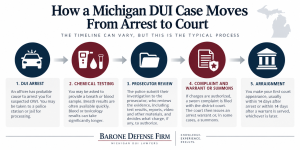 The delay is not simply “lab time.” Several steps may occur:
- The blood sample is collected and submitted for testing.
- The laboratory performs the requested alcohol or toxicology analysis.
- The laboratory issues its report.
- The report is returned to the investigating agency or prosecutor.
- The prosecutor reviews the complete investigation.
- The prosecutor determines what charge, if any, to authorize.
- A complaint is filed and the court issues the appropriate warrant or summons.
For that reason, it is misleading to promise that a Michigan DUI blood case will be charged within a particular number of weeks. Laboratory workload, the substances being tested, the complexity of the analysis, the police agency, the prosecutor’s office, and the particular court can all affect the timeline.
For a deeper discussion of how forensic blood evidence is collected and challenged, see our guide to DUI blood testing in Michigan OWI cases.
What If I Was Released After a DUI Arrest Without a Ticket?
This is one of the most common sources of confusion. A person may leave jail with bond paperwork or other documents but no citation telling them exactly when to appear in court.
That does not establish that the prosecutor declined the case.
Michigan’s appearance-ticket statute treats operating while intoxicated offenses differently from many other misdemeanors. The general statutory requirement that police issue an appearance ticket and release a person does not apply in the same way to an OWI offense. The absence of a ticket does not mean that DUI charges will not be filed later.
The police may instead submit the investigation to the prosecutor for later authorization. This is especially common when evidence remains outstanding.
Does a Michigan DUI Case Begin With a Warrant or a Summons?
In the Michigan DUI cases we handle, when no citation was issued at the time of arrest, the practical procedure usually involves the filing of a complaint followed by issuance of an arrest warrant. Lawyers sometimes refer to the type of warrant used to bring a released defendant before the court as an “appearance warrant,” although the Michigan Court Rules formally describe it as an arrest warrant.
Michigan procedure also permits a summons. Under MCR 6.102, a summons is generally used unless one of the rule’s exceptions applies. One of those exceptions expressly permits an arrest warrant when the prosecutor requests one.
This distinction explains why the formal rules and day-to-day DUI practice may look different. The court rule establishes the available procedures, while prosecutorial practices can determine which procedure is commonly used in a particular type of case or jurisdiction.
An experienced DUI lawyer can often monitor the court and prosecutor so the filing of the case does not come as a surprise. If a warrant has been issued, counsel can ordinarily determine how the particular court wants the defendant to address it and arrange the first appearance rather than leaving the client to guess what to do.
How Will I Know When Charges Are Filed After a DUI Arrest?
There is no single notification method used in every Michigan court.
If you received a citation, the citation may direct you to respond or appear. If the court issues a summons, it can be served personally, left with an appropriate person at your home, or mailed to your last known address under MCR 6.102.
If an arrest warrant is issued, the procedure can vary by court and jurisdiction. In many DUI cases involving a defendant who was previously arrested and released, defense counsel can work with the court to arrange an appearance and arraignment. But a person should not simply assume that police will never execute the warrant.
If you have moved since your arrest, have problems receiving mail, or have reason to believe the prosecutor may have authorized charges, relying solely on a letter arriving at your home is risky.
Once the case reaches the arraignment stage, our separate guide explains what happens at a Michigan criminal arraignment.
Does Michigan Have a 14-Day Deadline to File DUI Charges?
No. This is an important distinction.
MCL 257.625b(1) provides that a person arrested for specified misdemeanor OWI offenses must be arraigned on the citation, complaint, or warrant within 14 days after the arrest or, if an arrest warrant is issued or reissued, within 14 days after that warrant is served, whichever is later.
That is an arraignment rule. It is not a rule saying that the prosecutor loses the ability to file an OWI case 14 days after the arrest.
The statute makes the distinction even clearer by providing that a court may not dismiss the case or impose another sanction merely because the 14-day time limit was violated. The provision also does not apply in the same way when the OWI is punishable as a felony or is joined with a felony charge.
Someone who has been waiting more than 14 days after an arrest therefore should not assume the case is over.
This 14-day arraignment rule should not be confused with the separate 14-day deadline for requesting a hearing after an implied-consent chemical-test refusal. (see above).
How Long Can Michigan Wait Before Filing a DUI Charge?
The much longer outer boundary is Michigan’s criminal statute of limitations. Under MCL 767.24, offenses that are not subject to one of the statute’s special limitation periods generally fall within a six-year limitations period.
That does not mean prosecutors ordinarily wait six years to file a misdemeanor DUI charge. They generally do not. The six-year statute is an outer legal limit, not a prediction of normal charging practice.
There is also a constitutional limit on prejudicial precharge delay in unusual cases. Michigan courts require more than the passage of time. A defendant generally must show that the delay caused actual and substantial prejudice to the ability to receive a fair trial. If that showing is made, the court considers the prosecution’s reason for the delay.
Ordinary investigative delay, including reasonable time spent obtaining evidence necessary to make a charging decision, is very different from an intentional delay designed to gain an unfair tactical advantage.
Can the Prosecutor Charge Me Before My Blood Results Come Back?
Yes. Nothing automatically requires the prosecutor to wait for a laboratory result in every Michigan DUI case.
If the available evidence supports an impairment-based OWI charge, the prosecutor may have a charging theory independent of the final blood number. Other offenses arising from an accident or traffic incident can also cause a case to begin before toxicology is complete.
Whether a particular chemical-test result changes the charge is a separate question. Michigan recognizes several different DUI and OWI charges, and the reported chemical result may affect which theory the prosecutor ultimately pursues.
Should I Hire a Lawyer Before Charges Are Filed After a DUI Arrest?
In most instances, yes, but whether immediate representation is necessary depends on the facts. However, waiting for the prosecutor to finish the case is not always the best use of the time between arrest and arraignment.
Evidence preservation may matter. Video, dispatch material, private surveillance footage, receipts, electronic records, witness recollections, and other evidence may be easier to locate soon after the incident than months later.
A lawyer can also monitor for the filing of the complaint and warrant, review potential driver’s-license issues, and begin investigating the circumstances surrounding the stop, arrest, and chemical testing.
That is a different question from how quickly charges will be filed. We address the strategic considerations separately in When Should I Hire a DUI Attorney in Michigan?
There is one important reason not to assume that nothing needs to be done while you are waiting for DUI charges to be filed. If you refused the post-arrest evidentiary chemical test, Michigan’s implied consent law creates a separate administrative deadline. You generally have only 14 days from the date of the written refusal notice to request a Secretary of State hearing challenging the proposed license suspension. That deadline can expire before the criminal case is formally filed. Missing it can result in an automatic license suspension even though the DUI charge itself is still pending or has not yet been filed.
What Changes If the Michigan DUI Is a Felony?
This article primarily addresses the ordinary misdemeanor OWI case. Felony cases can involve different procedures and significantly more investigation.
A third-offense OWI, an OWI causing serious impairment of a body function, an OWI causing death, or another DUI-related felony may require accident reconstruction, medical evidence, toxicology, witness interviews, expert consultation, and additional prosecutorial review before charging decisions are complete.
The 14-day misdemeanor arraignment provision discussed above also expressly excludes qualifying felony cases and misdemeanor OWI charges joined with a felony.
For the larger sequence of court proceedings after a case is filed, see our overview of the Michigan DUI case process.
Frequently Asked Questions About Michigan DUI Charges After Arrest
How long after a DUI arrest are charges filed in Michigan?
There is no single statewide filing period. Cases involving an immediately available breath result may move faster. Blood and drug cases can take longer because laboratory testing and prosecutorial review may occur before a complaint is filed.
If I did not get a ticket, does that mean I am not being charged?
No. A person can be arrested, released without a citation, and charged later after the police investigation is submitted to the prosecutor.
Can I be charged with OWI before my blood result is available?
Yes. Michigan OWI can be prosecuted under theories that do not depend entirely on a numerical blood result. Whether the prosecutor chooses to proceed before laboratory testing is complete depends on the evidence and circumstances.
Is there a 14-day statute of limitations for a Michigan DUI?
No. MCL 257.625b contains a 14-day arraignment requirement for specified misdemeanor OWI cases, but it is not a 14-day statute of limitations and the statute expressly says violation of the deadline does not require dismissal.
Can an old Michigan DUI charge still be filed months after the arrest?
Potentially, yes. The fact that weeks or months have passed does not by itself prevent filing. Michigan’s general criminal limitations statute provides a much longer period for offenses that are not governed by a special limitations provision.
Will police come to my house if a DUI warrant is issued?
That depends on the agency, court, warrant, and circumstances. It is not safe to assume that a misdemeanor DUI warrant will never be executed. When counsel is already involved, the lawyer can often determine the appropriate procedure for addressing the warrant and arranging the first court appearance.
Waiting for Michigan DUI Charges Does Not Mean You Have to Wait to Protect Yourself
If you were arrested for DUI in Michigan but have not received a ticket, warrant, summons, or court date, the uncertainty can be frustrating. It does not necessarily mean the prosecutor declined the case, particularly when blood or toxicology evidence is still pending.
Barone Defense Firm represents clients in Michigan OWI cases throughout the state. We can investigate the case, monitor for the filing of charges, preserve evidence, and help you understand what should happen next.
Call 1-877-ALL-MICH (877-255-6424) to discuss your Michigan DUI case.
About Patrick Barone
Patrick T. Barone is the founding attorney of Barone Defense Firm and has concentrated his practice on Michigan DUI and OWI defense for more than three decades. He is an IACP/NHTSA-certified standardized field sobriety test instructor and practitioner and has been judicially qualified as an expert in standardized field sobriety testing.
Barone is the author of Defending Drinking Drivers and four other books addressing criminal defense and trial practice. His background includes undergraduate study in biology on a pre-medical track, extensive work with the scientific evidence used in impaired-driving prosecutions, and decades of teaching and writing about DUI defense.
Sources and Legal Authorities
- Mich. Ct. R. 6.101, 6.102, 6.615 (complaints, warrants, summonses, and initiation of misdemeanor criminal cases).
- Mich. Comp. Laws § 257.625b(1) (arraignment timing in specified misdemeanor OWI cases).
- Mich. Comp. Laws § 764.9c (appearance-ticket procedures and treatment of operating-while-intoxicated offenses).
- Mich. Comp. Laws § 767.24(10)-(11) (general six-year criminal limitations period and statutory tolling provision).
- People v. Burrill, 391 Mich. 124, 128, 214 N.W.2d 823 (1974) (explaining the function of the criminal complaint in initiating the judicial phase of prosecution).
- People v. Cain, 238 Mich. App. 95, 108-10, 605 N.W.2d 28 (1999); People v. Adams, 232 Mich. App. 128, 134-35, 591 N.W.2d 44 (1998) (standards governing claims of prejudicial prearrest delay). See also the Michigan Judicial Institute discussion of prearrest delay.