Search
 Michigan Criminal Defense Lawyer Blog
Should I Refuse the Field Sobriety Tests in Michigan?


You have the right to refuse field sobriety tests in Michigan, and the refusal carries no license sanctions and no criminal penalties. But the decision involves tradeoffs that most people facing this choice do not fully understand. A 2016 Michigan statute changed the admissibility framework for these tests, Michigan case law has established that refusal can be used to support probable cause for your arrest, and prosecutors may argue your refusal as evidence of consciousness of guilt at trial. The right question to ask is not simply whether you can refuse. The question is whether you should, given the specific facts of your stop and the legal landscape that now surrounds that choice.
What Are Field Sobriety Tests and Why Do They Matter in a Michigan OWI Case?
Field sobriety tests are roadside assessments an officer uses to observe your physical and cognitive performance before making an arrest decision. In an alcohol-impaired driving investigation, Michigan recognizes three standardized field sobriety tests endorsed by the National Highway Traffic Safety Administration: the horizontal gaze nystagmus test, the walk and turn, and the one leg stand. These are the tests an officer will administer during a typical roadside alcohol investigation and the ones at issue in the vast majority of OWI arrests.
Other tests, that have not been endorsed, are also sometimes used, such as the finger-to-nose, finger count, alphabet, counting backwards and pick a number. While not standardized, they are nevertheless admissible, given a proper foundation.
The officer uses the three exercise SFST battery tests to help establish probable cause for an OWI arrest. If you perform them and the officer observes clues, that documented clue count becomes part of the prosecution’s evidence at trial. The officer’s evaluations are also used to establish probable cause for arrest or for the issuance of warrant in a blood test case.
If you refuse them, the officer must establish probable cause through other observations alone, which weakens the arrest record and may make a constitutional challenge to the stop or blood test warrant more viable.
What Does Michigan Law Say About Field Sobriety Test Refusal?
Most people believe that field sobriety test refusal carries no legal consequences in Michigan. That is partially true but no longer the complete picture, and the part that has changed matters significantly to how the refusal decision should be made.
Since 2016, MCL 257.62a defines a standardized field sobriety test as one of the NHTSA-endorsed tests administered in substantial compliance with NHTSA standards. A test not administered in substantial compliance does not qualify as a standardized field sobriety test under the statute, regardless of what the officer claims to have observed. This matters because MCL 257.625s requires a proper foundation of qualifications before an officer can testify about standardized test results at trial.
The NHTSA-commissioned studies that form the basis for these tests have faced significant criticism in the scientific community. The original 1977 study produced an officer error rate of 47 percent, a figure the researchers themselves described as produced by studies with serious methodological shortcomings. Dr. Spurgeon Cole of Clemson University subsequently found that experienced officers identified completely sober individuals as too drunk to drive 46 percent of the time. The studies NHTSA cites in support of the three-test battery reflect what courts have accepted, not what independent science has confirmed, and Michigan’s 2016 statute requiring substantial compliance with NHTSA standards is therefore both the floor and the ceiling of the admissibility framework.
These are the same statutes that give the Barone Defense Firm the cross-examination framework it applies in every OWI case involving field sobriety test evidence. An officer who cannot establish that the tests were administered in substantial compliance with their training has a foundational problem before the merits of any clue observation are even reached. A court that accepts NHTSA endorsement without scrutinizing the underlying methodology is accepting a legal standard, not a scientific one, and a prepared defense attorney understands that distinction.
Can a Prosecutor Use My Decision to Refuse Field Sobriety Tests Against Me?
This is the question most people do not know to ask. Michigan’s statutory protection for chemical test refusal under MCL 257.625a(9) explicitly limits the use of refusal evidence to showing that a test was offered, and prohibits using it to establish guilt or innocence. That protection applies by its plain terms only to chemical tests, not to field sobriety tests.
Michigan courts have not extended that protection to FST refusal. In City of Bloomfield Hills v Fawkes, an unpublished 2010 Michigan Court of Appeals decision, the court held that a defendant’s refusal to perform field sobriety tests could properly contribute to probable cause for a search warrant. The court explicitly noted that cases applying MCL 257.625a(9) are based on statutory provisions governing chemical tests and have not been extended to field sobriety tests, and that decisions from other jurisdictions recognize that it is proper to infer a consciousness of guilt from a motorist’s refusal to perform field sobriety tests. Michigan has not published a binding decision resolving this question at trial, but the Fawkes reasoning leaves the door open for prosecutors to make that argument, and some do.
The consciousness of guilt inference is not automatic and is not strong. There are many legitimate reasons to decline a subjective test with a known error rate administered under stressful roadside conditions by an officer with limited training. A well-prepared defense can neutralize the argument. But it is a risk the client needs to understand before making the decision.
Why the HGN Test Is Different from the Other Two Field Sobriety Tests
The horizontal gaze nystagmus test is not like the walk and turn or the one leg stand. It is a scientific test measuring an involuntary physiological response, and Michigan courts treat it differently as a result. The foundation required for its admissibility is stricter, and its vulnerability to improper administration is greater.
In People v Berger, 217 Mich App 213 (1996), the Michigan Court of Appeals established that the only foundation necessary for HGN evidence in Michigan is that the test was properly performed and the administering officer was qualified to perform it. Proper performance is not a soft requirement. In People v Mullen, 282 Mich App 14 (2008), the court found that an officer who could not recall the correct stimulus distance and held the pen four to six inches from the defendant’s face instead of the required twelve to fifteen inches administered the test in a non-standardized way. That improper administration was properly excluded from the probable cause affidavit as unreliable.
Research discussed in the Michigan Bar Journal found that officers in the field perform the HGN test incorrectly at least 95 percent of the time, a figure that is impossible for a judge or jury to assess without the depth of technical knowledge that comes from instructor-level training. That figure predates MCL 257.62a’s substantial compliance requirement, which now provides the statutory basis for the argument that an improperly administered HGN does not qualify as a standardized field sobriety test at all.
The HGN test has six total clues, three per eye, each requiring specific head position, specific stimulus placement, specific movement speeds, and specific observation durations. Officers frequently do it wrong. A stimulus held too close produces an artificially elevated angle of onset. Moving the stimulus too quickly goes past the onset point and renders the clue count unreliable.
An officer who cannot state the correct stimulus distance, the required hold time at maximum deviation, or the angle at which onset of nystagmus should be observed has administered a test that does not support the scientific premise underlying it, and the specific field sobriety test protocol violations that produce unreliable clue counts are documented in detail.
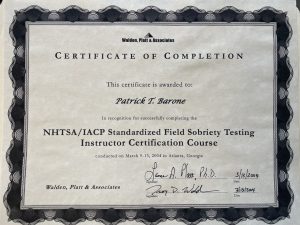 The attorneys at the Barone Defense Firm approach field sobriety test evidence with a depth of technical knowledge that is unusual and unsurpassed even among experienced OWI defense lawyers. Patrick Barone completed the IACP/NHTSA standardized field sobriety test participant course, which involves three days of intensive instruction including hands-on practice administering all three tests on other students under faculty evaluation, followed by the five-day instructor course, which adds a teaching component evaluated by course faculty.
That instructor evaluation requires demonstrating mastery not just of how to take the tests but of how to teach them, meaning every protocol step, every clue, and every common administration error. He has been judicially qualified as an SFST court expert, a designation believed to be unique among Michigan attorneys, earned in a specific case where a court evaluated his credentials and found them sufficient to qualify him to testify as an expert on administration and scoring.
Ryan Ramsayer and Michael Boyle each hold NHTSA participant certification in standardized field sobriety tests. Michael Boyle has been involved through the Michigan Association of OWI Attorneys in teaching this material to other defense lawyers. Ryan Ramsayer pairs that certification with a detailed FOIA practice that produces the complete investigative and laboratory file in every case, regularly exceeding 450 pages of material, and has found procedural errors and omissions in the state toxicology laboratory’s work that would not be visible to an attorney without his level of preparation.
When the firm reviews a dashcam video and the officer’s report in a client’s case, it is applying an instructor-level and laboratory-level standard to every clue the officer claimed to observe. In its experience, officer administration errors are the rule rather than the exception, and Michigan’s substantial compliance requirement under MCL 257.62a now provides the statutory foundation for turning those errors into admissibility arguments rather than merely weight arguments.
Officers are also trained under the NHTSA curriculum not to use pass or fail language when testifying about field sobriety test results. They are taught to describe clues observed, not outcomes reached. When an officer tells a jury that a defendant failed the field sobriety tests, that officer is using language their own training manual prohibits, and a cross-examiner who recognizes that fact can use it to significant effect.
Should I Refuse the Field Sobriety Tests in Michigan? The Honest Analysis
In most cases, the decision to refuse field sobriety tests is likely the better strategic choice. The reason to refuse is not that refusal is risk-free. It is that the tests are designed to generate clues, that officers frequently administer them improperly, and that the evidence produced by a flawed test does not accurately reflect impairment but is difficult to challenge once it is in the record.
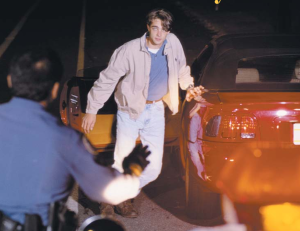 If the tests would have been done wrong, submitting to them produces evidence that is both unreliable and present. Refusing means the prosecution has no test results to rely on and must establish probable cause through the officer’s other observations alone. That is a weaker arrest record and a more vulnerable one. An attorney arguing that the officer lacked probable cause without field sobriety test results has a cleaner case than one trying to challenge results that are already documented.
The consciousness of guilt risk is real but manageable. A defense attorney can argue in closing that there are many legitimate reasons to decline a subjective test under stressful conditions, that the error rate for the one leg stand is as high as 35 percent in testing conducted on sober subjects, and that a person who knows these facts has every rational reason to decline.
That argument does not require admitting guilt. It requires only that the jury understand what the tests actually measure and how reliably they measure it. A related defense approach, which pairs the refusal decision with the absence of a chemical test result or a result that does not match the officer’s impairment observations, is the disconnect defense.
What Happens to the Arrest If I Refuse Field Sobriety Tests?
Refusing field sobriety tests does not prevent an arrest. The officer can arrest you based on all other observations: the reason for the stop, the odor of alcohol, your speech, your balance while standing at the car, and the preliminary breath test result if one was given. Under People v Russo, 439 Mich 584 (1992), probable cause requires only a substantial basis for inferring a fair probability that a crime was committed. That is a low threshold and one that can be met without field sobriety test results.
What refusal does is remove the officer’s most detailed and documented evidence of impairment from the probable cause calculation. The officer’s report will note the refusal. In a search warrant affidavit for a blood draw, that refusal can be included in the totality of the circumstances. The arrest is still likely.
But the case going forward is built on a thinner evidentiary foundation, and a thinner foundation is a more vulnerable one. The decision to refuse field sobriety tests therefore shifts the evidentiary burden in a meaningful way.
The decision about whether to also refuse the Michigan breath test refusal involves a separate legal analysis with different consequences.
Frequently Asked Questions About Refusing Field Sobriety Tests in Michigan
Is it legal to refuse field sobriety tests in Michigan?
Yes. Field sobriety tests are voluntary in Michigan. There is no implied consent law covering them, no license sanction for refusing them, and no civil infraction. The refusal is legal and carries no direct administrative penalty.
Can the prosecutor tell the jury I refused the field sobriety tests?
Michigan’s statutory protection in MCL 257.625a(9) applies only to chemical test refusal. It does not protect FST refusal by its plain terms, and Michigan courts have not extended it to do so. Prosecutors may argue that the refusal supports an inference of consciousness of guilt. A prepared defense attorney can counter that argument, but it is a risk the client should understand before making the decision.
What is the difference between refusing the PBT and refusing the field sobriety tests?
Refusing the roadside preliminary breath test is a civil infraction carrying a fine of $100 to $200. Refusing the standardized field sobriety tests carries no penalty at all. These are governed by different legal provisions and produce different consequences. The evidentiary breath test at the police station after arrest is governed by the implied consent law and carries a one-year license suspension for refusal.
Can a police officer force me to perform field sobriety tests?
No. You have the right to refuse field sobriety tests in Michigan and no officer can lawfully compel you to perform them. You may decline politely. Your refusal does not authorize the officer to use force or to escalate the stop in a way that would otherwise not be justified.
If I refused and was arrested anyway, does that help my case?
Potentially yes, depending on the other evidence. Without field sobriety test results, the prosecution’s probable cause foundation rests entirely on the officer’s other observations. If those observations are limited, a challenge to the lawfulness of the arrest becomes more viable. A successful suppression motion can result in dismissal of the charges entirely. The Barone Defense Firm evaluates every refusal case for this specific vulnerability from the first consultation.
What should I do if I have already refused or performed the tests?
Contact an experienced Michigan OWI attorney immediately. The 14-day implied consent hearing deadline may already be running if you also refused the evidentiary breath test. Evidence must be preserved before it is purged.
The field sobriety test decision is not simply a matter of knowing your rights. It is a strategic calculation that depends on the facts of the stop, the strength of the officer’s other observations, and the litigation leverage that comes from a weaker arrest record.
The Barone Defense Firm has litigated these questions in Michigan courts for more than 30 years, holds the only SFST instructor certification ever judicially recognized in Michigan as an expert qualification, and applies that standard to every case involving these tests. Call 1-877-ALL-MICH (877-255-6424) for a free, confidential consultation available 24 hours a day.
About the Author
Patrick Barone is the founding attorney of the Barone Defense Firm and is believed to be the only attorney in Michigan ever to have been judicially qualified as an SFST court expert, a designation earned in a specific case where the court evaluated his credentials and found them sufficient to qualify him to testify as an expert on the administration and scoring of standardized field sobriety tests.
Barone completed the IACP/NHTSA standardized field sobriety test participant course and the five-day instructor course, which required demonstrating mastery of the NHTSA standards at the level of teaching them to others under faculty evaluation. His undergraduate training in biology and pre-medical sciences informs his analysis of the horizontal gaze nystagmus test at a physiological level that goes beyond what officer training covers. He is the author of the July 2005 Michigan Bar Journal article on standardized field sobriety testing, covering the NHTSA validation research, the three-test battery, and what proper administration requires.
Barone has more than 130 publications in legal and professional journals and is the author of five books including Defending Drinking Drivers, a national DUI defense treatise published by James Publishing. He is a graduate of the Gerry Spence Trial Lawyers College and has been named a Michigan Super Lawyer continuously since 2007 and is recognized by Best Lawyers in America, and has been selected as a Leading Lawyer in Michigan.