Search
 Michigan Criminal Defense Lawyer Blog
What Happens at a Michigan Implied Consent Hearing?


A Michigan implied consent hearing is an administrative proceeding before a Secretary of State administrative law judge, entirely separate from and independent of the criminal OWI case. The officer who made the arrest must appear and prove four specific elements under the civil preponderance standard, not the beyond-a-reasonable-doubt standard that applies in criminal court. If the officer fails to appear, or establish any one of those four elements, the license suspension is dismissed entirely, as if the refusal never happened.
What Is a Michigan Implied Consent Hearing and Why Does It Exist?
 Michigan’s implied consent law rests on a legal fiction: by accepting a Michigan driver’s license, a person is deemed to have consented in advance to a chemical test if lawfully arrested for OWI. But that fictional consent cannot operate as a legitimate exception to the Fourth Amendment’s warrant requirement until it comes into actual existence. It does so only when the officer reads the prescribed chemical test rights advisement following a lawful arrest, and the driver is given a genuine opportunity to either reaffirm that consent by submitting to the test or withdraw it by refusing. Until that advisement is given, there is no actual consent, only the legal fiction of it, and a fiction alone cannot satisfy the Fourth Amendment.
Because the advisement is the mechanism that converts the legal fiction into a Fourth Amendment-cognizable consent, Michigan law requires that it be read verbatim from the prescribed form. An officer who paraphrases, omits a required element, or misstates the consequences has not produced the actual consent the Fourth Amendment requires as an exception to the warrant requirement. Element three of the four required elements at the hearing is whether the driver was properly advised of the chemical test rights under MCL 257.625a(6).
A defective or incomplete advisement is a direct failure of that element, and the hearing is dismissed on that basis regardless of everything else the officer established. In People v Hyde, 285 Mich App 428 (2009), the Michigan Court of Appeals held that an officer who misstated the implied consent advisement for a diabetic driver undermined the voluntariness of any resulting compliance, and rejected inevitable discovery as a substitute for obtaining a warrant.
When a driver refuses, the officer issues a DI-93 form and reports the refusal to the Secretary of State. The driver then has exactly 14 days from the date of arrest to submit a written request for hearing. Filing that request tolls the suspension until after the hearing concludes. A driver who fails to request the hearing within 14 days loses their license for one year automatically, with no further opportunity to contest it. A second refusal within seven years results in a two-year suspension with no hearing available and no hardship appeal.
A driver who fails to request the hearing within 14 days loses their license for one year automatically, with no further opportunity to contest it. A second refusal within seven years results in a two-year suspension with no hearing available and no hardship appeal. The distinction between refusing the roadside PBT and refusing the evidentiary breath test carries significantly different consequences under Michigan’s breathalyzer refusal and implied consent law
What Are the Four Elements the Officer Must Prove — and Why Are They Not a Rubber Stamp?
Most drivers who refused a breath test assume the implied consent hearing is a procedural formality, a brief administrative step before a predetermined outcome. It is not. The officer appears without a prosecuting attorney, must prove four distinct elements under a preponderance standard, and sometimes fails on one or more of them.
The four elements under MCL 257.625f(4)(a)-(d) are:
- whether the officer had reasonable grounds to believe the driver was operating a vehicle while intoxicated;
- whether the driver was placed under lawful arrest for an OWI-related offense;
- whether the officer properly advised the driver of the chemical test rights required by MCL 257.625a(6); and
- whether the driver’s refusal was unreasonable.
Because this is a civil administrative proceeding, the standard is preponderance of the evidence. The officer must show only that each element is more likely than not satisfied. That low threshold makes the hearing sound easy to lose. But the absence of a prosecuting attorney to guide the officer’s testimony, combined with the specificity of what must be proven on each element, creates genuine and recurring opportunities for a prepared defense to prevail.
How Do the Lawfulness of the Stop and the Validity of the Arrest Affect the Four Elements?
Element two of the four required elements, whether the driver was placed under lawful arrest for an OWI-related offense, is treated at implied consent hearings as requiring only a perfunctory showing. The officer must establish that an arrest occurred for one of the enumerated offenses under MCL 257.625c(1), and hearing officers routinely find that element satisfied with minimal testimony.
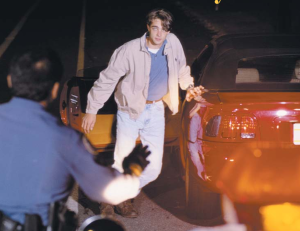 The real defense work concentrates on elements one and three. If the stop lacked reasonable suspicion, the case is constitutionally infirm: the officer cannot establish the reasonable grounds required for element one, and the hearing is dismissed on that basis. But even where the stop was lawful, the validity of the arrest is encapsulated in elements one and three together, and this is where thorough cross-examination bears the most fruit.
All three phases of the standardized field sobriety test investigation are fair game. The horizontal gaze nystagmus test, the walk and turn, and the one leg stand are governed by specific NHTSA administration and scoring protocols that officers are trained on and required to substantially comply with. Showing that an officer failed to substantially comply with those protocols in administering or evaluating any of the three tests whittles away at the most significant evidence being used to establish element one. It also bears directly on element three: if the officer’s own investigation was procedurally deficient, the driver’s refusal to submit to a chemical test on the basis of that investigation becomes more defensible, not less.
An attorney who understands SFST validation research and administration standards at the level of the original NHTSA studies, and who knows precisely what substantial compliance requires for each test, is an attorney who can cross-examine the officer’s field sobriety testimony in a way that simultaneously undermines both elements. Understanding what standardized field sobriety tests require of the administering officer, and the specific ways in which field sobriety test protocol violations compromise the reliability of the officer’s observations, is the foundation of that cross-examination.
What Changed About Michigan Implied Consent Hearings and What Wins Them Now?
For many years, the most reliable path to winning an implied consent hearing was the failure of the arresting officer to appear. That path is now largely closed. Implied consent hearings are now conducted almost universally by video through Microsoft Teams. Officers appear in virtually every case, and the default win from non-appearance is rarely available.
What wins these hearings today is something fundamentally different: careful preparation, careful listening, and disciplined restraint. The hearing officer at a Michigan implied consent hearing is not a neutral umpire in the conventional sense. Under Mich. Admin. Code R. 257.310, the hearing officer has an affirmative duty to assist unrepresented parties, and the police officer is an unrepresented party.
If the hearing officer recognizes that the officer has failed to address one of the four required elements, the hearing officer may ask clarifying questions to elicit the missing testimony. Aggressive cross-examination that signals to the hearing officer what the officer has missed can prompt exactly that intervention, effectively handing the officer a chance to repair a failure that would otherwise result in dismissal.
The correct strategy at most implied consent hearings is restraint. Listen carefully to the officer’s testimony. Identify the gap. Let the officer fail on their own. An officer who testifies that a driver was stopped for speeding but cannot state what the applicable speed limit was has failed to establish the lawfulness of the stop, and that failure goes to element one. Pointing that gap out through aggressive cross-examination before the officer has finished testifying is the surest way to give the hearing officer an opportunity to repair it.
 There is one more reason to conduct an implied consent hearing that many attorneys overlook. Even where a driver’s license is already revoked and the administrative outcome is relatively meaningless, the hearing still produces sworn officer testimony before the criminal case goes to trial. That testimony, obtained under oath, functions as a deposition. Inconsistencies between what the officer says at the hearing and what they later testify to at trial become impeachment material. The Barone Defense Firm conducts implied consent hearings in these circumstances for exactly that reason, while many attorneys skip them as pointless.
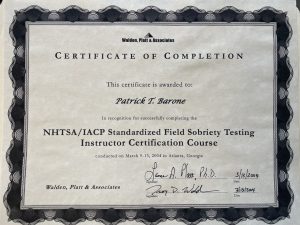
Patrick Barone has litigated implied consent hearings before the Michigan Secretary of State for more than 30 years and has argued administrative appeals before Circuit Courts throughout Michigan. He is the author of Chapter 8, Administrative Hearings, in Defending Drinking Drivers, the nationally recognized DUI defense treatise used by other Michigan defense attorneys to learn how to handle these matters. His IACP/NHTSA-certified SFST instructor credential, and his standing as the only attorney in Michigan ever judicially qualified as an SFST court expert, mean he approaches cross-examination of the officer’s field sobriety test observations with a depth of technical knowledge most defense attorneys cannot match.
What Happens Procedurally at a Michigan Implied Consent Hearing?
The hearing is conducted by a hearing officer employed by the Michigan Secretary of State, not an elected judge. The hearing officer’s proper title is Hearing Officer, not Your Honor. Hearings are now conducted almost universally by video through Microsoft Teams, with the hearing officer typically appearing remotely from the Secretary of State’s administrative offices in Lansing or Livonia.
The hearing begins with the hearing officer activating the recording and calling the case. All parties identify themselves for the record, and the defense attorney places an appearance. The hearing officer then invites opening statements, which may be given or waived. The arresting officer is sworn and testifies about the stop, the investigation, the advisement, and the refusal. The defense attorney cross-examines the officer after the initial testimony concludes.
The strict rules of evidence that apply in criminal court do not govern implied consent hearings. Hearsay is admissible. The hearing officer may call witnesses and question any witness directly. Under Mich. Admin. Code R. 257.310, the hearing officer also has an affirmative duty to assist unrepresented parties, which as a practical matter includes the police officer appearing without a prosecutor. After all witnesses have testified and closing arguments have been made, the hearing officer issues a decision either sustaining or dismissing the suspension.
Does Winning the Implied Consent Hearing Help the Criminal OWI Case?
The implied consent hearing and the criminal OWI case are formally independent proceedings under Michigan law. A driver can win the hearing and still be convicted of OWI in criminal court. A driver can be acquitted of OWI in criminal court and still lose the hearing and face a one-year license suspension. The outcomes do not bind each other, and the results of the chemical test are not relevant at the hearing.
But the hearing affects the criminal case in a significant indirect way. The officer’s sworn testimony at the hearing is a record. If the officer testifies at the hearing that the driver’s balance was steady and speech was clear, and then testifies at trial that the driver was visibly impaired, the hearing transcript becomes the foundation for cross-examination on that inconsistency. A hearing that is lost on the merits can still produce testimony that materially shifts the balance in the criminal case.
Frequently Asked Questions About the Michigan Implied Consent Hearing
Is the burden of proof the same as in a criminal OWI case?
No. A Michigan implied consent hearing is a civil administrative proceeding, not a criminal case. The officer must prove the four required elements by a preponderance of the evidence, meaning more likely than not. The beyond-a-reasonable-doubt standard that applies in a criminal OWI trial does not apply here.
Can I win the hearing even if I was intoxicated at the time of arrest?
Yes. Whether you were actually intoxicated is not one of the four elements at the hearing. The hearing officer’s only task is to determine whether the four statutory elements under MCL 257.625f are satisfied. If the officer fails to prove any one of them, the suspension is dismissed regardless of what the chemical test result would have shown.
What if the officer does not appear at the hearing?
If the officer fails to appear, the driver wins by default and the suspension is dismissed. Officer non-appearance was once a relatively frequent occurrence at these hearings. The shift to Microsoft Teams video hearings has made it rare. It still happens, but it cannot be relied upon as a strategy.
What happens if I lose the implied consent hearing?
A first-refusal suspension of one year takes effect. The driver may petition the Circuit Court for a hardship appeal, seeking restricted driving privileges. A direct challenge to the hearing officer’s decision on the merits, arguing that one or more factual findings were erroneous, can also be pursued in Circuit Court and is a separate avenue from the hardship appeal.
Is a hearing available for a second refusal within seven years?
No. A second refusal within seven years results in a two-year hard suspension with no hearing available and no hardship appeal. The 14-day request window and the hearing itself apply only to first refusals. This is one of the most consequential distinctions in Michigan’s implied consent framework, and it makes the stakes of the first refusal hearing significantly higher.
How soon should I contact an attorney after refusing a chemical test?
Immediately. The 14-day deadline to request the hearing runs from the date of arrest, not from the date you retain counsel. Missing that deadline makes the one-year suspension automatic and virtually impossible to undo. The Barone Defense Firm is available 24 hours a day at 1-877-ALL-MICH (877-255-6424) for a free, confidential consultation.
A Michigan implied consent hearing is not a formality. It is a proceeding with four specific elements, a specific burden of proof, and specific points of failure that a prepared attorney can identify and develop. The 14-day deadline to request that hearing is already running from the date of your arrest. The Barone Defense Firm is available 24 hours a day at 1-877-ALL-MICH (877-255-6424) for a free, confidential consultation.
About the Author
Patrick Barone is the founding attorney of the Barone Defense Firm and the author of Chapter 8, Administrative Hearings, in Defending Drinking Drivers, the nationally recognized DUI defense treatise published by James Publishing that other Michigan defense attorneys use to learn how to handle these matters. He has represented Michigan drivers at implied consent hearings before the Secretary of State for more than 30 years and has argued administrative appeals before Circuit Courts throughout Michigan.
He is an IACP/NHTSA-certified standardized field sobriety test instructor and practitioner and is believed to be the only attorney in Michigan ever to have been judicially qualified as an SFST court expert, a credential directly relevant to the cross-examination of officer field sobriety test observations at the hearing stage. He is a graduate of the Gerry Spence Trial Lawyers College and has published more than 130 articles in peer-reviewed legal and professional journals. He has been named a Michigan Super Lawyer continuously since 2007 and is recognized by Best Lawyers in America.