Search
 Michigan Criminal Defense Lawyer Blog
Should I Refuse the Breath Test If Stopped for DUI in Michigan?


A Michigan breath test refusal is not a single decision. It is two separate questions with two separate answers, because Michigan law treats the roadside preliminary breath test and the evidentiary breath test at the police station as fundamentally different instruments governed by different statutes with different consequences for refusal. Understanding that distinction is the most important thing a Michigan driver can know before they are ever put in the position of having to decide.
What Is the Difference Between the PBT and the Evidentiary Breath Test in a Michigan DUI?
Michigan law recognizes two categories of breath test in a DUI investigation. The first is the preliminary breath test, or PBT, a small handheld device an officer asks you to blow into at the roadside before any arrest has been made. The second is the evidentiary breath test, administered on the Intoxilyzer 9000 at the police station after you have been placed under arrest.
These two tests are governed by different provisions of the Michigan Vehicle Code, with MCL 257.625a specifically governing the consequences for refusing the evidentiary test, and they carry entirely different consequences for refusal.
The PBT result is not admissible as evidence in a Michigan OWI trial. Its purpose is to give the officer probable cause to make an arrest. That is an important distinction, as a PBT result can legally justify an arrest under Michigan law even if no other evidence of impairment exists. The evidentiary breath test result, by contrast, is admissible as evidence and becomes the centerpiece of the prosecution’s case if a result above the legal limit is obtained.
Michigan Breath Test Refusal: Should I Refuse the Roadside PBT?
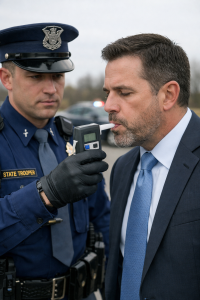 Yes, in nearly every case, refusing the roadside PBT is the strategically correct decision, and most people do not know this. Refusing the PBT is a civil infraction only: a fine of $100 to $200, no points added to the driving record, and no driver’s license sanction of any kind. The result never appears in court as evidence against you. The officer may still arrest you without it, but refusing places the defense in a stronger position to argue the arrest was not supported by probable cause, because Michigan law allows a PBT result alone to serve as the basis for a valid arrest. Remove the PBT result from the equation and that probable cause foundation weakens considerably.
There is one additional consequence of refusing the PBT that cuts in the defense’s favor. An officer who wishes to obtain a blood draw by warrant must establish probable cause. Where the officer has no PBT result to rely on, the warrant application is more difficult to support. That is not a guarantee, but it is a meaningful tactical advantage that costs the driver nothing in terms of license sanctions or criminal exposure.
What Happens If I Refuse the Evidentiary Breath Test at the Police Station?
When it comes to Michigan breath test refusal, the evidentiary test is an entirely different matter from the PBT. Under Michigan’s implied consent law (MCL 257.625a), by accepting a Michigan driver’s license you have legally consented to submit to a breath, blood, or urine test upon a lawful arrest for suspected OWI. Refusing this test after arrest, specifically the Intoxilyzer 9000 test at the police station, triggers a separate set of civil penalties under MCL 257.625c that are independent of any criminal OWI charge.
A first refusal results in a one-year driver’s license suspension and six points added to the driving record. The driver has 14 days from the date of arrest to request a hearing at the Secretary of State to contest the suspension, and filing that request tolls the sanction until after the hearing concludes.
A driver who requests a hearing and prevails avoids the suspension entirely. A driver who loses the hearing, or who fails to request one within 14 days, faces the full one-year suspension. A second refusal within seven years results in a two-year suspension with no hearing available and no opportunity for a hardship appeal.
These consequences are imposed independently of the criminal OWI case, meaning a person can be found not guilty of OWI and still lose their license because they refused the evidentiary test. Michigan’s breathalyzer refusal and implied consent framework operates as an entirely separate civil proceeding.
The refusal generates a Form DI-93, as opposed to the Form DI-177 that is issued when a driver submits to the test. That form triggers the implied consent proceedings. The driver has exactly 14 days from the date of arrest to request a hearing at the Secretary of State to contest the suspension. If no hearing is requested within 14 days, the suspension is automatic and virtually impossible to undo.
Will a Michigan Breath Test Refusal Actually Help My DUI Case?
In almost every case, the answer is no, and this is the fact that surprises most people who believe refusing the evidentiary test is a smart strategy. In Michigan, when a driver refuses the evidentiary breath test, police will in nearly every case obtain a warrant and conduct a forced blood draw. Blood testing is generally more accurate and more difficult to challenge than breath testing, though the science of breath and blood test admissibility establishes that neither result is beyond challenge.
The driver who refuses the evidentiary test and forces a blood draw has not avoided being tested, and has traded a potentially challengeable breath test result for a harder-to-challenge blood test result, while simultaneously incurring a one-year license suspension.
There is a narrow scenario in which the timing delay created by refusal and the subsequent warrant process could theoretically benefit a defendant, specifically where the driver’s BAC was rising at the time of the stop and would have been lower at the moment of driving than it will be by the time the blood draw occurs.
But this argument runs directly into the prosecution’s ability to introduce retrograde extrapolation evidence: the use of expert testimony to calculate backwards from the later test result to estimate the BAC at the time of driving. Michigan’s standard jury instruction provides that the jury may presume the BAC at the time of testing was the same as at the time of driving, but the prosecution can and does rebut that presumption with expert witnesses.
The narrow exception to the general rule is this: a driver whose license is already revoked and who faces little realistic prospect of restoration for many years, and who does not object to the blood draw itself, may rationally calculate that the delay is worth attempting. But even then, the retrograde extrapolation problem remains, and the decision should only be made after speaking with an experienced Michigan OWI attorney.
The Barone Defense Firm has represented clients at implied consent hearings before the Michigan Secretary of State for more than three decades. Patrick Barone understands not only the legal framework that governs these hearings but the four specific elements the officer must prove, and the points of failure in each, because he has litigated them hundreds of times.
His manufacturer-equivalent certification on Michigan’s prior evidentiary breath testing instruments means he also evaluates the Intoxilyzer 9000 result in every case not as a number to be accepted but as a scientific output to be interrogated. The decision of whether to submit to the evidentiary test is one that ideally should be made after a brief phone call to a defense attorney, and the 14-day window to request an implied consent hearing begins the moment of arrest, not the moment a lawyer is retained. The Barone Defense Firm is available 24 hours a day precisely because these decisions cannot wait.
How Can You Win a Michigan Implied Consent Hearing After a Breath Test Refusal?

At an implied consent hearing, the officer who made the arrest has the burden of proving four elements: that the officer had reasonable grounds to believe the driver was operating a vehicle while intoxicated, that the driver was placed under lawful arrest for an OWI offense, that the driver was properly advised of the chemical test rights under Michigan law, and that the driver unreasonably refused to submit to the chemical test. The driver wins if the officer fails to prove any one of the four.
The most commonly successful challenges involve the lawfulness of the arrest, whether the underlying stop was constitutionally valid, and the adequacy of the chemical test advisement. Officers who do not appear at the hearing result in an automatic win for the driver. An experienced attorney who knows what to examine in the arrest documentation and how to cross-examine the officer on each element gives a driver the best realistic chance of prevailing.
Frequently Asked Questions About Michigan Breath Test Refusal
Is the roadside PBT the same as the evidentiary breath test?
No. The PBT is a handheld device used at the roadside before arrest to help establish probable cause. Its result is not admissible as evidence in a Michigan OWI trial. The evidentiary breath test is administered on the Intoxilyzer 9000 at the police station after arrest and its result is admissible in court. These two tests are governed by different statutes with different consequences for refusal.
What happens to my license if I refuse the roadside PBT?
A PBT refusal is a civil infraction only. There is no license suspension, no points, and no criminal charge. The fine is $100 to $200. The result of the refusal does not appear in any court proceeding related to the OWI charge.
What happens to my license if I refuse the evidentiary breath test?
A first refusal of the evidentiary test triggers a one-year driver’s license suspension and six points added to the driving record under Michigan’s implied consent law. These penalties are imposed by the Secretary of State independently of the criminal OWI case. You have 14 days from the date of arrest to request a hearing to contest the suspension.
If I refuse the evidentiary breath test, can the police still get my blood?
Yes, in nearly every case. When a driver refuses the evidentiary test, police will apply for a warrant and conduct a forced blood draw. Blood test results are generally more accurate and more difficult to challenge than breath test results. Refusal does not prevent testing; it typically results in a harder-to-challenge test and a one-year license suspension.
I already refused. What should I do now?
Contact an experienced Michigan OWI attorney immediately. The 14-day deadline to request an implied consent hearing is already running from the date of your arrest. Missing that deadline means the one-year suspension is automatic and virtually impossible to undo. The breath test decision in a Michigan DUI investigation is one of the most consequential choices a driver will make, and it needs to be the right decision for the right test.
After a Michigan breath test refusal, the 14-day implied consent deadline does not pause while you decide whether to call. The Barone Defense Firm is available 24 hours a day at 1-877-ALL-MICH (877-255-6424) for a free, confidential consultation, because in implied consent cases the clock is already running.
About the Author
Patrick Barone is the founding attorney of the Barone Defense Firm and has represented Michigan drivers at implied consent hearings before the Secretary of State for more than 30 years. His manufacturer-equivalent certification on Michigan’s evidentiary breath testing instruments, including co-authorship of the February 2026 Michigan Bar Journal article on the Intoxilyzer 9000 transition, gives him the scientific foundation to challenge breath test evidence at a depth most defense attorneys cannot approach.
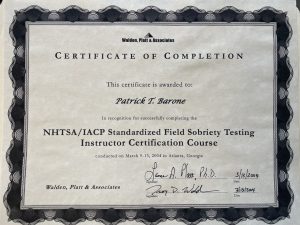 Barone is an IACP/NHTSA-certified standardized field sobriety test instructor and practitioner and is believed to be the only attorney in Michigan ever to have been judicially qualified as an SFST court expert. He is the author of five books including Defending Drinking Drivers, a national DUI defense treatise published by James Publishing, and has published more than 130 articles in peer-reviewed legal journals.
He has been named a Michigan Super Lawyer continuously since 2007 and is recognized by Best Lawyers in America. He holds board certification at the highest level in psychodrama, sociometry, and group psychotherapy through the American Board of Examiners, a credential held by no other attorney in Michigan.