Search
 Michigan Criminal Defense Lawyer Blog
Is It Worth Hiring a DUI Attorney If My Case Looks Really Bad in Michigan?


Yes, hiring an experienced Michigan DUI attorney is worth it even when your case looks bad, and in many respects it is worth it most when your case looks bad. A breath test result above the legal limit, a high BAC reading, a prior record, or the involvement of an accident does not make a case unwinnable. It makes a case more complex, and complexity is where the gap between a trained specialist and a general practitioner is widest. The Barone Defense Firm never assumes a breath test result is reliable or even admissible. Every case begins with a complete investigation of the evidence, regardless of how it first appears.
 What Does a Bad Case Michigan DUI Actually Look Like to a Defense Attorney?
A case that looks bad to a defendant, and sometimes to a general practitioner, often looks very different to an attorney with deep scientific training and years of experience examining the specific evidence that Michigan OWI prosecutions depend on. The charging document describes what the officer observed and what the instruments reported.
It does not describe whether the officer followed the required protocols, whether the instrument was functioning within acceptable parameters, or whether the scientific assumptions underlying the test result are actually valid in this defendant’s case.
The three categories of evidence most commonly presented in a seemingly difficult Michigan DUI case are a breath test result at or above the legal limit, field sobriety test observations, and the officer’s narrative of the arrest.
Each requires a different type of scientific and legal knowledge to evaluate properly, which is why experienced Michigan OWI defense counsel approaches each element of the prosecution’s case as a distinct challenge to be investigated and attacked on its own terms. That investigation is where the Michigan OWI defense process either finds its footing or loses it.
What Makes a Bad Case Michigan DUI Winnable? What Police Get Wrong
One of the most consistent findings in the Barone Defense Firm’s case investigations is that police officers do not follow their own rules. This is not a provocative claim, it is a documented pattern that emerges in case after case when the records are examined by someone who knows what to look for.
Michigan’s Intoxilyzer 9000, the current evidentiary breath testing instrument, requires certified operators. Certification is not a one-time event. Officers must complete a two-year refresher training to maintain their certification. The Barone Defense Firm has found, with striking regularity, that officers who administered the breath test in a client’s case had allowed their refresher training to lapse. An operator who is not currently certified cannot lawfully administer the test.
A breath test result produced by an uncertified operator is potentially inadmissible, regardless of the number it shows. The standard to which breath test operators must be held in Michigan has been the subject of published analysis in the criminal defense literature, and the argument for strict compliance with operator certification requirements is well established.
The instrument itself is also not uniform across jurisdictions. The historical maintenance and calibration records for Intoxilyzer 9000 units vary considerably from one machine to another. Some instruments show clean, consistent calibration histories. Others show repeated error codes, status anomalies, and calibration failures that raise serious questions about the reliability of results produced by that specific unit. Most attorneys never look at the instrument’s historical records.
The Barone Defense Firm always does. A complete explanation of how breath test evidence is obtained, what the forms and records mean, and how that evidence can be challenged is available on our dedicated page covering DUI chemical testing in Michigan.
The field sobriety tests present a parallel problem. The standardized field sobriety tests, the walk and turn, the one leg stand, and the horizontal gaze nystagmus test, are governed by specific NHTSA protocols for administration and scoring. Deviation from those protocols invalidates the scientific basis for the test result. The officer’s subjective assessment of whether the defendant passed or failed means nothing if the test was not administered according to the published standard.
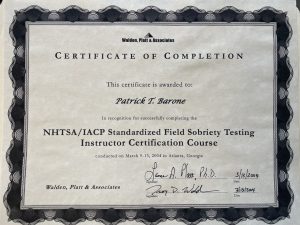 An attorney who has been certified as an SFST instructor, not merely a practitioner, but an instructor, reads the video and the report very differently than one who has only read about the tests in a textbook, and understands precisely when refusing the field sobriety tests would have been the legally sound choice.
Patrick Barone’s undergraduate training in biology on a pre-medical track was not incidental to his career as an OWI defense attorney, it is foundational to it. The pharmacokinetics and pharmacodynamics of alcohol, the physiology of breath alcohol measurement, the chemistry of blood testing, and the physics of infrared spectroscopy are not abstract subjects to him. They are the scientific disciplines he applies every time he reviews a breath or blood test result in a client’s case.
Most attorneys approach chemical test evidence as a legal document to be challenged on procedural grounds. Patrick approaches it as a scientist who understands why the instrument produced the number it did, whether the physiology of this particular defendant makes that number meaningful, and where the evidentiary gaps are.
Partner and senior trial attorney Michael Boyle brings the same scientific orientation to blood test cases specifically, he is a certified NHTSA/IACP SFST practitioner, trained in Drug Recognition Evaluation protocols, and has taught other Michigan defense attorneys how to challenge forensic blood testing evidence through the Michigan Association of OWI Attorneys, which he helped found.
Lead litigating attorney Ryan Ramsayer authored the chapter on traffic offenses and OWI in Michigan Criminal Law and Procedure with Forms, the LexisNexis practice guide used by attorneys and judges across the state. When a case looks bad at first glance, the Barone Defense Firm brings three attorneys whose combined training in the science and law of OWI evidence is unmatched in Michigan, and that depth of preparation is what turns a seemingly difficult case into a defensible one.
What If the BAC Was Very High? Understanding the Disconnect Defense in a Bad Case Michigan DUI
A high BAC reading is often the specific fact that makes a defendant feel their case is hopeless. A result of 0.17 or above triggers Michigan’s Super Drunk enhancement. A result of 0.20 or higher seems, on its face, to be conclusive evidence of serious intoxication. The prosecutors and many judges treat it that way. But the scientific reality is more nuanced, and that nuance is where the defense can find meaningful ground.
T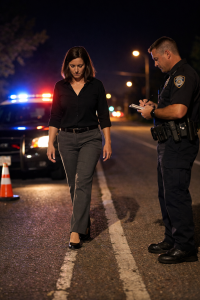 he disconnect defense applies when there is a significant inconsistency between a defendant’s reported BAC and their observable behavior at the time of the arrest. If a breath or blood test reports a BAC of 0.20, a level associated in the scientific literature with symptoms including emotional instability, impaired motor coordination, and slurred speech, but the officer’s own dashcam video shows the defendant speaking clearly, walking steadily, and performing field sobriety tests without significant errors, something does not add up.
That inconsistency is not explained by attorney argument. It is explained by science. Additionally, field sobriety tests are not reliable predictors of intoxication, even when a person performs poorly on them.
Prosecutors and judges frequently respond to the disconnect argument by invoking alcohol tolerance, the idea that a person who drinks heavily develops a higher threshold for observable impairment at any given BAC level. This is not an accurate description of how tolerance works. Tolerance affects the outward behavioral signs of intoxication at a pharmacokinetic level, that is, the rate at which the body processes alcohol.
It does not reduce the pharmacodynamic impact of alcohol on the brain and nervous system at a given BAC concentration. Published peer-reviewed research establishes that at the same BAC level, heavy and light drinkers perform equivalently on the complex psychomotor tasks that field sobriety tests are specifically designed to measure.
Arguing that a defendant’s apparent sobriety at 0.20 is explained by tolerance is a claim about pharmacology that is, in most contexts, simply wrong, and may constitute misconduct on the part of a prosecutor who makes it without evidentiary support. Patrick Barone examined the ethical dimensions of this argument in a 2017 article in the SADO Criminal Defense Newsletter, “May a Prosecutor Ethically Imply to a Jury that a Drinking Driver Has Tolerance to Alcohol?” (Vol. 40), concluding that such an argument, unsupported by evidence in the record, crosses an ethical line.
Here is a fact that surprises many people who call us after a high-BAC arrest: a very high reported result can in some respects make a case easier to defend, not harder. The higher the number, the more the prosecution’s entire case depends on the accuracy and reliability of the testing process. A result of 0.09 is close enough to the limit that the officer’s observations and the defendant’s behavior carry most of the evidentiary weight.
A result of 0.22 places enormous scientific demands on the prosecution, the instrument must have been properly calibrated, the operator must have been certified, the observation period must have been properly conducted, and the result must be physiologically plausible given everything else the officer documented. When any one of those requirements is not met, the highest-seeming evidence in the case becomes its most vulnerable point.
What If This Is a Repeat Offense or There Was an Accident?
Aggravating factors, a prior conviction, a high BAC, property damage, or an accident, make the stakes higher. They also make the quality of legal representation more consequential, not less. A defendant facing a second-offense misdemeanor with a five-day mandatory minimum, or a third-offense DUI felony under Heidi’s Law, has more to lose from inadequate representation than a defendant facing a first-offense 93-day DUI misdemeanor. The complexity of the case increases the value of an attorney who knows how to investigate it properly.
In cases involving accidents, additional evidence is generated that a trained defense attorney can use as well as challenge. Accident reconstruction evidence, medical records documenting injuries, witness accounts, and physical evidence from the scene all require evaluation. Dashcam and bodycam footage from the response is particularly important and must be preserved immediately. Evidence that appears to strengthen the prosecution’s case often contains inconsistencies that are only visible to an attorney who knows what to look for, and who looks before the evidence is purged.
In repeat-offense cases, the most important work is often sentencing mitigation rather than case dismissal. Even where the legal defense does not result in a reduction of the charge, an attorney who builds a thorough and credible mitigation record from the first day of representation can produce outcomes, alternative sentencing, treatment court, restricted driving privileges, that a defendant without counsel would never have known were available.
What Can a Michigan DUI Attorney Actually Accomplish in a Bad Case?
The outcomes a skilled Michigan OWI attorney can pursue even in a difficult case range from outright dismissal to meaningful mitigation of consequences. Dismissal follows from a successful challenge to the lawfulness of the traffic stop, the constitutional validity of the arrest, or the admissibility of the chemical test evidence. Charge reduction, from OWI to operating while visibly impaired, or from a second-offense misdemeanor to a first, follows from a combination of legal challenges and negotiation with the prosecutor. Alternative sentencing follows from a thorough sentencing mitigation program built from the first consultation. Restricted driving privileges follow from an aggressive challenge to the implied consent suspension and, where necessary, a Circuit Court appeal.
None of these outcomes are guaranteed in any individual case. What is guaranteed is that none of them are available to a defendant who appears in court without representation, and that the quality of the representation determines the range of outcomes that can realistically be pursued. The Barone Defense Firm’s approach is to investigate completely, challenge everything that can be challenged, and build the strongest possible mitigation record regardless of how the case appears at the outset, because how a case appears on day one and how it looks after a thorough investigation are often very different things.
Frequently Asked Questions About Hiring a DUI Attorney When Your Case Looks Bad
My BAC was well above the legal limit. Is there still a defense?
Yes. A DUI breath test for alcohol result above the threshold does not establish that the Intoxilyzer 9000 was properly calibrated, that the operator was currently certified, that the observation period was correctly conducted, or that the result is physiologically consistent with the defendant’s observable behavior at the time of the arrest. Each of these elements requires independent investigation. The Barone Defense Firm treats every breath test result as a hypothesis to be tested, not a fact to be accepted.
The officer’s report says I failed the field sobriety tests. Is that conclusive?
No. The standardized field sobriety tests are governed by specific NHTSA administration and scoring protocols. An officer’s conclusion that a defendant failed is only scientifically meaningful if the tests were administered exactly according to those protocols. Video of the testing often tells a different story than the written report. An attorney certified as an SFST instructor knows precisely what to look for and how to challenge test administration that does not meet the published standard.
I have a prior DUI conviction. Does that mean I should just plead guilty?
No. A prior conviction affects the charge level and the sentencing exposure. It does not determine the outcome of the current case. Every element of the prosecution’s evidence in the current case must still be proven beyond a reasonable doubt. A prior conviction also makes the quality of sentencing mitigation work more consequential — which is an additional reason to retain experienced counsel, not a reason to forgo it.
What is the most important thing I can do right now?
Call an experienced Michigan OWI attorney immediately. The 14-day implied consent hearing deadline may already be running. Evidence must be preserved before it is purged. And the investigation that determines what defenses are available in your case must begin as soon as possible, while the facts are fresh and the records are accessible.
A Michigan DUI case that looks bad on its face is not a lost cause. No one in Michigan knows more ways to find the flaw in a seemingly strong case than the Barone Defense Firm, the firm whose founding attorney wrote the national treatise on DUI defense, holds the only SFST instructor certification ever judicially recognized in Michigan, and brings a scientist’s analytical discipline to every piece of chemical test evidence. If you are facing a bad case Michigan DUI charge, call 1-877-ALL-MICH (877-255-6424) for a free, confidential consultation available 24 hours a day.
About the Author

He wrote the book!
Patrick Barone is the founding attorney of the Barone Defense Firm and has spent more than 30 years defending Michigan OWI cases that other attorneys told their clients were hopeless. His undergraduate training in biology on a pre-medical track gives him the scientific foundation to evaluate breath test results, blood test methodology, and field sobriety test science at a depth that most defense attorneys cannot approach.
He is an IACP/NHTSA-certified standardized field sobriety test instructor and practitioner and is believed to be the only attorney in Michigan ever to have been judicially qualified as an SFST court expert. He co-authored the February 2026 Michigan Bar Journal article documenting Michigan’s transition to the Intoxilyzer 9000, and his 2015 Michigan Bar Journal article established that breath and blood test results are inadmissible without a valid uncertainty range.
He is the author of five books including Defending Drinking Drivers, a national DUI defense treatise published by James Publishing, and has published more than 130 articles in peer-reviewed legal journals. He has been named a Michigan Super Lawyer continuously since 2007 and is recognized by Best Lawyers in America.