Search
 Michigan Criminal Defense Lawyer Blog
Can Accidental or Involuntary Intoxication Be a Defense to a Michigan DUI?


What Is Involuntary Intoxication Under Michigan Law?
Michigan courts describe involuntary intoxication as intoxication that is not self-induced. It can arise when a person does not knowingly ingest an intoxicating substance or ingests something the person did not know was capable of causing intoxication.
The phrase “accidental intoxication” is commonly used to describe these situations, but Michigan law generally uses the term involuntary intoxication.
Examples that may justify investigation include a secretly drugged drink, accidental ingestion of an intoxicating substance, or an unexpected reaction to a medically prescribed drug. None of those facts automatically establishes the legal defense.
An accidental intoxication DUI claim therefore requires careful analysis of how the substance was consumed, whether its effects were reasonably foreseeable, and whether the facts satisfy Michigan’s much narrower legal standard for involuntary intoxication.
Can an Accidental Intoxication DUI Defense Apply in Michigan?
Potentially, yes, but not as an independent exception written into Michigan’s OWI statute.
Michigan’s OWI statute, MCL 257.625, does not contain a general affirmative defense for accidental intoxication. The relevant Michigan doctrine comes instead from the law of insanity.
The Michigan Judicial Institute explains that involuntary intoxication is part of the insanity defense when the chemical effects of drugs or alcohol render the defendant temporarily insane. Michigan law also recognizes that insanity may operate as a defense to criminal offenses even when the underlying offense does not require specific intent.
This distinction resolves an apparent contradiction. It is inaccurate to say simply that Michigan has an “accidental intoxication DUI defense.” It is also too broad to say that involuntary intoxication can never be a defense to Michigan OWI.
What Must Be Proven in an Accidental Intoxication DUI Case?
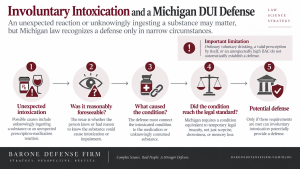
Michigan decisions involving prescription medication identify three requirements.
- The defendant did not know and had no reason to know that the prescribed drug was likely to produce the intoxicating effect.
- The prescribed medication, rather than another intoxicant, caused the defendant’s intoxicated condition.
- The intoxication rendered the defendant temporarily insane under the governing legal standard.
The third requirement is what makes the defense substantially narrower than most clients initially assume. Feeling unexpectedly impaired, becoming unusually sleepy, experiencing poor judgment, having memory loss, or being more intoxicated than expected is not necessarily equivalent to legal insanity.
The defense therefore turns on the severity and legal significance of the resulting mental condition, not simply on whether the reaction was surprising.
Does the Person Have to Be Forced to Take the Drug?
No.
Michigan law does not limit involuntary intoxication to someone physically forcing a substance into another person’s body. The relevant question can instead be whether the person knowingly consumed an intoxicating substance or knew or reasonably should have known that the substance could produce the intoxicating effect.
This is especially important in prescription-medication cases. A person can intentionally take medication exactly as directed while still claiming that the resulting intoxication was involuntary if the particular intoxicating effect was not known or reasonably foreseeable. The remaining requirements of causation and temporary insanity still must be established.
What If Someone Put a Drug in My Drink Without My Knowledge?
 Secretly drugging a person’s drink is a classic example of ingestion that is involuntary in the ordinary sense. It can therefore present facts relevant to Michigan’s involuntary-intoxication doctrine.
But even then, lack of knowledge of the drug is only part of the analysis. To establish the complete insanity-based defense, the evidence must support the required mental condition resulting from the drug.
For that reason, corroborating evidence can be critical. Toxicology results, surveillance video, witness observations, medical treatment, receipts, text messages, and the timing and severity of symptoms may all help determine what actually happened.
What Does Not Usually Establish Involuntary Intoxication?
Several facts that sound like “accidental intoxication” in ordinary conversation do not, by themselves, satisfy Michigan’s legal doctrine.
- Drinking alcohol voluntarily and becoming more intoxicated than expected.
- Discovering later that the BAC was much higher than anticipated.
- Having a valid prescription for a medication.
- Experiencing an ordinary side effect that the person knew or reasonably should have anticipated.
- Taking the medication together with another intoxicant that actually caused the condition.
- Having a blackout or inability to remember what happened without evidence of the required insanity-equivalent state.
The facts must be evaluated against the legal standard rather than the everyday meaning of the word “accidental.”
What Does Michigan’s Intoxication-Defense Statute Say?
Michigan has a statute that directly addresses when intoxication may and may not be used as a defense. Under MCL 768.37, being under the influence of alcohol, a drug, or another substance that was voluntarily and knowingly consumed generally is not a defense to a crime.
The statute contains a narrow exception. A person charged with a specific-intent crime may assert an affirmative defense if the person voluntarily consumed a legally obtained and properly used medication or other substance but did not know, and reasonably should not have known, that it would cause intoxication or impairment. The defendant bears the burden of proving that defense by a preponderance of the evidence.
That does not mean unexpectedly caused intoxication is legally irrelevant. Michigan separately recognizes involuntary intoxication through the insanity doctrine. That is a different and much more demanding defense. In a prescription-medication case, the defendant generally must establish that the intoxicating effect was not reasonably foreseeable, that the medication itself caused the condition, and that the resulting condition reached the level required for temporary legal insanity.
The distinction is important. MCL 768.37 addresses a narrow statutory defense for certain specific-intent crimes. Involuntary intoxication is a separate insanity-based doctrine. Neither should be described as a simple rule that an unexpected reaction to medication defeats a Michigan DUI charge.
hat Evidence Matters in an Accidental Intoxication DUI Case?
 These cases frequently depend on evidence that is not contained in the police report.
Depending on the claimed cause, defense counsel may need to obtain:
- the original prescription and prescribing records;
- the medication container and dosing instructions;
- pharmacy records and warnings supplied with the medication;
- the client’s prior experience with the drug;
- the exact dose and time it was taken;
- other medications, alcohol, or substances consumed;
- hospital and emergency medical records;
- toxicology testing and the underlying laboratory data;
- witness observations before and after the alleged driving;
- surveillance or body-camera video;
- receipts and electronic records establishing the timeline; and
- expert medical, pharmacological, toxicological, or psychiatric evidence where appropriate.
The purpose is not simply to show that the person had a prescription. The evidence must address foreseeability, causation, and the resulting mental condition.
Why Early Investigation Can Be Especially Important
An involuntary-intoxication claim can trigger procedural requirements that do not arise in an ordinary DUI defense.
Because Michigan evaluates the defense through the insanity framework, counsel must consider the procedural rules governing an insanity defense. In a felony case, MCL 768.20a generally requires written notice of the intent to assert insanity at least 30 days before trial unless the court directs otherwise.
Early investigation also matters for practical reasons. Surveillance recordings may be overwritten. Witness memories change. Prescription bottles disappear. Medical and pharmacy records take time to obtain. A remaining biological sample may require preservation or independent testing.
Because an accidental intoxication DUI defense depends on much more than the defendant’s description of an unexpected reaction, independent evidence can become especially important.
Frequently Asked Questions About Accidental Intoxication DUI Cases
Is accidental intoxication a defense to DUI in Michigan?
Not as a freestanding defense merely because intoxication was unexpected. Michigan recognizes involuntary intoxication through the insanity doctrine, which requires a much more demanding showing.
Can a prescription medication cause involuntary intoxication?
Yes. Michigan law recognizes that a medically prescribed drug can produce involuntary intoxication under appropriate circumstances. The defendant must satisfy the requirements involving foreseeability, causation, and temporary insanity.
Is having a prescription enough?
No. Lawful possession or proper use of the medication does not by itself create a defense to OWI.
What if someone secretly put a drug in my drink?
That can support the involuntary-ingestion portion of the analysis, but the complete Michigan defense still requires proof of the required insanity-equivalent mental state.
What if I simply did not realize how intoxicated I had become?
Unexpected severity of intoxication is generally not enough. Michigan’s involuntary-intoxication doctrine requires substantially more than misjudging one’s level of impairment.
Charged With a Michigan DUI After an Unexpected Drug or Medication Reaction?
Cases involving an unexpected medication effect, an unknown substance, or suspected drugging require careful factual and legal analysis. The existence of a prescription or an unexpected reaction does not determine the outcome, but unusual intoxication facts should not be dismissed without investigation.
Barone Defense Firm represents clients in complex alcohol- and drug-related Michigan OWI cases. After the corrections identified above are made, readers can also review our Michigan prescription drug DUI information or our broader Michigan DUI defense resources.
About Patrick T. Barone
Patrick T. Barone is the founder of Barone Defense Firm and a nationally recognized Michigan DUI defense attorney. For more than 30 years, he has handled complex impaired-driving and criminal cases involving scientific evidence, disputed operation, causation, and trial strategy. He is the author of five books, including Defending Drinking Drivers, and has taught and written extensively for lawyers on DUI law and forensic science. Barone also brings advanced trial training to his practice as a Board-Certified Trainer, Educator, and Practitioner of Psychodrama and a graduate of the Gerry Spence Trial Lawyers College. Learn more about Patrick T. Barone.
Sources and Legal Authorities
- Mich. Comp. Laws § 257.625.
- Mich. Comp. Laws § 768.21a.
- Mich. Comp. Laws § 768.37.
- Mich. Comp. Laws § 768.20a.
- People v. Caulley, 197 Mich. App. 177, 187-89, 494 N.W.2d 853 (1992).
- People v. Wilkins, 184 Mich. App. 443, 448-50, 459 N.W.2d 57 (1990).
- Michigan Judicial Institute, Criminal Proceedings Benchbook, § 10.2, Defenses Involving a Defendant’s Mental Status.
- Michigan Model Criminal Jury Instructions, M Crim JI 15.2, Operating While Intoxicated.
Whether an involuntary-intoxication theory is available depends on the charged offense and the specific evidence. The doctrine should not be inferred merely from an unexpected reaction to alcohol or medication.
There are two site changes I would make before publishing the accidental-intoxication article: correct the Birmingham drug-defense page because it presently contradicts the new article, and correct the Prescr