Search
 Michigan Criminal Defense Lawyer Blog
Michigan DUI Duress Defense: When Can It Apply?


The defense is much narrower than simply having a compelling reason to drive. Fear, inconvenience, being stranded, or even a serious argument will not necessarily be enough. The threat must be sufficiently serious and immediate, the defendant must actually have feared death or serious bodily harm, and the decision to drive must have been made because of that threat.
Timing is often the controlling issue. A person may have been genuinely threatened minutes earlier and still lack a duress defense if the threat had ended before the person began driving. Michigan appellate decisions involving intoxicated drivers illustrate both sides of that line.
What Is the Michigan DUI Duress Defense?
D uress is a common-law affirmative defense. Instead of denying that the prosecution can prove the elements of the offense, the defense seeks to excuse the conduct because another person placed the accused in a situation in which violating the law was the lesser of two evils.
The Michigan Supreme Court has explained that this is the basic rationale for duress: the law may excuse a person who violates the criminal law to avoid a greater evil threatened by someone else. People v Gafken, 510 Mich 503, 511; 990 NW2d 826 (2022).
Michigan formally uses the term OWI rather than DUI. The terms are commonly used interchangeably in ordinary conversation, but OWI is the correct term when discussing the offense under Michigan law. For a fuller explanation, see our guide to the difference between DUI and OWI in Michigan.
What Must Be Proven for Duress in a Michigan DUI Case?
Michigan Model Criminal Jury Instruction 7.6 states that a defendant acted under duress if four conditions existed:
- The threatening or forceful conduct would have caused a reasonable person to fear immediate death or serious bodily harm.
- The defendant actually feared death or serious bodily harm at the time.
- The defendant committed the criminal act to avoid the threatened harm.
- The situation did not arise because of the defendant’s own fault or negligence.
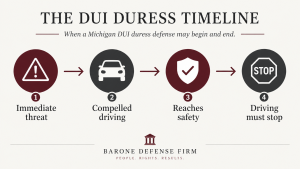
The instruction imposes two additional limitations. A person forfeits the defense by failing to use a reasonable opportunity to escape without exposure to death or serious bodily harm, or by continuing the unlawful conduct after the duress has ended.
These limitations are especially important in an OWI case because the relevant conduct may continue after the initial decision to move the vehicle. The question is therefore not simply why the person first drove. The defense must also account for why the driving continued and what the driver did when safety became available.
Why Does the Timing of the Threat Matter So Much?
Michigan law requires a real connection between the threat and the criminal act. The danger cannot merely explain why the defendant was frightened earlier. It must be operating on the defendant at the time the person committed the act and must explain why that act was undertaken.
This is where many apparently sympathetic cases become legally difficult. Someone may have experienced an assault, confrontation, or threat and still lack a duress defense if there was time to remain safely where the person was, call police, obtain another ride, seek shelter, or take another reasonable course that did not require intoxicated driving.
What Did People v. Hoch Say About Duress and Michigan OWI?
People v Hoch is particularly useful because the Michigan Court of Appeals addressed duress in an actual OWI prosecution. Hoch had been drinking while another person drove. After an altercation, that person pulled at the passenger door and then walked away. Hoch later moved into the driver’s seat and drove.
Hoch argued that he drove because he feared the other man might return. The Court of Appeals concluded that the alleged threat had already ended. The other man had walked away, Hoch remained near another person’s house, and Hoch then drove in the same direction the allegedly threatening person had gone.
The court held that the evidence did not show that Hoch drove while intoxicated to avoid the threatened harm. Because the evidence failed to support an essential part of the defense, the trial judge did not err by refusing to give the duress instruction. People v Hoch, unpublished per curiam opinion of the Court of Appeals, issued November 30, 2023 (Docket No. 362132).
The Michigan Court of Appeals opinion in People v Hoch demonstrates an important point: a past threat and a present need to drive are not the same thing.
Can Duress Actually Work in a Michigan OWI Case?
People v Espino demonstrates that sufficiently strong evidence can require the defense to be considered by a jury.
 Espino was convicted of OWI causing death and another driving offense after an altercation. Evidence indicated that several people pursued him back toward his truck. Espino told police that he had been attacked by several people and that some had weapons. A large pry bar and baseball bat were recovered near the scene. Witness testimony also showed people grabbing or attempting to enter the truck while Espino accelerated away.
The Court of Appeals majority concluded that the record established a prima facie case of duress. There was evidence from which jurors could find both an objectively serious threat and an actual fear of death or serious injury, as well as evidence that Espino drove to escape the threatened harm.
His attorney had effectively argued a duress theory to the jury without requesting the legal instruction that would tell jurors how to apply it. The Court of Appeals held that counsel was ineffective, found a reasonable probability that an instruction could have changed the result, and ordered a new trial. People v Espino, unpublished per curiam opinion of the Court of Appeals, issued October 30, 2024 (Docket No. 363814).
Because Espino is unpublished, it is not binding precedent. It nevertheless provides a useful Michigan example of the type of evidence that can make duress a genuine trial issue in an OWI case.
Hoch and Espino Show the Critical Difference
| Issue | People v. Hoch | People v. Espino |
|---|---|---|
| Threat when driving began | The allegedly threatening person had already walked away. | Several people were actively pursuing Espino and interacting with the truck. |
| Why defendant drove | The evidence did not establish that driving was undertaken to escape the threat. | Evidence supported the claim that he accelerated to escape a potentially serious physical threat. |
| Result | No duress instruction required. | Failure to request a duress instruction supported reversal and a new trial. |
The contrast is more useful than a general statement that duress is simply “available.” The decisive question is whether the evidence connects an immediate serious threat to the defendant’s decision to operate the vehicle.
Must the Driver Stop Once the Danger Ends?
Yes. The current Michigan jury instruction specifically states that duress is forfeited if the defendant continues the unlawful conduct after the duress ends.
Consider a person who is intoxicated and is chased toward a vehicle by an armed attacker. Driving away may present a legitimate duress question. But suppose the driver reaches a police station, open business, or another secure location and then continues driving toward home. The reason for the initial movement and the reason for the continued driving may be legally different.
A strong duress investigation therefore needs to determine not only when the emergency began, but also when it ended. Distance, route, stops, opportunities for assistance, and the driver’s actions after reaching apparent safety may all become important.
Does It Matter If the Driver Moved the Vehicle Only a Short Distance?
A short distance does not by itself prevent an OWI charge. Hoch argued that he had driven only about 45 feet, but the Court of Appeals explained that Michigan law does not impose a minimum distance for operation.
This distinction matters. Driving only a few feet may be relevant to understanding what the defendant was trying to accomplish, but it does not automatically mean there was no operation. Michigan’s definition of operation in a DUI case is broader than ordinary conversational use of the word “driving.”
What If the Driver Helped Create the Dangerous Situation?
This issue requires particular care. Michigan Supreme Court precedent states that the threat supporting duress must arise without the negligence or fault of the person asserting the defense. The current M Crim JI 7.6 now expressly includes lack of the defendant’s fault or negligence as one of the four conditions of duress.
Espino adds a procedural complication. Decided shortly before the jury instruction was amended in December 2024, the majority concluded under the then-existing instruction that whether Espino was at fault or negligent in producing the dangerous circumstances was a matter for the jury rather than a prerequisite to receiving a duress instruction.
The present instruction is different. It now places the fault-or-negligence issue directly within the stated requirements for duress. Because Espino is unpublished and predates that amendment, lawyers should be cautious about assuming that its discussion of the instructional threshold resolves how a current trial court should handle the issue.
Factually, the issue can be decisive. A person unexpectedly attacked while leaving a restaurant presents a very different case from someone who deliberately sought out a confrontation and then claims that intoxicated driving became necessary when the confrontation turned against them.
How Is Duress Different From Necessity in a Michigan DUI Case?
The concepts are closely related, but Michigan authority treats them as distinct defenses. Under People v Hubbard, the traditional distinction is the source of the compulsion. Duress involves the threatening conduct of another human being. Necessity involves compulsion arising from natural physical forces or circumstances.
Hoch raised both defenses. His duress argument concerned the conduct of the other person. His necessity argument was based on the alleged danger of leaving the vehicle where it had been parked. The Court of Appeals separately rejected both theories.
The court also noted an important procedural difference. Michigan has a model criminal jury instruction for duress, M Crim JI 7.6, but no comparable model instruction for necessity. The Hoch panel assumed that Michigan recognizes necessity as a defense separate from duress, but found the facts insufficient to support it.
For a DUI case arising from an assault, threat, armed confrontation, domestic violence situation, or threatening passenger, duress is therefore ordinarily the doctrine that should be examined first.
What Most Michigan DUI Duress Explanations Miss
The difficult part of these cases is usually not defining duress. It is proving the sequence of events with enough precision to show why the person drove at the exact time they did.
Four questions tend to control the analysis: Was the threat immediate when the vehicle was operated? Was the threatened harm serious enough? Was there a reasonable safe alternative? Did the driver stop, or at least attempt to stop, once the danger ended?
There is also a less obvious procedural issue. Michigan has not definitively resolved who bears the ultimate burden of persuasion once duress is properly before the jury. The current M Crim JI 7.6 therefore contains two alternative versions of the final burden-of-proof instruction. One places the burden on the prosecution to disprove duress beyond a reasonable doubt. The other requires the defendant to establish the defense by a preponderance of the evidence.
The Michigan Supreme Court avoided deciding that question in both People v Lemons and People v Reichard. The Model Criminal Jury Instructions Committee likewise states that it takes no position. That issue should therefore be identified and preserved before the case reaches final jury instructions.
What Facts Tend to Strengthen or Weaken a Michigan DUI Duress Defense?
The strongest factual pattern is immediate flight from serious violence. Evidence that an attacker was armed, actively pursuing the defendant, attempting to enter the vehicle, or inflicting serious injury can support both the objective and subjective components of the defense.
The defense becomes weaker when the threat is remote, speculative, or already over. It is also weakened when a clearly safe alternative existed, when the defendant drove toward rather than away from the danger, when the defendant substantially created the emergency, or when the driving continued after safety had been reached.
This is why a duress case cannot be evaluated only from the client’s explanation. The explanation must be tested against the objective chronology. In Hoch, for example, the fact that he drove in the direction of the person he claimed to fear undermined the contention that the driving occurred to avoid that person.
Can Duress Be a Complete Defense to Michigan DUI?
Potentially, yes. M Crim JI 7.6 states that a defendant is not guilty if the crime was committed while acting under legally sufficient duress.
But the defense does not automatically reach the jury merely because the accused describes an emergency. There must be evidence supporting the essential requirements. Michigan courts act as gatekeepers on whether the factual record justifies giving the instruction.
For that reason, duress should not be treated as a fallback argument that the driver had a “good reason” to drive. It is a narrow defense for extraordinary circumstances in which an immediate human threat creates a genuine choice between serious harm and violating the law.
Frequently Asked Questions About the Michigan DUI Duress Defense
Can a threat from a passenger support a duress defense?
Potentially. The important questions are whether the passenger’s conduct created a reasonable and actual fear of immediate death or serious bodily harm and whether the defendant drove because of that threat. Gafken involved a claimed threat from a passenger who allegedly pressed a gun into the driver’s ribs and threatened to kill her if she stopped.
Can domestic violence lead to a DUI duress defense?
It can potentially create the necessary factual circumstances, but the label “domestic violence” does not itself establish duress. The immediate threat, seriousness of the feared harm, available alternatives, and relationship between the threat and the driving still must be established.
What if the danger ended before the person started driving?
That is a major problem for the defense. Hoch illustrates that an earlier threat does not justify later intoxicated driving when the evidence shows that the danger had already passed.
Is necessity the same thing as duress?
No. Michigan authority distinguishes the two according to the source of the compulsion. A human threat ordinarily sounds in duress. Necessity traditionally involves pressure from circumstances or natural physical forces.
Does driving only a few feet prevent an OWI conviction?
No. Michigan does not impose a minimum-distance requirement for operation. The distance may matter to the factual duress analysis, but moving only a short distance does not by itself eliminate the operation element.
Charged With DUI After Driving to Escape a Threat?
A Michigan OWI case involving an assault, threatening passenger, domestic violence incident, armed confrontation, or other emergency requires a different investigation from an ordinary drunk-driving case. Evidence explaining why the person drove may exist outside the materials gathered in the routine DUI investigation, and some of that evidence may disappear quickly.
Barone Defense Firm represents people charged with DUI and serious OWI offenses throughout Michigan. The defense begins by reconstructing both sides of the case: the prosecution’s intoxication and operation evidence, and the circumstances that allegedly compelled the client to drive.
For broader information about defending an impaired-driving charge, see our
Michigan DUI defense guide.
About Patrick T. Barone
Patrick T. Barone is the founding attorney of Barone Defense Firm and has focused his practice for more than three decades on Michigan DUI and serious criminal defense. He is the author of five books, including Defending Drinking Drivers, a nationally used DUI defense treatise, and has written and lectured extensively on impaired-driving law, forensic science, and trial advocacy. His background includes undergraduate study in biology on a pre-medical track, service as an adjunct law professor, and advanced training in trial advocacy and psychodrama. His practice regularly involves complex DUI issues including operation, chemical testing, causation, and affirmative defenses such as duress and necessity.
Sources and Legal Authorities
- People v Lemons, 454 Mich 234, 245-248; 562 NW2d 447 (1997).
- People v Gafken,
510 Mich 503, 511-514; 990 NW2d 826 (2022). - People v Hubbard, 115 Mich App 73, 77; 320 NW2d 294 (1982).
- People v Hoch,
unpublished per curiam opinion of the Court of Appeals, issued November 30, 2023 (Docket No. 362132). - People v Espino,
unpublished per curiam opinion of the Court of Appeals, issued October 30, 2024 (Docket No. 363814). - M Crim JI 7.6, Duress,
amended December 2024. - MCL 257.625,
Michigan’s Operating While Intoxicated statute.