Search
 Michigan Criminal Defense Lawyer Blog
Can GLP-1 Medications Affect BAC Evidence in a Michigan DUI Case?


Why Could GLP-1 Medications Matter in an Alcohol-Related DUI Case?
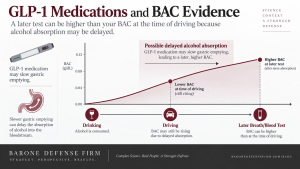
 After a person drinks alcohol, the alcohol does not appear instantly and uniformly in the bloodstream. Alcohol moves through the gastrointestinal tract, enters the bloodstream, distributes through body water, and eventually reaches a peak concentration before declining.
The rate at which the stomach empties is one of the variables that affects that process. Alcohol is absorbed much more rapidly after it reaches the small intestine. Anything that materially changes gastric emptying can therefore affect the timing of alcohol absorption.
GLP-1 receptor agonists are widely used to treat diabetes and obesity. Semaglutide is the active ingredient in Ozempic and Wegovy. Liraglutide is another GLP-1 receptor agonist. Tirzepatide, sold as Mounjaro and Zepbound, is more precisely a dual GIP and GLP-1 receptor agonist.
FDA prescribing information for both semaglutide and tirzepatide recognizes delayed gastric emptying as a pharmacological effect of these medications. That gives the issue a plausible biological mechanism. A newer human alcohol study provides more direct evidence that the timing of alcohol’s appearance in breath may also be affected.
What Did the Human GLP-1 and Alcohol Study Actually Find?
In 2025, researchers led by Fatima Quddos published a pilot study in Scientific Reports examining alcohol consumption in people with obesity who were taking GLP-1 or related medications.
The final study included 20 participants: 10 taking a GLP-1 or related medication and 10 controls. Among the treated participants, six were taking semaglutide, two liraglutide, and two tirzepatide. The treated participants had been on a maintenance dose for at least 30 days.
After a controlled alcohol challenge, the treated group had significantly lower breath alcohol concentrations at the 10-, 15-, and 20-minute measurements. The investigators characterized the pattern as a delayed rise in breath alcohol concentration. The treated participants also reported lower subjective feelings of intoxication early in the session.
From approximately 35 through 60 minutes during the drinking session, the difference between the groups was not statistically significant. Importantly, however, the study also reported that differences persisted across measurements obtained later in the recovery room. The cumulative breath-alcohol exposure during the measured period was also lower in the medication group.
| What the Study Supports | What the Study Does Not Establish |
|---|---|
| A delayed early rise in breath alcohol occurred in the treated group. | Every person taking a GLP-1 drug will absorb alcohol more slowly. |
| Medication history can be relevant when evaluating assumptions about alcohol absorption. | A fixed number of minutes by which GLP-1 medication delays alcohol absorption. |
| The issue deserves investigation when BAC timing matters to the prosecution’s theory. | A mathematical GLP-1 correction factor that can be applied to a breath or blood result. |
| A prosecution expert’s assumption that alcohol absorption was complete may require individualized support. | That the medication necessarily made the driver’s BAC lower at the time of driving. |
Why Is This Study Important to Michigan DUI Defense?
The study is important less because it supplies a new calculation than because it challenges an assumption.
Police typically obtain a breath or blood sample after the driving has ended. Sometimes the delay is relatively short. In other cases, especially when there has been a crash, medical treatment, a search warrant, or transportation to a hospital, the alcohol test may occur substantially later.
The chemical test therefore measures alcohol at the time of testing. If a prosecutor wants to use that later number to prove a different number at the earlier time of driving, the prosecution may have to rely on assumptions about where the driver was on the alcohol absorption and elimination curve.
That is precisely where GLP-1 treatment can become relevant.
How Can GLP-1 Medication Affect Retrograde Extrapolation?
Retrograde extrapolation in a DUI case is the process of estimating an earlier alcohol concentration from a later test.
A common approach begins with the measured BAC and adds back an assumed amount of alcohol eliminated between the time of driving and the test. The arithmetic can be simple. The biology is not.
That calculation assumes, expressly or implicitly, that the driver was in the elimination phase during the period being reconstructed. If alcohol was still being absorbed, the relationship between the later result and the earlier BAC becomes substantially more complicated.
The Quddos study does not prove that a particular GLP-1 user remained in the absorption phase for any specific period. It does provide a scientific basis to ask whether a prosecution expert has enough individualized information to assume that absorption was already complete.
Can GLP-1 Medication Support a Rising BAC Defense?
Potentially, but the prescription alone does not prove a rising BAC.
A rising-BAC defense applies when the driver’s alcohol concentration was lower while driving and increased before the later police or hospital test. That can happen when alcohol consumed before driving continues to enter the bloodstream after the driving has ended.
A medication that alters gastric emptying may make continued absorption more plausible in an appropriate factual setting. But continued absorption does not automatically mean that the BAC was rising. Alcohol can be entering the bloodstream while alcohol is also being eliminated.
The actual question is whether the rate at which alcohol was entering circulation exceeded the effect of elimination and distribution at the relevant time.
For that reason, a meaningful analysis requires the chronology of drinking, food, medication, driving, and testing rather than simply the name of the prescription.
Does Ozempic or Mounjaro Cause a False BAC Test?
 There is presently no scientific basis to say that GLP-1 medications make a breath or blood instrument manufacture ethanol that is not present.
The central issue is generally one of timing and interpretation. A blood sample can accurately contain a particular concentration when collected while still leaving open a different question about what the driver’s BAC was earlier.
The same distinction applies to breath testing. The instrument reports a concentration associated with the time of the breath sample. It does not independently determine whether the driver’s BAC had been rising, falling, or near its peak before the test.
For broader information about how those testing methods differ, see our discussion of Michigan DUI chemical testing and DUI blood testing in Michigan.
Does the Effect Stay the Same Throughout GLP-1 Treatment?
Not necessarily.
This is another reason a lawyer or expert should not treat all GLP-1 users as interchangeable. FDA data for tirzepatide indicate that its effect on gastric emptying is greatest after the first dose and diminishes after subsequent doses. Experimental research has similarly found a strong initial delay with some reduction during repeated treatment.
That does not mean long-term treatment eliminates the issue. Nor does it mean a recently started medication necessarily produced a particular degree of delay. It means that treatment duration and dosing history can matter.
Relevant facts may include when the medication was started, whether the dose was recently increased, whether treatment was interrupted and restarted, the actual dose, and which medication was being used.
Why the Exact Medication Matters
The term “GLP-1” is often used loosely to describe several medications that are not pharmacologically identical.
Semaglutide, liraglutide, dulaglutide, and exenatide are GLP-1 receptor agonists. Tirzepatide acts at both GIP and GLP-1 receptors. Different medications, doses, treatment histories, and patient characteristics may produce different gastric effects.
The Quddos pilot study grouped several medications together. That was appropriate for an exploratory study, but it limits how precisely the findings can be applied to a particular defendant taking one particular medication.
What Evidence Should Be Preserved in a GLP-1 DUI Case?
A scientifically useful investigation should document the actual treatment and alcohol timeline. Depending on the case, relevant information can include:
- the exact medication and active ingredient;
- the dose and prescribed dosing schedule;
- how long the person had been taking the medication;
- the date and time of the most recent dose;
- any recent dose escalation, interruption, or restart;
- pharmacy and prescribing records;
- the type, amount, and timing of alcohol consumed;
- food consumed before and during drinking;
- the approximate time drinking ended;
- the time the vehicle was operated;
- the time of each preliminary, evidentiary breath, blood, or hospital test; and
- receipts, video, phone data, and witnesses capable of corroborating the chronology.
Clients should not alter or discontinue prescribed medication for purposes of a criminal case without consulting the medical professional responsible for their treatment.
Frequently Asked Questions About GLP-1 Drugs and Michigan DUI Cases
Can Ozempic change how quickly alcohol reaches the bloodstream?
Semaglutide delays gastric emptying, and preliminary human research involving GLP-1 medications found a delayed early rise in breath alcohol. How much that matters for one person cannot be determined from the prescription alone.
Can Mounjaro or Zepbound affect alcohol absorption?
Tirzepatide delays gastric emptying. Its gastric effect is strongest initially and may diminish with continued treatment. The individual treatment history therefore matters.
Does taking a GLP-1 drug prove that my BAC was still rising?
No. It provides a reason to investigate absorption timing. A rising-BAC conclusion still depends on the drinking history, food intake, medication history, driving time, test time, and individual physiology.
Can my BAC have been lower when I was driving than when police tested me later?
Yes, that is biologically possible when alcohol is still being absorbed. Whether it happened in a particular case requires evidence rather than assumption.
Can a prosecutor still use retrograde extrapolation if I take a GLP-1 medication?
A prosecutor may attempt to do so. The defense issue is whether the expert has a reliable factual and scientific basis for the assumptions used in that calculation.
Charged With a Michigan DUI While Taking a GLP-1 Medication?
A GLP-1 prescription does not create a defense by itself. But when a DUI prosecution depends on a later BAC and an assumption about what that number supposedly proves at the time of driving, medication history may become an important part of the forensic analysis.
Barone Defense Firm evaluates Michigan DUI cases by examining the science behind the alcohol evidence as well as the number reported on the police report. Learn more about Michigan DUI defense and the firm’s approach to complex alcohol-testing cases.
About Patrick T. Barone
Patrick T. Barone is the founding attorney of Barone Defense Firm and the author of five books, including Defending Drinking Drivers, a national treatise addressing the legal and scientific issues involved in DUI defense. His undergraduate education included biology on a pre-medical track, and he is an IACP/NHTSA-certified standardized field sobriety test instructor and practitioner.
Barone has concentrated his practice on Michigan DUI and OWI defense for more than three decades and has written and taught extensively on alcohol testing, pharmacology, forensic evidence, and trial strategy.
Sources and Further Reading
- Fatima Quddos et al., A Preliminary Study of the Physiological and Perceptual Effects of GLP-1 Receptor Agonists During Alcohol Consumption in People with Obesity, 15 Scientific Reports 32385 (2025), doi:10.1038/s41598-025-17927-w.
- Shweta Urva et al., The Novel Dual Glucose-Dependent Insulinotropic Polypeptide and GLP-1 Receptor Agonist Tirzepatide Transiently Delays Gastric Emptying in Subjects with Type 2 Diabetes, 22 Diabetes, Obesity & Metabolism 1886 (2020).
- U.S. Food & Drug Administration, Mounjaro (tirzepatide) Prescribing Information (rev. Jan. 2026).
- U.S. Food & Drug Administration, Ozempic (semaglutide) Prescribing Information.
The existing research is developing and should not be used to infer a particular absorption delay or BAC for an individual without case-specific evidence and appropriate expert analysis.