Search
 Michigan Criminal Defense Lawyer Blog
Retrograde Extrapolation in DUI Cases: Science, Strategy, and Cross-Examination


Retrograde extrapolation is the process of estimating a driver’s earlier blood alcohol concentration from a later test. In DUI and Michigan OWI cases, the calculation can appear precise, but its reliability depends on facts that are often missing.
What Is Retrograde Extrapolation in a DUI Case?
Retrograde extrapolation is a forensic toxicology method used to estimate a person’s alcohol concentration at an earlier point in time. In a DUI or Michigan OWI case, the prosecutor may use a later blood or breath test and ask an expert to work backward to estimate the BAC at the time of driving.
The calculation usually starts with a measured alcohol result. The expert then adds back alcohol that the body supposedly eliminated between the time of driving and the time of testing. That sounds like a straightforward equation, but the real scientific dispute is whether the assumptions behind the equation are reliable in the individual case.
Basic Formula Prosecutors Often Use
Measured BAC + (elapsed time x assumed elimination rate) = estimated earlier BAC.
For example, if a blood test is 0.10 two hours after driving and the expert assumes an elimination rate of 0.015 per hour, the expert may estimate an earlier BAC of about 0.13. That number is only as reliable as the assumptions used to produce it.
Visual Concept: A Single Test Does Not Show Where the Driver Was on the BAC Curve
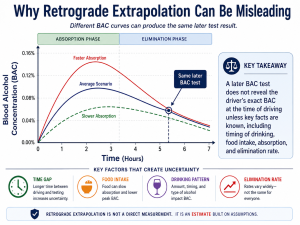
This simplified illustration shows why a single later test cannot, by itself, prove whether the driver was still absorbing alcohol, at peak concentration, or eliminating alcohol at the time of testing.
Why Retrograde Extrapolation Is Often Vulnerable
Alcohol absorption, distribution, and elimination are not uniform across all people. The absorption phase is especially important because a driver who is still absorbing alcohol may have a lower BAC while driving than when later tested. The OSAC alcohol calculation guideline states that absorption is a complex dynamic process, that absorption rates are highly variable and not linear, and that factors such as food, beverage type, beverage volume, other drugs, and gastrointestinal condition can affect absorption.
The same guideline warns that alcohol calculations should not be overstated or oversimplified. In long-delay situations, it explains that the science does not support a single precise value for the earlier BAC. A range may be more appropriate, with assumptions clearly stated.
Defense Point
The blood or breath test may be a valid measurement of alcohol concentration when the sample was taken. Retrograde extrapolation asks a different question: whether an expert can reliably estimate what the alcohol concentration was earlier, when no sample was taken.
The Five Problems With Retrograde Extrapolation in DUI Cases
The existing Barone Defense Firm article correctly identifies the essential problem: retrograde extrapolation requires facts that police often do not collect. The revised analysis below expands those points for lawyers who need to litigate the issue in motions, expert hearings, and cross-examination.
- Absorption Must Be Known – The most important question is whether the person was in the post-absorptive elimination phase. If the driver was still absorbing alcohol, a later test may be higher than the BAC at driving.
- Multiple Timed Samples Are Rare – The best way to know the direction of the BAC curve is to obtain multiple properly spaced samples. That almost never happens in ordinary OWI investigations.
- Drinking History Is Usually Incomplete – The expert needs reliable information about when drinking began, when it ended, what was consumed, drink size, alcohol concentration, and pacing.
- Elimination Rate Is Assumed – Experts often use population averages, but elimination rates vary by individual and circumstance. A small change in the assumed rate can change the conclusion.
- The Result Can Look More Certain Than It Is – Numerical testimony may create an appearance of precision, even when the calculation rests on incomplete facts and generalized assumptions.
What Michigan Law Says About Delayed Alcohol Tests
The leading Michigan case is People v. Wager, 460 Mich. 118; 594 N.W.2d 487 (1999). In Wager, the Michigan Supreme Court held that Michigan’s drunk driving statute did not impose a rigid admissibility rule based only on the time between driving and the chemical test. The Court rejected the Court of Appeals’ suppression ruling and treated the delay as a matter ordinarily affecting weight rather than automatic admissibility.
For defense lawyers, Wager does not end the analysis. It means the delayed result may come in, but the defense can still challenge what the result proves. The gap between a test-time BAC and a driving-time BAC remains fertile ground for expert testimony, cross-examination, and argument.
Michigan Practice Note
In Michigan OWI litigation, do not frame every retrograde extrapolation issue as a simple suppression issue. The stronger challenge may be foundation, expert reliability, scope of opinion, uncertainty, and the difference between admissibility of the test result and proof of BAC at the time of operation.
Why Mata v. State Is Important for DUI Lawyers
Mata v. State, 46 S.W.3d 902 (Tex. Crim. App. 2001), is not binding in Michigan, but it is one of the most useful judicial discussions of retrograde extrapolation. The Texas Court of Criminal Appeals examined the science carefully and focused on whether the expert reliably applied the method to the facts of the case.
Mata recognized a central principle that applies across jurisdictions: retrograde extrapolation can be reliable in some settings, but reliability depends on the amount and quality of information available to the expert. The court emphasized the time between driving and testing, the number of tests, the time between tests, and whether the expert knew individualized facts about the defendant.
| Reliability Factor Identified in Mata | Why It Matters in DUI Defense |
|---|---|
| Length of time between driving and testing | The longer the delay, the greater the possible difference between driving-time BAC and test-time BAC. |
| Number of alcohol tests | A single test generally cannot establish whether BAC was rising, falling, or at peak. |
| Time between multiple tests | Properly spaced tests may show the direction of the BAC curve. Nearly simultaneous breath samples usually do not. |
| Known personal characteristics | Weight, sex, drinking history, food intake, and timing can materially affect absorption and elimination. |
| Whether absorption was complete | If absorption was continuing, a back-calculation based on elimination may overstate the BAC at driving. |
In Mata, there was only one meaningful test, taken more than two hours after the alleged driving. The expert did not know what Mata ate, what he drank, how much he drank, when his last drink occurred, how long he had been drinking, or even his weight. The court concluded that the State failed to prove the reliability of the retrograde extrapolation under those circumstances.
A useful way to translate Mata for cross-examination is this: the issue is not whether retrograde extrapolation exists as a general scientific concept. The issue is whether this expert had enough reliable case-specific data to apply the concept to this driver at this time.
The Widmark Equation and Its Limits
Most courtroom retrograde extrapolation testimony traces back to principles associated with Erik Widmark’s early work on alcohol pharmacokinetics. Widmark’s work remains foundational, but the courtroom problem is usually oversimplification. A formula can be mathematically correct and still produce an unreliable opinion if the inputs are unknown, assumed, or treated as if averages describe the individual defendant.
Alcohol is distributed primarily through body water. Because body water varies with sex, body composition, age, and other physiological factors, a calculation based on a generic distribution ratio may not accurately describe the individual. The same is true for elimination rate and absorption timing.
What Typical Articles Miss
Many articles say only that retrograde extrapolation is either “science” or “guesswork.” The more accurate defense position is narrower and stronger. Alcohol calculations can be scientifically recognized, but the opinion is only reliable when the expert has enough accurate facts and clearly communicates the assumptions, range, and limitations.
Rising BAC Defense and Retrograde Extrapolation
The rising BAC defense turns on a simple biological point: BAC does not instantly reach its peak when a person drinks. Alcohol must move through the stomach and small intestine, enter the bloodstream, distribute through body water, and reach equilibrium. If the person drives before full absorption, the BAC at driving may be lower than the BAC later measured by police or hospital personnel.
Barone Defense Firm has previously explained in its SADO article on drinking after driving and rising BAC issues that a rising blood alcohol defense requires both a specific fact pattern and careful application of alcohol metabolism science. That same principle applies to retrograde extrapolation. Without a reliable timeline and drinking history, the expert may not know whether the test captured a rising, peak, or falling BAC.
Food, Gastric Bypass, and Other Individualized Variables
Food is one of the most important variables in any retrograde extrapolation DUI analysis. A full stomach can delay gastric emptying, slow absorption, and extend the time needed to reach peak BAC. That matters because a person tested later may not have been in the elimination phase when the test was taken.
Gastrointestinal anatomy can also matter. In the SADO article on alcohol metabolism after gastric bypass surgery, Patrick T. Barone explained why altered anatomy can change how alcohol enters the bloodstream and why that may matter in drunk driving cases. Peer-reviewed literature likewise reports faster ethanol absorption and higher peak concentration in women after gastric bypass surgery, a finding relevant when a case involves unusual alcohol kinetics.
Case Development Point
When retrograde extrapolation is part of the prosecution theory, defense counsel should investigate food intake, bariatric surgery, gastrointestinal conditions, medications, drinking pattern, fatigue, illness, and the exact timeline from last drink to driving to test. These facts may determine whether the expert’s opinion is grounded or speculative.
How OSAC and ASB Guidance Helps the Defense
The OSAC guideline for alcohol calculations and the 2024 ANSI/ASB best practice recommendation both recognize that alcohol calculations include retrograde extrapolation and require attention to post-absorptive status, specimen type, population variance, and reporting limitations. These are not merely defense talking points. They are forensic science quality issues.
The OSAC guideline states that experts should be conservative, knowledgeable about limitations, and careful not to overstate or oversimplify alcohol calculations. It also explains that, where there is a long delay between the incident and blood draw, science may not support a single value for the earlier BAC. Instead, an estimated range may be more appropriate, with the assumptions identified.
| Forensic Guidance Issue | Defense Use |
|---|---|
| Post-absorptive status | Ask how the expert determined absorption was complete. |
| Population variance | Challenge whether averages were substituted for individual facts. |
| Reporting limitations | Require the expert to state assumptions, range, and uncertainty. |
| Specimen type | Distinguish blood, serum, plasma, and breath issues where applicable. |
| Long delay | Argue that a precise single-number opinion overstates the science. |
Cross-Examination Themes for DUI Lawyers
Retrograde extrapolation testimony can sound authoritative because it uses numbers. Cross-examination should separate measured facts from assumptions. The goal is not always to prove the expert is unqualified. Often, the better objective is to show the jury that the expert’s opinion changes if the assumed facts change.
Timeline
Confirm the exact time of operation, stop, arrest, implied-consent request, blood draw, breath test, and laboratory analysis. Expose any estimated or missing times.
Absorption
Ask whether the expert can prove the person was fully absorbed. If not, ask whether the later test could be higher than the driving-time BAC.
Drinking Pattern
Ask what the expert knows about number of drinks, size, alcohol concentration, timing, and last drink. Then identify what the expert does not know.
Food and Physiology
Ask what the expert knows about food, body composition, medical history, medications, bariatric surgery, and gastrointestinal conditions.
Elimination Rate
Ask whether the elimination rate was measured in this person or assumed from a population range.
Range and Uncertainty
Ask whether the expert can provide a range rather than a single number, and whether the range crosses a legally significant threshold.
Sample Cross-Examination Sequence
- You did not see the driver consume alcohol.
- You do not know precisely when the last drink was consumed.
- You do not know what food was in the stomach.
- You do not know whether absorption was complete at the time of the test.
- You used an assumed elimination rate.
- You cannot directly measure the BAC at the time of driving.
- Your opinion depends on assumptions that are not all proven by the evidence.
Retrograde Extrapolation and Michigan Expert Reliability
Michigan lawyers should evaluate retrograde extrapolation under MRE 702 and the case-specific reliability principles that govern expert testimony. The central question is not simply whether alcohol pharmacokinetics is a recognized scientific field. The question is whether the expert reliably applied the method to the facts of the case.
This distinction is critical. An expert may be qualified in toxicology and still lack enough case-specific information to offer a reliable driving-time BAC opinion. A court may admit the test result and still limit or scrutinize an opinion that purports to translate that result into a specific earlier BAC.
Motion Practice Point
A defense motion should identify the missing facts, not merely attack retrograde extrapolation in the abstract. The stronger argument is that this expert, using this data, cannot reliably give this opinion about this driver at this time.
When Retrograde Extrapolation Is Most Vulnerable
| Case Situation | Why the Back-Calculation Is Vulnerable | Defense Response |
|---|---|---|
| Single blood draw two or more hours after driving | A single point does not establish the BAC curve. | Challenge absorption status and require a range. |
| No documented drinking history | The expert lacks the facts needed to individualize the calculation. | Separate known facts from assumed facts. |
| Bar-close or rapid-consumption case | The driver may have been in a rising BAC phase. | Develop timeline, receipts, witness statements, and video. |
| Food before or during drinking | Food can delay absorption and change peak timing. | Investigate meal timing and content. |
| Hospital blood case | Delay, serum/plasma issues, and medical context may complicate interpretation. | Obtain medical records and expert review. |
| Bariatric surgery or altered GI anatomy | Alcohol kinetics may differ materially from assumptions. | Investigate medical history and relevant pharmacokinetic literature. |
How Defense Lawyers Should Investigate a Retrograde Extrapolation DUI Case
A retrograde extrapolation challenge should begin before expert disclosure. The defense needs a complete timeline and the facts needed to test the prosecution’s assumptions.
- Build the Timeline – Identify driving time, police contact, last drink, test time, crash time, hospital admission, and any unexplained delay.
- Collect Drinking Facts – Determine beverage type, size, alcohol by volume, number of drinks, pace of consumption, and whether drinking continued after driving.
- Collect Absorption Facts – Investigate food, meal timing, stomach contents, gastrointestinal conditions, medications, and bariatric history.
- Review Testing Evidence – Analyze blood draw records, breath test sequence, hospital lab records, serum/plasma conversion issues, and chain of custody.
- Frame the Expert Issue – Ask whether the expert can state a reliable range, whether that range crosses the legal limit, and whether the expert has overstated certainty.
Attorney Insight
In many OWI prosecutions, the chemical test becomes the center of the case because it appears scientific and objective. Retrograde extrapolation can magnify that effect by converting a delayed test into an opinion about a moment that was never tested.
At Barone Defense Firm, the defense focus is often on separating the actual measurement from the prosecutorial interpretation. A blood test may accurately report alcohol concentration at the time of collection. It does not automatically prove the alcohol concentration at the time of operation. That distinction matters in cases involving delayed blood draws, hospital testing, late-night drinking patterns, food consumption, or incomplete police investigation.
The best defense usually does not depend on calling every calculation “junk science.” It depends on showing the limits of the calculation, the missing facts, and the assumptions that must be accepted before the jury can rely on the opinion.
Frequently Asked Questions About Retrograde Extrapolation DUI Evidence
What is retrograde extrapolation in a DUI case?
Retrograde extrapolation is an estimate of a person’s earlier BAC based on a later blood or breath test. In DUI cases, prosecutors may use it to argue that the BAC at the time of driving was higher than the later test result.
Is retrograde extrapolation always admissible in Michigan OWI cases?
No single rule answers every case. Michigan law generally allows delayed alcohol test results into evidence, but a specific retrograde extrapolation opinion may still be challenged based on foundation, expert reliability, assumptions, and whether the opinion would assist the jury.
What is the biggest scientific problem with retrograde extrapolation?
The biggest problem is usually uncertainty about absorption. If the person was still absorbing alcohol when tested, a later test may be higher than the BAC at the time of driving. A back-calculation that assumes elimination may then overstate the earlier BAC.
Why does a single blood or breath test create problems?
A single test provides one data point. It does not show whether the person’s BAC was rising, peaking, or falling. Multiple timed samples may help establish the direction of the BAC curve, but they are rarely obtained in ordinary DUI investigations.
Can food affect retrograde extrapolation?
Yes. Food can delay gastric emptying and slow alcohol absorption. That may affect when BAC peaks and whether the person was post-absorptive when tested.
Does gastric bypass surgery matter in a DUI alcohol calculation?
It can. Gastric bypass and other gastrointestinal changes may alter alcohol absorption and peak concentration. A defense lawyer should investigate bariatric history when the drinking history or test result seems inconsistent.
How should DUI lawyers challenge retrograde extrapolation?
The lawyer should identify missing individualized facts, challenge assumptions about absorption and elimination, test whether the expert can provide only a range, and determine whether the range crosses or stays below legally important thresholds.
Challenging Retrograde Extrapolation in Michigan OWI Cases
When a prosecutor relies on retrograde extrapolation, the defense must act quickly to preserve evidence, reconstruct the timeline, and obtain expert review where appropriate. The scientific question is not just what the test showed. The question is what the test can reliably prove about the time of operation.
For related guidance, see Barone Defense Firm’s page on when to hire a Michigan DUI attorney and its resources on preliminary breath test evidence.
About the Author
 Patrick T. Barone is a Michigan criminal defense attorney and nationally recognized DUI defense lawyer. He is the founder of Barone Defense Firm and the author of five books, including Defending Drinking Drivers. He is an IACP/NHTSA certified standardized field sobriety test instructor and practitioner, manufacturer certified on the DataMaster DMT, and has undergraduate training in biology on a pre-medical track.
Mr. Barone has been continuously recognized as a Michigan Super Lawyer since 2007, is listed in Best Lawyers in America, and has been named a Leading Lawyer, Advisory Board Member, Peer Selected 2026. His work includes forensic toxicology, breath testing, blood testing, standardized field sobriety testing, and the strategic defense of Michigan OWI cases.
External References and Authorities
- People v. Wager, 460 Mich. 118; 594 N.W.2d 487 (1999).
- Mata v. State, 46 S.W.3d 902 (Tex. Crim. App. 2001).
- OSAC, Guidelines for Performing Alcohol Calculations in Forensic Toxicology.
- ANSI/ASB Best Practice Recommendation 122, Best Practice Recommendation for Performing Alcohol Calculations in Forensic Toxicology (First Edition, 2024).
- Patrick T. Barone, Alcohol Metabolism Changes Considerably After Gastric Bypass Surgery, SADO.
- Patrick T. Barone, DUI Defense: Is Drinking After Driving a Viable Defense to DUI in Michigan?, SADO.
- Klockhoff, Näslund & Jones, Faster absorption of ethanol and higher peak concentration in women after gastric bypass surgery, Br. J. Clin. Pharmacol. 54(6):587-591 (2002).