Search
 Michigan Criminal Defense Lawyer Blog
Drunk Driving Lawyer: DUI DWI OWI Defense Attorney Near Me


When someone searches for a Michigan DUI lawyer near me after an OWI arrest, what they need most is not a list of credentials, it is reassurance that the outcome of their case is not yet decided. A Michigan OWI arrest is not a conviction. The Barone Defense Firm was built for exactly this moment: to stand with people in the most difficult hours of their lives, understand what matters most to them, and fight to win their lives back. Call 1-877-ALL-MICH for a free, confidential consultation available 24 hours a day.
Why Does Choosing the Right Michigan DUI Lawyer Matter?
Approximately 95% of all drunk driving convictions in Michigan are misdemeanors. A felony charge occurs on a third lifetime OWI, not the fourth within ten years as in most other states. Even for a first offense, the consequences of a conviction, jail time, license suspension, criminal record, fines, and increased insurance costs, are serious enough that hiring the right attorney is one of the most consequential decisions you will make. When you search for a Michigan DUI lawyer near me, the quality of that decision determines everything that follows.
 Not all Michigan DUI lawyers have the same training, the same knowledge of the science behind chemical testing, or the same experience with the courts and prosecutors in your area. The gap between a specialist and a generalist in OWI defense is wide, and it often determines the difference between a dismissal, a reduced charge, and a conviction.
An attorney who cannot challenge a breath test result, cross-examine a field sobriety test officer, or identify a constitutional defect in the traffic stop cannot effectively represent you regardless of how persuasive they are in front of a judge.
Those who call a Michigan DUI lawyer near me, including the attorneys at the Barone Defense Firm, are typically everyday citizens, law-abiding and hard-working people who made a mistake and now need skilled help navigating a criminal justice system they have never encountered before. Our goal is to help every client avoid a conviction where possible, and where that is not achievable, to prevent the worst potential consequences and protect what matters most to them.
Most people arrested for OWI in Michigan assume the best DUI lawyers practice in Detroit. The opposite is true. Detroit police handle an enormous volume of violent crime and devote comparatively little attention to OWI enforcement. The highest concentration of serious OWI prosecutions in Michigan occurs in the suburban counties, Oakland, Macomb, Washtenaw, and Kent, where district court judges and prosecutors focus heavily on drunk driving cases and where the courts are far less forgiving than many defendants expect.
The attorneys who have built the deepest expertise in this area are located in those same suburbs, practicing every day in the courts where your case will actually be heard. The Barone Defense Firm is headquartered in Birmingham, Oakland County, with offices also in Grand Rapids, Michigan, and its attorneys appear regularly in every court that matters to your case.
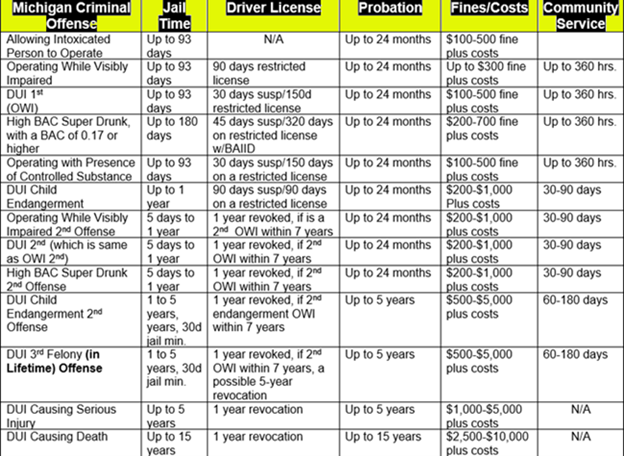
A first offense DUI in Michigan can result in up to 93 days in jail. If the blood alcohol concentration BAC is very high (e.g., above 0.170 grams percent, or more than twice the legal limit), more jail time is likely in some Michigan courts.
Individuals charged with operating while intoxicated are often stigmatized and portrayed as irresponsible and dangerous. If convicted of a first offense OWI in Michigan, the defendant will also face a suspended license for 30 days, followed by a restricted license for an additional 150 days. Repeat offenders are treated far more harshly, and based on Heidi’s law, three OWIs in a lifetime will result in a felony charge.
Can a Michigan OWI Charge Be Defended Even With a Test Result?
Yes, in most cases more effectively than people initially believe. One of the most important facts about Michigan OWI law is not widely understood: drinking and driving, by itself, is not illegal in Michigan. Every Michigan OWI jury is instructed by the judge that the mere consumption of alcohol, or even the smell of alcohol, is not proof of intoxication.
Here is a fact most people find counterintuitive: a very high BAC reading can in some respects make a case easier to defend, not harder. The higher the reported result, the more the prosecution’s case depends on the accuracy of the testing instrument and the reliability of the testing process. A result of 0.09 is easily proved by an officer’s observations alone.
But, with a result of 0.22, there may be a disconnect in the intoxication evidence, between what the numbers say and what is observed. requires the jury to believe the instrument was working perfectly, the operator was certified, the calibration was current, and no physiological variable affected the reading, because the number strains ordinary credibility without perfect testing conditions supporting it. An experienced Michigan OWI attorney with deep scientific training knows how to turn the prosecution’s most powerful-looking number into its most vulnerable point.
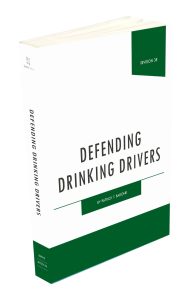
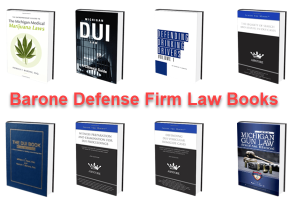
2025 Edition – Defending Drinking Drivers
The prosecutor bears the burden of proving beyond a reasonable doubt that alcohol impaired the driver’s ability to operate a vehicle, or that their bodily alcohol content met or exceeded the statutory threshold at the time of driving. That burden is never automatically satisfied by a test result.
Breath test results depend on proper calibration and maintenance of the Intoxilyzer 9000, Michigan’s current evidentiary breath testing instrument, a valid operator certification, and the absence of physiological variables that can artificially elevate a reading.
Blood test results require an unbroken chain of custody, proper collection technique, correct use of the state police kit, and laboratory compliance with Michigan’s administrative rules.
Field sobriety tests are scored subjectively and are based on NHTSA studies with documented error rates. Even a case that appears difficult at first glance frequently contains vulnerabilities a trained OWI attorney can identify and develop.
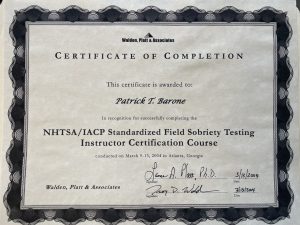
When Patrick Barone and his team at the Barone Defense Firm review the chemical test records and field sobriety scoring in your case, they are not reading them as a lawyer interpreting a document. Barone is an IACP/NHTSA-certified SFST instructor and is believed to be the only attorney in Michigan ever judicially qualified as an SFST court expert, meaning he has personally administered, scored, and taught the same tests the officer used against you, and he knows precisely where errors are made and how to expose them.
The Barone Defense Firm’s published scholarship on these scientific issues includes a February 2026 Michigan Bar Journal article documenting Michigan’s transition to the Intoxilyzer 9000, a 2015 Michigan Bar Journal article establishing that breath and blood test results are inadmissible without a reported uncertainty range, an August 2003 Michigan Bar Journal article setting out the full foundational requirements for challenging blood test evidence, and a July 2005 Michigan Bar Journal article documenting the error rates and methodological shortcomings of the standardized field sobriety tests used in Michigan OWI arrests.
No one in Michigan has more ways to find the flaw in the state’s chemical evidence than the attorney who helped write the published scientific critique of that evidence.
What Happens to Your Driver’s License After a Michigan OWI Arrest?
A Michigan OWI arrest triggers two separate proceedings that run on parallel tracks: the criminal case in district court, and an administrative license proceeding before the Michigan Secretary of State. Understanding both is essential from the moment of arrest.
 If you took the post-arrest breath or blood test and your result was at or above 0.08 grams percent, the officer confiscated your physical license and issued a DI-177 paper form, which serves as your temporary driving permit. If you refused the post-arrest breath test, you received a DI-93 form instead.
Refusing the post-arrest evidentiary test is a civil matter with no criminal consequences, but it triggers Michigan’s implied consent law, which imposes a 12-month administrative license suspension. You have exactly 14 days from your arrest date to request a hearing with the Michigan Secretary of State to contest that suspension. Missing that deadline results in an automatic suspension with no further administrative remedy available.
By retaining an experienced Michigan OWI attorney and filing that appeal within 14 days, in most cases the suspension can be significantly reduced or avoided at the hearing level. Even where the suspension is upheld, a Circuit Court appeal for restricted driving privileges is available under MCL 257.323, and the Barone Defense Firm has an extremely high success rate with those appeals.
What Sets the Barone Defense Firm Apart From Other Michigan DUI Lawyers?
When law enforcement and prosecutors move to build a case against you, you need a Michigan DUI attorney whose training goes deeper than the law. What if you could retain a firm whose founding attorney literally wrote the book on drunk driving defense in Michigan, as well as a national DUI-DWI treatise? You are on that attorney’s website. If you are looking for a Michigan DUI lawyer near me with the credentials to match that claim, you have found the right place.

He wrote the book!
Patrick Barone is an IACP/NHTSA-certified standardized field sobriety test instructor and practitioner, believed to be the only attorney in Michigan ever to have been judicially qualified as an SFST court expert.
He holds manufacturer-equivalent certification on Michigan’s previous evidentiary breath testing instrument and has co-authored the Michigan Bar Journal article documenting the transition to the Intoxilyzer 9000.
His undergraduate training in biology on a pre-medical track gives him the scientific foundation to challenge chemical test evidence at a depth most attorneys cannot approach. He has been named a Michigan Super Lawyer continuously since 2007 and is recognized by Best Lawyers in America.
Senior partner Michael Boyle is a graduate of the Gerry Spence Trial Lawyers College, holds NHTSA/IACP SFST certification as a practitioner, is trained in Drug Recognition Evaluation protocols, and has been recognized as a Super Lawyers Rising Star.
Partner Ryan Ramsayer serves as the firm’s lead litigating attorney, handling cases across Michigan with the same scientific and trial preparation approach.
Keith Corbett, of counsel, brings more than 30 years of federal prosecutorial experience, including leadership of the organized crime unit in the Eastern District of Michigan. The firm’s combined experience exceeds 100 years of criminal defense practice. When you need a Michigan DUI lawyer near me, that depth of combined experience is available to you from the first call.
Michigan DUI Lawyers Are Called Attorney and Counselor for a Reason
At the Barone Defense Firm, we believe that a Michigan DUI lawyer is called “Attorney and Counselor” for a reason. We embrace our roles as counselors by carefully interviewing clients to better individualize their cases for the prosecutor and judge.
In addition, we can help you prepare your testimony so that it is clear and reliable should we need to go to court. This also helps us identify lifestyle patterns that may have led to the drunk driving arrest, as well as other needs, feelings, and fears that the client may be experiencing.
Our Michigan OWI lawyers do this because every case is unique, and we want to help guide our clients through this tumultuous and uncertain time. Because our OWI defense lawyers approach each client as an individual and not just a case number, we are interested in treating the whole patient, not just the symptom. This means that we want to know what is going on in your life that caused the OWI arrest in the first place.
In some cases, a person may be battling underlying issues such as alcohol or drug addiction. In these situations, our Michigan DUI lawyers can help identify the need for help with this threat to your livelihood and assist in obtaining the proper treatment so that our client can begin the road to recovery.
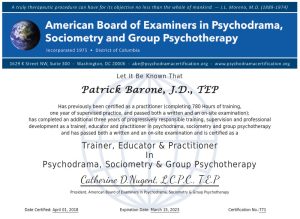 Patrick’s board certification at the highest level in psychodrama, sociometry, and group psychotherapy, a credential he holds as the only attorney in Michigan, shapes how the firm approaches every client relationship from the first call.
While our record of results speaks for itself, it is not up to us to determine what a successful outcome will look like in your case. During the initial consultation, our attorneys will discuss your goals for the case and how you will define success given your unique situation.
It is then our job to reach those goals and obtain the best possible outcome for you. Our legal team offers flexible payment plans to suit our clients’ budgets. Our Michigan OWI attorneys offer free, confidential consultations in person or over the phone. Even if you do not hire us, contact us, and let us hear your story.
The Best-Rated DUI Defense Attorney Near Me Who Knows Michigan OWI Laws
The legal blood alcohol content (BAC) limit for drivers over 21 in Michigan is 0.08 grams %. If you are found driving while having a BAC of this level or higher, you can be charged with operating while intoxicated or OWI.
The state’s Zero Tolerance law makes it a crime for underage drivers to operate a vehicle with a BAC above 0.02 grams percent. The state’s Super Drunk law makes it an even more serious crime to have a BAC at or above 0.17 grams %.
BAC is typically determined through a breath, blood, or urine chemical test. Please note that even if you refuse to submit to a chemical test, you can still be charged with drunk driving and face penalties and a suspended drivers’ license.
Though the specific punishments will depend on several individual case factors, a person convicted of impaired or intoxicated driving can typically expect jail time, fines, and court costs. In addition, some type of driver’s license sanction will occur upon conviction, making it imperative that an OWI attorney in Michigan is contacted.
See the Michigan OWI Penalties Infographic Set Forth Below:
Common Misspellings of DUI-OWI Phrases in Michigan Online Searches:
DUI attourney
DUI atorney
OWI layer
OWI laywer
Frequently Asked Questions — Michigan OWI Arrest
Will I go to jail for a first-offense OWI in Michigan?
Jail is possible but not inevitable for a first offense. Most first-time OWI defendants do not serve additional jail time beyond any time served at the point of arrest, though outcomes depend heavily on the specific court, the judge assigned, and the facts. Some Michigan jurisdictions, including the 48th District Court in Bloomfield Hills, impose jail on first offenders far more frequently than others. An experienced OWI attorney who knows the tendencies of your assigned court can give you a realistic, candid assessment and work actively to prevent incarceration.
If my BAC was over the legal limit, is my case hopeless?
No. A test result above the statutory threshold does not establish that the Intoxilyzer 9000 was properly calibrated, that the operator was certified, that no physiological factor affected the reading, or that the stop and arrest were constitutionally valid. Many Michigan OWI cases involving readings above the legal limit are successfully defended, reduced to lesser charges, or resolved to outcomes significantly better than a full conviction.
What is the difference between OWI, DUI, and DWI in Michigan?
Michigan’s drunk driving statute uses the term OWI, operating while intoxicated, under MCL 257.625. DUI and DWI are the terms most commonly used in other states and in everyday conversation. In Michigan, all three refer to the same offense and there is no legal distinction between them for purposes of your case.
Can a first-offense OWI be expunged from my record in Michigan?
Yes, under legislation that took effect in 2021, a first-offense OWI conviction may be eligible for expungement. There is a five-year waiting period from the date of conviction, and a person with any subsequent OWI conviction is ineligible. The process requires a court hearing before a judge and is considerably more involved than other Michigan expungements. The Barone Defense Firm recommends retaining counsel for the expungement petition.
How soon should I contact a Michigan DUI attorney?
Immediately. Evidence must be preserved, the 14-day implied consent deadline may already be running, and decisions made in the hours following an arrest directly affect the defense that can be built later. For a complete overview of Michigan OWI charges, penalties, and defense strategies across every offense level, visit our primary Michigan DUI defense practice area page.
The Barone Defense Firm, Michigan DUI lawyer near me for clients across the entire state, is available 24 hours a day at 1-877-ALL-MICH (877-255-6424) for a free, confidential consultation.
About the Author
Patrick Barone is the Michigan DUI lawyer near me that clients across Michigan call when the stakes are highest, and the founding attorney of the Barone Defense Firm. He is an IACP/NHTSA-certified standardized field sobriety test instructor and practitioner and is believed to be the only attorney in Michigan ever to have been judicially qualified as an SFST court expert. He holds manufacturer-equivalent certification on Michigan’s evidentiary breath testing instruments and co-authored the February 2026 Michigan Bar Journal article documenting the state’s transition to the Intoxilyzer 9000.
He is the author of five books including Defending Drinking Drivers, a national DUI defense treatise published by James Publishing, and has published more than 130 articles in peer-reviewed legal journals on breath and blood testing science, field sobriety test methodology, and trial advocacy. His undergraduate training in biology on a pre-medical track gives him the scientific foundation to challenge chemical test evidence that most attorneys cannot approach.
His published writing on jury communication spans more than two decades, covering voir dire strategy, the psychology of persuasion, narrative structure in closing argument, and the science of juror attention, including multiple articles in the NACDL Champion and the DWI Journal: Law and Science.
Patrick Barone approaches every jury trial as a story that must be told authentically, a methodology grounded in his training at the Gerry Spence Trial Lawyers College and his work as a board-certified TEP practitioner of psychodrama through the American Board of Examiners.
No other Michigan attorney brings that combination of trial advocacy training, behavioral science certification, and published depth on how juries actually make decisions. He has been named a Michigan Super Lawyer continuously since 2007 and is listed in The Best Lawyers in America.