Search
 Michigan Criminal Defense Lawyer Blog
What Should I Expect on a Michigan First Offense OWI Charge?


A first-offense OWI in Michigan is a misdemeanor under MCLA 257.625, carrying up to 93 days in jail, fines between $100 and $500, up to 360 hours of community service, and a 180-day license suspension with no driving permitted for the first 30 days. Most first-time offenders do not serve jail time, but the charge is serious and the collateral consequences extend well beyond the formal penalties.
A first-offense OWI conviction in Michigan carries formal penalties that are significant but knowable in advance. The consequences that most consistently blindside clients are the ones that do not appear in the stathe professional licensing consequences are where the damage is most acute for many clients.
A healthcare professional facing an OWI charge risks disciplinary action by their licensing board, potential conditions on their license, and in some cases suspension or revocation. A CDL holder faces a one-year federal disqualification from commercial driving on a first offense, which for a professional driver means losing their livelihood entirely.
Insurance producers, Series 7 licensed financial professionals, liquor license holders, and medical marijuana license holders, growers, transporters, and dispensary operators, all face licensing board reviews and potential adverse action that has nothing to do with the criminal court outcome. The criminal case and the licensing consequences run on parallel tracks and must both be managed from the beginning.
The super drunk threshold, a BAC of 0.17 or above, creates a specific practical urgency beyond the enhanced criminal penalties. A conviction at that level triggers a mandatory 45-day hard suspension during which no driving is permitted under any circumstances. In the Detroit metropolitan area, where mass transit is limited and commutes of 30 minutes or more are common, relying on rideshare services for every work trip for 45 days is a significant financial burden for most people.
That reality makes negotiating a charge reduction before conviction not just a legal objective but an economic necessity for a substantial portion of clients facing super drunk charges in southeast Michigan.
The formal penalty range for a first offense, up to 93 days in jail, fines between $100 and $500, up to 360 hours of community service, rarely represents the most consequential outcome of the case. For most clients the most important questions are whether the conviction can be avoided entirely, whether a charge reduction is achievable, and what the defense strategy does to protect the professional and financial life that exists outside the courtroom.
The Barone Defense Firm approaches every first-offense OWI with the same level of preparation regardless of where the BAC falls. The breath test result is a starting point for the defense analysis, not a conclusion. In every case the firm obtains the COBRA data for the Intoxilyzer 9000 instrument used in the client’s test, examines the calibration and exception message history, reviews the field sobriety test administration against NHTSA standards, and evaluates the constitutionality of the stop itself.
The accuracy and reliability of the Intoxilyzer 9000, including its calibration protocols, histogram analysis, and the expanded acceptable range for dry-gas testing compared to the DataMaster — are examined in detail on our Intoxilyzer 9000 accuracy page.
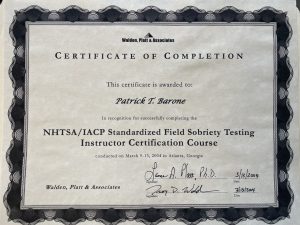
Patrick Barone holds manufacturer-level certification on the DataMaster DMT, Michigan’s former evidentiary breath testing instrument, and is an IACP/NHTSA certified Standard Field Sobriety Test instructor and practitioner.
He is the only Michigan attorney judicially qualified as an SFST court expert, a ruling made by a judge after adversarial challenge, not a credential listed on a website.
For clients whose professional licenses are at risk alongside their driving privileges, the Barone Defense Firm coordinates with licensing counsel where appropriate to ensure that the criminal defense strategy and the licensing defense strategy are aligned from the beginning of the case.
What Happens After a Michigan First Offense OWI Charge?
Most people charged with a first offense OWI have never been through the criminal court system before. Understanding the sequence of events helps you make better decisions and helps you see why early retention of counsel matters.
Arraignment. Within 24 to 72 hours of arrest, you will appear before a judge or magistrate to be formally charged and to enter an initial plea. Bond conditions may be set at arraignment, including requirements such as alcohol testing, a breath interlock device on your vehicle, or GPS monitoring. It is advisable to have an attorney present at arraignment if at all possible, because conditions imposed at that stage can be difficult to modify later.
Pretrial Proceedings. After arraignment, your attorney will obtain police reports, dash-camera footage, and breath or blood test records through the discovery process. This is the phase in which constitutional challenges to the traffic stop, to the field sobriety test administration, and to the chemical testing equipment are developed.
At the Barone Defense Firm, our attorneys review every aspect of the testing protocol, including Intoxilyzer 9000 breath test procedures and standardized field sobriety test (SFST) administration, because errors in testing are among the most powerful grounds for dismissal or reduction of charges.
Plea or Trial. The majority of first offense OWI cases resolve through a negotiated plea to a reduced charge, such as impaired driving (OWVI) or careless driving, which carry substantially lower penalties and fewer licensing consequences. If the evidence does not support reduction, or if the prosecutor is unwilling to negotiate, trial is always an option.
Our attorneys are experienced trial lawyers who prepare every case as though it will go before a jury. Before you begin to think about the question should I plea guilty or take My DUI case to trial, be sure to read our article explaining how to think about this important decision.
Sentencing. If you are convicted, whether by plea or verdict, sentencing for a standard first offense typically involves a term of probation (often 12 to 24 months), fines, possible community service, and driver’s license restrictions. Jail time is possible but uncommon for a standard first offense. What you are sentenced to depends significantly on the judge, the county, and the quality of your legal representation at that stage. Sentencing for high BAC above .17 or super drunk driving are typically higher. a standard first offense.
The Total Cost of a First Offense OWI Conviction.
The fines and jail exposure set out in the statute are only part of the financial picture. A first offense OWI conviction in Michigan routinely involves substance abuse screening costs, driver responsibility fees, increased insurance premiums that can persist for years, the cost of an ignition interlock device if required, and, depending on your profession, potential licensing consequences with regulatory bodies such as LARA. Understanding the full cost of a DUI conviction before deciding how aggressively to contest the charge is essential.
Any other drunk driving convictions in any jurisdiction make that person seeking expunction ineligible. The initial effective date of the primary law is April 11, 2021. An automatic expungement law takes effect April 11, 2023, too, after the attorney general sets up this processing.
Also be aware that this law can only control Michigan criminal records and does not change federal criminal records, which still will show the conviction.
What Is an OWI in Michigan — and How Does It Compare to a DUI?
Most people are familiar with the term DUI, but Michigan uses a slightly different acronym: OWI, or Operating While Intoxicated. Legally, there’s no meaningful distinction. Whether you’re facing a DUI, OWI, OUIL (Operating Under the Influence of Liquor), or OUID (Operating Under the Influence of Drugs), the implications are the same, and the consequences can be severe.
A first-time OWI in Michigan is a misdemeanor. The penalties are steep, and a conviction can affect your job, your finances, and your ability to drive. If this is your third offense, you’re now facing felony DUI charges with life-changing consequences.
Is an OWI Worse Than a DUI?
Not necessarily. The severity of the punishment depends more on the facts of your case, your BAC level, prior offenses, whether anyone was injured, than the acronym used. Michigan’s OWI laws come with mandatory driver’s license suspensions, potential jail time, and heavy fines. A skilled OWI lawyer can often reduce or eliminate some of these penalties. The acronyms DUI and OWI both refer to the same crime.
Can You Get Jail Time for a First OWI in Michigan?
The statute allows up to 93 days in jail, fines up to $500, and up to 360 hours of community service. The license suspension is 180 days with no driving permitted for the first 30 days, followed by restricted driving for the remaining 150 days. Some Michigan judges impose jail time even for a first offense; others focus on probation, alcohol education, or treatment. Your outcome will depend significantly on your defense strategy and the quality of your representation.
A standard first offense OWI in Michigan is a 93-day misdemeanor; however, certain circumstances, including a BAC of 0.17 or above, a minor passenger in the vehicle, or prior convictions, can elevate the charge. For a full breakdown of when a Michigan OWI becomes a felony, see our guide on whether a DUI is a felony or misdemeanor in Michigan.
Some Michigan judges, especially in counties with stricter reputations, may impose jail time even for a first offense. Others may focus on probation, alcohol education, or treatment. Your outcome will depend heavily on your defense strategy and who’s representing you.
Is There Any Way to Keep My License?
Losing your license is one of the toughest parts of an OWI. For many, it’s not just about convenience, it’s about being able to work, care for family, and fulfill daily responsibilities.
You may qualify for a restricted license after the first 30 days. If your case involved a high BAC (0.17 or more), you’ll likely need to install an ignition interlock device. These are serious restrictions, but they can be managed with the help of a defense team that knows how to negotiate terms and fight for flexibility.
Can I Get an OWI Expunged in Michigan?
Michigan’s expungement law effective April 11, 2021 allows one OWI conviction to be removed from your criminal record provided it is your only OWI conviction from any jurisdiction, ten years have passed since sentencing or release from incarceration, and you meet all other eligibility requirements. The expungement does not affect federal criminal records and does not automatically reinstate a CPL or other privileges revoked as a result of the conviction.
What Happens If I’m Convicted?
Beyond the formal penalties, a conviction typically results in significantly higher car insurance premiums that can persist for years, difficulty or impossibility of renting a vehicle, and potential immigration consequences for non-citizens. For professionals in licensed fields including healthcare, financial services, and commercial driving, a first offense OWI may trigger reporting obligations to Michigan’s Department of Licensing and Regulatory Affairs and can result in disciplinary proceedings before a licensing board. The stakes of a first offense are frequently higher for professionals than the criminal statute alone suggests.
For professionals in licensed fields, including healthcare, law, education, and financial services, a first offense OWI conviction may trigger reporting obligations to Michigan’s Department of Licensing and Regulatory Affairs (LARA) and can result in disciplinary proceedings before a licensing board. The stakes of a first offense are frequently higher for professionals than the criminal statute alone suggests.
What Does Michigan Law Say About First Offense OWI Penalties?
Michigan’s drunk driving statute, MCLA 257.625, sets out the following penalties for a standard first offense OWI conviction:
(9) If a person is convicted of (OWI first offense):
(a) The person is guilty of a misdemeanor punishable by 1 or more of the following:
(i) Community service for not more than 360 hours.
(ii) Imprisonment for not more than 93 days.
(iii) A fine of not less than $100.00 or more than $500.00.
Additionally, the Secretary of State will suspend the driver’s operator’s license for 180 days. There shall be no driving at all for the first 30 days. The offender may drive on a restricted basis only for the remaining 150 days.
These penalties apply only to a standard first offense OWI. If a person has a prior offense within the past seven years or two prior offenses within the past ten years, significantly harsher penalties apply. If the driver’s BAC was 0.17 or greater, Michigan’s super drunk driving law applies and the penalties increase substantially. Different penalty structures also apply to drivers under 21 years of age and to commercial drivers.
An experienced OWI defense attorney can often negotiate a charge reduction with the prosecuting attorney, thereby reducing the penalties. You may also have defenses that could result in your first offense OWI charges being dismissed or further reduced. Trial is always an option when the evidence supports it.
Can a Lawyer Get My OWI Charge Reduced?
Yes , Yes, in appropriate cases. The Barone Defense Firm’s legal team has successfully negotiated plea bargains that reduce OWI charges to lesser offenses like careless or impaired driving. In other cases, we’ve had charges dropped completely due to procedural errors or lack of evidence.
The Barone Defense Firm examines whether the traffic stop was constitutionally valid, whether the breath or blood test was properly administered and the equipment was functioning correctly, whether your rights were violated at any stage, and whether the evidence was properly handled and preserved. If any of these lines of inquiry reveals a weakness in the prosecution’s case, we identify it and develop it fully.
For a comprehensive overview of Michigan OWI charges, BAC thresholds, penalty tiers, and license consequences, see our guide to Michigan’s legal BAC limit and OWI charges.
Frequently Asked Questions: Michigan First Offense OWI
What is the difference between OWI and DUI in Michigan?
Michigan uses the term OWI, operating while intoxicated, rather than DUI. The two terms describe the same offense and carry identical consequences. Michigan also uses OUIL (operating under the influence of liquor) and OUID (operating under the influence of drugs) for related charges. The acronym used has no effect on the penalty range or the severity of the charge.
Can a first-offense OWI in Michigan be reduced or dismissed?
Yes, in appropriate cases. A charge reduction to impaired driving or careless driving is achievable when the evidence has weaknesses, a questionable stop, a breath test result that can be challenged on calibration or operator grounds, or field sobriety tests that were not properly administered. A dismissal is possible when constitutional violations or evidentiary failures are identified. Neither outcome is guaranteed, and both depend entirely on the specific facts of the case and the quality of the defense.
Will a first-offense OWI affect my professional license in Michigan?
Possibly, and the answer depends on the specific license and the licensing board that governs it. Healthcare professionals, CDL holders, insurance producers, Series 7 licensed financial professionals, liquor license holders, and medical marijuana license holders all face potential adverse licensing consequences from an OWI conviction that are separate from and in addition to the criminal court penalties. Early coordination between criminal defense counsel and licensing counsel is essential for clients in regulated professions.
What is Michigan’s super drunk law and how does it affect a first offense?
Michigan’s super drunk law applies when a driver’s BAC is 0.17 percent or higher. The penalties are significantly more severe than a standard first-offense OWI, including a mandatory 45-day hard suspension during which no driving is permitted, followed by 320 days of restricted driving with an ignition interlock device required.
Fines increase to a maximum of $700 and jail time can extend to 180 days. Negotiating a charge reduction before conviction is particularly important at this threshold given the driving restrictions and their practical consequences in southeast Michigan where mass transit alternatives are limited.
How long does a first-offense OWI stay on my record in Michigan?
For the remainder of your life, subject to the limited expungement provisions enacted in 2021. Michigan’s expungement law allows one OWI conviction to be removed from your criminal record if it is your only OWI conviction from any jurisdiction and ten years have passed since sentencing or release from incarceration. The expungement does not affect federal criminal records and does not automatically restore a CPL or other privileges revoked as a result of the conviction.
Contact a Michigan First Offense OWI Defense Attorney
A first-offense OWI charge in Michigan is manageable with the right defense, but the window for achieving the best outcome is narrow and closes quickly. The evidence in your case — the breath test data, the field sobriety test recordings, the stop itself — needs to be evaluated by an attorney who understands the science before the prosecution’s version of events becomes the only version on record. The Barone Defense Firm offers free consultations and our phones are answered 24 hours a day, seven days a week. Call 1-877-ALL-MICH (877-255-6424) today.
About the Author: Patrick Barone
Patrick Barone is the founding attorney of the Barone Defense Firm in Birmingham, Michigan. He holds manufacturer-level certification on the Intoxilyzer 9000, the evidentiary breath testing instrument currently in use across Michigan, and is an IACP/NHTSA certified Standard Field Sobriety Test instructor and practitioner.
He is the only Michigan attorney judicially qualified as an SFST court expert, a ruling made by a judge after adversarial challenge that reflects expertise exceeding that of the arresting officer. Mr. Barone holds a Bachelor of Science in Biology, which informs his approach to the forensic and scientific evidence at the center of OWI litigation.
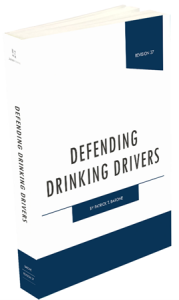
Mr. Barone co-authored “Intoxilyzer 9000 Replaces DataMaster DMT for Breath Tests,” published in the Michigan Bar Journal in February 2026, and is the author of five books including the two-volume treatise Defending Drinking Drivers.
Mr. Barone has been recognized as a Michigan Super Lawyer continuously since 2007 and is listed in Best Lawyers in America. The Barone Defense Firm defends first-offense OWI clients across Michigan at both the misdemeanor and felony level.