Articles Posted in OWI

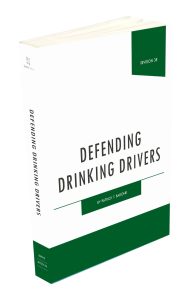
Defending Drinking Drivers, written by DUI defense attorney Patrick Barone

2024 Edition – Defending Drinking Drivers

The Barone Defense Firm is pleased to announce that the 2024 Edition of Patrick Barone’s Defending Drinking Drivers is now available from the publisher, Amazon, and wherever fine books are sold. Known as “revision 40,” the current Edition contains many new sections and model defense motions.

Regarding the defense of a DUI with a blood test, the 2024 update contains sample cross-examination of the doctor, nurse, technician, or phlebotomist. This model cross-examination includes sample questions relative to contamination and suggestions for how to approach and perhaps discredit the credibility of this important but often overlooked pr0secution witness. In Chapter Six, Trial, Mr. Barone sets forth a new way of approaching voir dire, and the 2024 update also contains a sample motion requesting attorney-conducted voir dire. Additionally, in his revision of Chapter 6, Mr. Barone provides a unique and compelling explanation for why seating arrangements are an important element of trial and why the court should consider allowing the defendant to sit next to the jury rather than always cede this seat to the prosecutor by default. A sample motion for requesting that the defendant be provided with the “best” seat is also included in this 2024 update.

With new cases of Covid-19 continuing to escalate in Michigan, on July 10, 2020, Governor Whitmer responded with Executive Order 2020-147, which indicates that “[A]ny individual who leaves their home or place of residence must wear a face covering over their nose and mouth.” The Order further provides that masks must be worn in any indoor public space and on all public transportation. Also, face masks are now mandatory when you are a passenger on any ride-sharing vehicle, such as Lyft or Uber, or in any private car when being used as “hired transportation.” Will this mandatory Covid-19 face mask requirement have any impact on law enforcement practices? Specifically, will a lack of a face mask by driver or a vehicle’s occupants lead to probable cause to stop a motor vehicle?

To answer this interesting legal question, we begin by noting that the Executive Order does make a failure to comply a crime.  Specifically, the order provides that a failure to wear a required face mask is a misdemeanor, though no jail time may be imposed for its willful violation. An open question in all this is how and even whether the police in the State of Michigan will enforce this Order?

As it relates to the existing law governing when the police may stop a moving vehicle, the general rule is that they must have “probable cause.”  However, there are many circumstances when the police may lawfully stop you, including and perhaps most commonly, for a violation the traffic code such as speeding. In 2014, the United States Supreme Court, in the Navarette case indicated that a vehicle may be stopped based on an anonymous 911 call provided the caller provides enough information and detail to have the indica of reliability and therefore enough to give rise to a reasonable suspicion that criminal activity was afoot.

Open Container Law Michigan | Open Intoxicants Motor Vehicle

A person in Michigan is guilty of a misdemeanor if they transport or possess alcoholic liquor in a container that is open or uncapped or upon which the seal is broken within the passenger area of a motor vehicles. However, the law passed by Whitmer during Covid may call this into question, and might provide a defense to your case.

Really? Are to-go Cocktails Legal?

There are 32 new drug recognition “experts” (DRE) qualified to make DUI arrests in Michigan. Only a trained DRE may administer the saliva tests in a DRE DUI investigation. Including this new crop of  32 DREs, there are currently 157 a total of DRE trained officers in Michigan.

The use of “oral fluid” drug tests began as a pilot program in Michigan in late 2017 and lasted one year. Initially, the devices were only used in DUI investigations in five Michigan counties, including Berrien, Delta, Kent, St. Clair, and Washtenaw Counties. During this time a little more than 7 drivers per month were tested.  No information is available relative to number of Michigan DUI arrests that followed.

The DRE officers in this pilot program used a device called a SoToxa Mobile Test System.  This device tests a DUI suspect’s saliva for the presence of amphetamines, benzodiazepines, cannabis (delta 9 THC), cocaine, methamphetamines, and opiates. As such it is only used to give a yes/no answer to the question of whether a drug is present. The test does not give a number, or a quantitative drug level. Therefore, it cannot indicate if a driver is actually DUI.

Allowing the sale of pre-made cocktails and other types of alcoholic beverages to be sold carry-out may increase the numbers of drunk drivers on Michigan’s roads. However, because the answer to how carry out liquor sales will impact instances of DUI is not clear-cut, only time will tell if this potential for increased DUI becomes reality.

A good argument can be made that the new carry-out laws will have zero impact on DUI in Michigan. But these arguments assume that the bars and restaurants will be keeping a close eye on their patrons after the carry-out sale is made. If the persons consuming the alcohol are under less scrutiny from the persons selling it, and therefore less likely to get “cut off” before becoming intoxicated, then the new law may create a greater likelihood of drunk drivers.

The covid-19 restrictions imposed by Governor Whitmer have hurt the bottom line for all of Michigan’s bars and restaurants, and these new bills are intended in part to create a new stream of revenue and help these small businesses survive. For example, as quoted in the Detroit Free Press, Ben Giovanelli, who is the president of the Rochester Downtown Development Authority, believes that outdoor sales will be the key to survival for many bars and restaurants, who are still only allowed to operate at half-capacity.  Social districts can help make up the difference.

How Much is Legal Limit to Drive in Michigan?

What is Legal limit in MichiganFor most drivers the legal limit to drive in Michigan is .08. For people under the age of 21, Michigan has zero tolerance, which is legally defined as .02 or above. Commercial drivers, such as truckers and limousine drivers, can’t have a BAC of more than .04 to drive legally.

Is it Legal to Drink and Drive in Michigan?

Driving under the influence (DUI), or in Michigan Operating While Intoxicated (OWI), is usually charged using a breath test result. However, due to the recently discovered breath testing fraud, more often Michigan DUI cases are charged using a blood test result.  Breath test results are available immediately after the test is administered at the police station or jail. Blood sample results, however, can take weeks or months to be returned from the Michigan State Police (MSP) forensics lab. The prosecutor in a DUI case generally, but not always, waits for blood results to submit formal charges because if the result is over .08 then the case can be charged under Michigan’s Unlawful Blood Alcohol Level law.  And if the test result is above a .17, then it is considered a super-drunk driving.

What is the Process That My Blood Sample Goes Through?

If you have gone through a Michigan DUI arrest that involved a blood sample, you may have noticed that the police officer provided special vials to be used for the sample. These blood collection vials come from a kit that is specifically made for police agencies in Michigan to collect blood samples for criminal investigations. There should be two vials with grey caps. Sodium fluoride should be in the vials to properly preserve the blood. The vials are sent to the Michigan State Police forensics lab in Lansing for testing. Once tested, the results are sent back to the arresting agency, and the prosecutor for that agency.  The prosecutor will review the matter, and if appropriate, will file DUI charges against you in court. If the blood is being tested for alcohol only, the process usually takes three to six weeks. If it’s also being tested for drugs, it could take months. During the coronavirus pandemic, the results could take even longer to be returned.

Almost since the uniform adoption of the automobile in the early 20th Century, drunk driving has been a vexing problem. After World War II, as the population began to move to the suburbs and the two-car garage become standard, instances of drunk driving increased. A couple decades later, Mothers Against Drunk Driving become one of the strongest, most influential, and most successful political action committees in all the land. Most recently, MADD has begun to champion Breath Alcohol Interlock Devices, or BAIIDs, as the panacea needed to end drunk driving.

History of HR 3011 Proposing to End DUI by 2024

There have been multiple attempts by both parties in the federal government to pass legislation that would require the mandatory use of BAIIDs. The most recent incarnation of these efforts manifests in a bill that would require BAIIDs in motor vehicles by 2024. Prefaced with the desire to “[T]o improve the safety of individuals by taking measures to end drunk driving”, H.R. 3011 is sponsored by Rep. Kathleen Rice, a Democrat from NY and supported by Senators Tom Udall (D-New Mexico) and Rick Scott (R-Florida) and Representative Debbie Dingell (D-Michigan). The Bill, originally submitted in 2019, seeks to force automotive manufacturers to install systems that would prevent a vehicle from being started if the driver was above a .08.  These bills represent the latest attempts to force untested and unreliable equipment into our motor vehicles, with little regard for the severe consequences that could potentially follow.

How Do I Find a Top Rated Drunk Driving Lawyer in Michigan?

Michigan DUI lawyer Patrick Barone knows Michigan DUI law and how to beat a DUI.If you’ve been arrested for operating a vehicle while intoxicated, also called DUI/OWI in Michigan, then you’re looking at potentially severe penalties. Your driving privileges can be suspended or revoked causing you to lose your drivers license and your ability to drive.

For many kinds of drunk driving cases, you’re also looking at the real possibility of jail time. Even if this is your first DUI arrest, you’ll want to find a top rated drunk driving lawyer in Michigan.