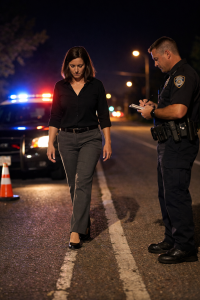
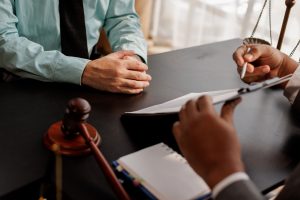
A Michigan implied consent hearing is an administrative proceeding before a Secretary of State administrative law judge, entirely separate from and independent of the criminal OWI case. The officer who made the arrest must appear and prove four specific elements under the civil preponderance standard, not the beyond-a-reasonable-doubt standard that applies in criminal court. If the officer fails to appear, or establish any one of those four elements, the license suspension is dismissed entirely, as if the refusal never happened.

What Is a Michigan Implied Consent Hearing and Why Does It Exist?

Michigan implied consent hearing at the Secretary of State administrative officeMichigan’s implied consent law rests on a legal fiction: by accepting a Michigan driver’s license, a person is deemed to have consented in advance to a chemical test if lawfully arrested for OWI. But that fictional consent cannot operate as a legitimate exception to the Fourth Amendment’s warrant requirement until it comes into actual existence. It does so only when the officer reads the prescribed chemical test rights advisement following a lawful arrest, and the driver is given a genuine opportunity to either reaffirm that consent by submitting to the test or withdraw it by refusing. Until that advisement is given, there is no actual consent, only the legal fiction of it, and a fiction alone cannot satisfy the Fourth Amendment.

A Michigan breath test refusal is not a single decision. It is two separate questions with two separate answers, because Michigan law treats the roadside preliminary breath test and the evidentiary breath test at the police station as fundamentally different instruments governed by different statutes with different consequences for refusal. Understanding that distinction is the most important thing a Michigan driver can know before they are ever put in the position of having to decide.

What Is the Difference Between the PBT and the Evidentiary Breath Test in a Michigan DUI?

Michigan law recognizes two categories of breath test in a DUI investigation. The first is the preliminary breath test, or PBT, a small handheld device an officer asks you to blow into at the roadside before any arrest has been made. The second is the evidentiary breath test, administered on the Intoxilyzer 9000 at the police station after you have been placed under arrest.

Yes, hiring an experienced Michigan DUI attorney is worth it even when your case looks bad, and in many respects it is worth it most when your case looks bad. A breath test result above the legal limit, a high BAC reading, a prior record, or the involvement of an accident does not make a case unwinnable. It makes a case more complex, and complexity is where the gap between a trained specialist and a general practitioner is widest. The Barone Defense Firm never assumes a breath test result is reliable or even admissible. Every case begins with a complete investigation of the evidence, regardless of how it first appears.

Michigan OWI attorney serving clients in courts across the state of MichiganWhat Does a Bad Case Michigan DUI Actually Look Like to a Defense Attorney?

A case that looks bad to a defendant, and sometimes to a general practitioner, often looks very different to an attorney with deep scientific training and years of experience examining the specific evidence that Michigan OWI prosecutions depend on. The charging document describes what the officer observed and what the instruments reported.

A third DUI arrest in Michigan is a felony under Heidi’s Law, a Class E felony carrying one to five years in prison, mandatory minimum jail time, and a license revocation measured in years rather than months. It does not matter when your prior convictions occurred. Two DUI convictions from thirty years ago can transform today’s arrest into a felony.

That is the weight of what you are facing. It is also not the end of the story. An arrest is not a conviction, and the outcome of a third-offense Michigan DUI case depends heavily on decisions made in the days and weeks immediately following the arrest. If you are facing a Heidi’s Law Michigan DUI charge, the decisions you make right now will shape every outcome that follows.

What Is Heidi’s Law and How Does It Affect Your Michigan DUI Case?

If you were arrested for DUI or OWI within the cities of Birmingham, Bloomfield Hills, Keego Harbor, Sylvan Lake, or Orchard Lake Village, or the townships of Bloomfield or West Bloomfield, your case will be heard in the 48th District Court located at 4280 Telegraph Road in Bloomfield Hills. What happens in that courtroom depends heavily on which of the three judges is assigned to your case and how well your attorney knows this specific court.

The Barone Defense Firm has appeared in the 48th District Court hundreds of times over more than three decades,  and no firm in Michigan knows this court better. If you are facing a 48th District Court Bloomfield Hills DUI charge, the firm you hire should have appeared in this building hundreds of times, and the Barone Defense Firm has.

What Is the 48th District Court and Which Communities Does It Serve?

When someone searches for a Michigan DUI lawyer near me after an OWI arrest, what they need most is not a list of credentials, it is reassurance that the outcome of their case is not yet decided. A Michigan OWI arrest is not a conviction. The Barone Defense Firm was built for exactly this moment: to stand with people in the most difficult hours of their lives, understand what matters most to them, and fight to win their lives back. Call 1-877-ALL-MICH for a free, confidential consultation available 24 hours a day.

Why Does Choosing the Right Michigan DUI Lawyer Matter?

Approximately 95% of all drunk driving convictions in Michigan are misdemeanors. A felony charge occurs on a third lifetime OWI, not the fourth within ten years as in most other states. Even for a first offense, the consequences of a conviction, jail time, license suspension, criminal record, fines, and increased insurance costs, are serious enough that hiring the right attorney is one of the most consequential decisions you will make. When you search for a Michigan DUI lawyer near me, the quality of that decision determines everything that follows.

Caduceus meetings are confidential twelve-step support groups designed exclusively for licensed healthcare professionals in Michigan navigating recovery from alcohol or substance use disorders. Unlike general AA or NA meetings, Caduceus groups restrict membership to licensed providers, which allows members to speak openly about workplace substance access, licensing board concerns, and the professional consequences of substance use with peers who face the same challenges.

What Are Caduceus Meetings?

If you’re a healthcare professional facing an DUI charge in Michigan, you may benefit from a specialized recovery support group designed specifically for medical professionals. Caduceus meetings are confidential 12-step support groups created exclusively for licensed healthcare providers struggling with chemical addiction and substance use disorders.

If you are a physician, nurse, advanced practice provider, dentist, or other licensed healthcare professional in Michigan, an OWI charge may threaten your license, your job, and your reputation. But Operating While Intoxicated with a minor passenger, often called OWI child endangerment, is uniquely dangerous for many licensed health care professionals is because it can be treated as “endangering others,” in this case children, and that framing can trigger Medicare and Medicaid consequences that do not typically attach to other misdemeanor OWI offenses.

The consequence framework that governs licensed healthcare professionals across all categories of criminal charge, and why the decisions made at the charging and plea stages often determine whether federal program exclusion is triggered, is addressed in the firm’s analysis of criminal charges and licensed healthcare professionals in Michigan.

The criminal case is only the beginning. A single misdemeanor conviction under Michigan’s OWI with a minor passenger enhancement can create a domino effect involving Medicaid termination for a minimum period of five (5) years, Medicare enrollment revocation, licensure emergency action, controlled substance and DEA consequences, national reporting, and exclusion from federally funded healthcare work.

A Michigan OWI for doctors triggers two separate proceedings that move on different timelines and are evaluated by different decision-makers: the criminal case in court, and a licensing inquiry before LARA and the Board of Medicine that applies its own fitness and public safety standard regardless of how the criminal case resolves.

A conviction that appears manageable in criminal court can produce a licensing consequence that threatens the medical career, because the Board does not evaluate OWI conduct as an isolated lapse in judgment. It evaluates what the charge reflects about the physician’s fitness to practice and risk to patients.

What Legal Consequences Do Michigan Doctors Face for an OWI?

Michigan licensed healthcare professionals are required to self-report any criminal conviction to LARA within thirty days of the date of conviction. Failure to self-report is not simply an oversight that can be corrected later. It is an independent licensing violation carrying its own sanctions, separate from and in addition to whatever discipline the underlying conviction itself produces.

When Must a Michigan Health Professional Report a Criminal Conviction?

In a criminal case, a conviction occurs when a person accused of a crime pleads guilty or is found guilty by a judge or jury at trial. This is the conviction date even if sentencing takes place days, weeks, or months later. The clock starts ticking as soon as the court acknowledges the conviction in a written order or judgment.

Contact Information